
Plays in the language you are reading. Tap any paragraph to start from there.
My most profitable software purchases every year happen in one ten-day window at the end of November.
Last Black Friday I bought four tools in a single sitting.
A wishlist built in October. A budget written on a sticky note. And a checkout session that took eleven minutes.
Those four purchases replaced roughly $170 a month of subscription billing. The whole sweep cost less than one quarter of that billing would have.
AppSumo already sells software at 67–95% below list on a normal Tuesday.
Black Friday is the one event where the marketplace pushes below its own floor, brings back fan-favourite deals, and stacks sitewide promotions on top.
Arrive unprepared and the urgency machine will happily empty your wallet. Arrive with the system below and it is the best buying day of your year. 🛒
🌮 See What's Live on AppSumo Right Now →
🧾 Key Takeaways
| Question | Short answer |
|---|---|
| When is AppSumo Black Friday? | Late November, running a week-plus around BF and Cyber Monday |
| How big are the discounts? | The deepest of the year — below the usual 67–95% |
| What comes back? | Fan-favourite tools return for encore campaigns |
| Biggest risk | Top-tier sell-outs, and impulse buying under urgency design |
| Prep window | September–October: wishlist and written budget |
| Sweep time, prepared | Eleven minutes |
| First-timer edge | 10% off your first order stacks with event pricing 🎁 |
🎢 Why Black Friday Is Different on a Deals Site
A fair question stops most people first.
If AppSumo discounts everything all year, what can Black Friday possibly add?
Three things. And each is structural rather than cosmetic.
First, the floor drops.
Vendors treat the event as their biggest user-acquisition moment of the year, and authorise prices below their own campaign norms.
Tools that ran at $69 in the spring reappear at $49 or $59. Sitewide promotions layer additional credits or coupons on top.
Second, the vault opens.
AppSumo campaigns normally end forever, which is the model's one cruelty.
Black Friday is the annual exception. Fan-favourite deals that Sumo-lings spent months mourning come back for limited encore runs.
My own best keeper — a tool I missed in March and grieved about in the community threads — returned in November. I have never clicked a buy button faster.
Third, the calendar concentrates.
Instead of deals dripping across months, dozens of strong campaigns land in the same ten-day corridor.
That transforms the buying problem from "is this deal good" into "which of these forty good deals fit my actual needs."
Which is precisely why preparation dominates outcomes
The shopper comparing forty live deals against a pre-built list of three needs wins in minutes.
The shopper browsing cold at 11pm buys whatever the countdown timer says.
The browse page's everyday urgency runs at maximum intensity during the event. And it is genuinely persuasive design.
Your defence is decided in October, not November. 🛡️
📋 The September–October Prep Playbook
Veterans win Black Friday in the two months before it. Four habits, an hour total.
| Habit | When | Why |
|---|---|---|
| Freeze non-urgent purchases | Mid-September | Pays 20–30% at the event |
| Build the wishlist from bills | October | Function-first lists survive the dazzle |
| Pre-commit the budget in writing | Before banners | Turns willpower into a lookup |
| Join the email list | Now | Schedule, teases, early access |
Habit one: freeze non-urgent purchases from mid-September.
Any tool you can live without for eight weeks goes on the wishlist instead of into the cart.
Steady-season prices in October are routinely beaten by event prices in November.
The discipline feels costly in the moment and pays 20–30% at the event.
Habit two: build the wishlist with bills, not wishes.
Walk your actual expenses. Subscriptions renewing. Tasks you pay contractors for. Bottlenecks costing you hours.
Then write the three to five functions you want covered.
"Email marketing under $80." "Video hosting." "Scheduling for two brands."
Function-first lists survive the event's dazzle. Product-first lists get seduced by whatever launches shiniest.
Habit three: pre-commit the budget in writing.
Decide the total number before the banners start flashing. Mine lives on a sticky note on my monitor every November.
The event's urgency design is world-class, and your January credit-card statement will audit every deviation.
A written cap converts "should I buy this fifth tool" from a willpower contest into a checklist lookup.
Habit four: join the email list now.
Deal alerts announce the event schedule, tease returning tools, and flag early access windows.
Subscribers routinely know the headline deals days before casual browsers.
If you have never bought here, the same sign-up carries the 10% off your first order offer.
And yes, it applies during Black Friday — making a first-timer's event sweep the best-priced purchase moment the platform offers all year. 🎁
🎁 10% Off First Order — Sign Up Before the Event →
🔍 What Actually Goes on Sale
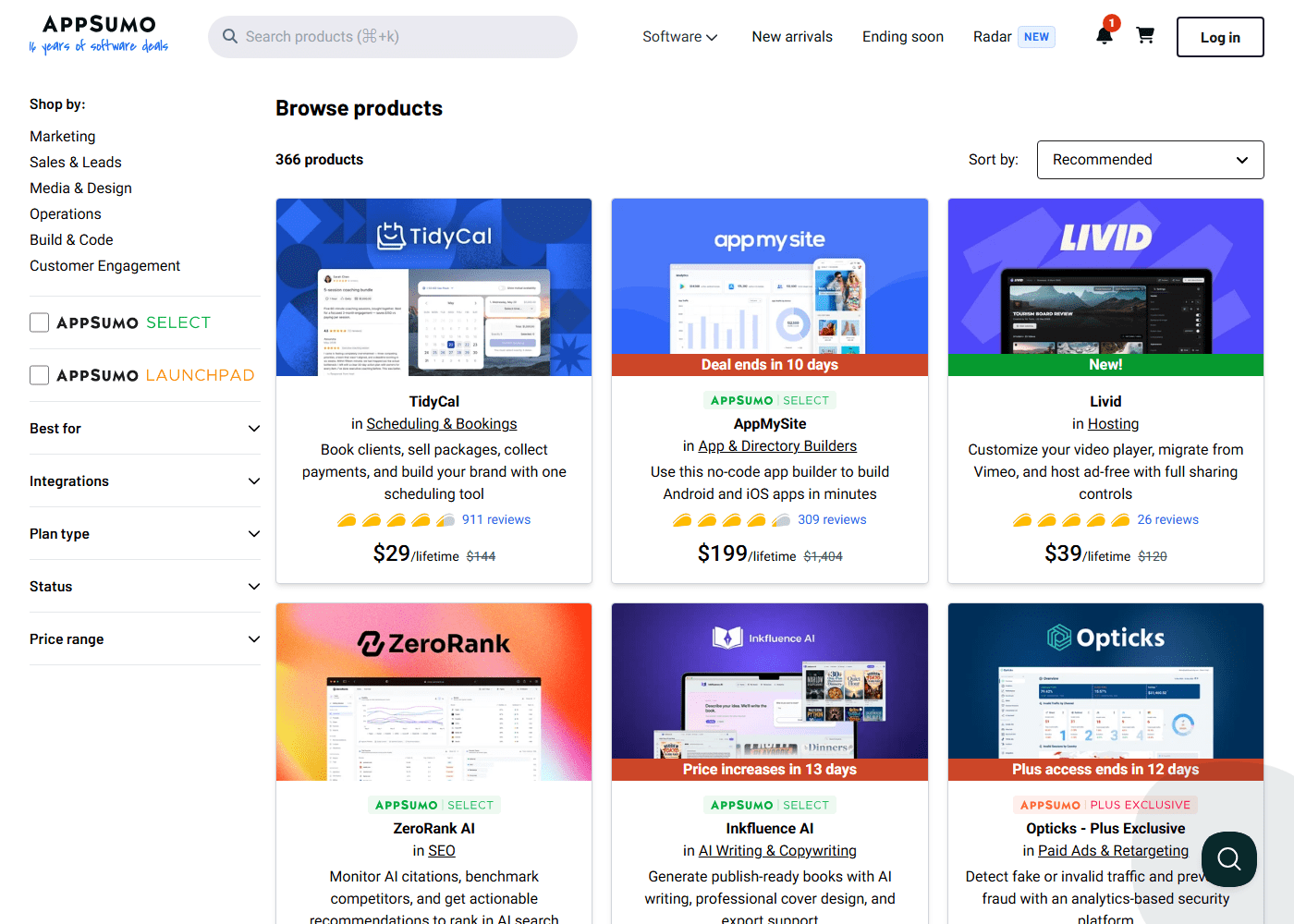
The event inventory clusters into four buckets. Each deserves different behaviour.
| Bucket | What it is | How to act |
|---|---|---|
| Encore returns | Sold-out favourites, back briefly | Buy decisively — sells out fastest |
| Deepened current deals | Running campaigns, event pricing | Re-check your shortlist prices |
| Timed new launches | Products saved for the traffic surge | Newest-reviews rule matters most |
| Sitewide promotions | Credits, thresholds, coupon drops | Where the true floor is reached |
Bucket one: encore returns. These are the crown jewels.
Proven tools with months of post-campaign reviews you can read before buying — which removes the biggest LTD risk entirely.
If something on your wishlist ever existed as a deal before, event week is your rescue window.
Bucket two: deepened current deals. The spring's $69 becomes $49, or a tier gains extra credits.
Check your existing shortlist against event prices before assuming nothing changed.
Bucket three: timed new launches. Vendors save strong products for the event's traffic surge.
Genuine first-run bargains appear. But launch-day information is thinnest here, so the newest-ten-reviews rule from my buying guide matters most in this bucket.
Bucket four: AppSumo's own promotions.
Sitewide mechanics vary by year — bonus credits, spend thresholds, coupon drops, Plus member extras.
They stack on top of listed prices, which is where the event's true floor gets reached.
Plus members historically do especially well. The quarterly coupons and 10% member discount ride on event pricing, and members-only windows soften the sell-out race.
My Plus review runs whether the membership pays for your volume. If you are activating anyway, doing so before the event compounds every purchase.
Across all four buckets one metric decides everything. Does the tool map to a function on your prepared list?
The event sells everything. Your list buys three things. 🎯
📊 Why prep beats browsing: my last three Black Fridays
Same event, same money — the keeper rate followed the preparation, not the deals.
💰 A $137 sweep vs what it replaces
Break-even in under seven weeks. Roughly 26x over three years.
⚡ Event-Week Execution
When the event opens, speed and calm must coexist. The sequence below delivers both.
Hour one: scan, don't buy.
Open the event page. Sweep every headline deal against your function list.
Sort candidates into three piles. "Match." "Tempting-but-off-list." "Ignore."
The second pile is where budgets die. Naming it explicitly defuses it.
Day one: verify the matches.
For each candidate, confirm the tier chart covers your twelve-month needs.
Skim the newest ten reviews — encore deals carry months of honest history, so read it.
And check the vendor's changelog for a pulse.
This is compressed diligence, but it is diligence. The event compresses timelines, not standards.
Then execute the sweep in one sitting.
Cart your matches. Apply whatever sitewide mechanic is running. Use the first-order 10% if you are new. Check out.
Mine took eleven minutes last year, because every decision predated the event.
Two tactical notes veterans learn expensively
Top tiers sell out first on hot deals.
The Tier 3s and agency licences vanish while Tier 1 lingers.
If your list calls for high capacity, execute early rather than waiting for Cyber Monday — which mostly re-runs survivors rather than restocking champions.
And set day-45 refund reminders at checkout. Every purchase, no exceptions.
The 60-day guarantee applies to event purchases like any other, which converts even a compressed-diligence sweep into a fully reversible position.
My year-three keeper rate of 100% owes as much to two Decembers of honest refund reviews as to October wishlists.
Buy fast, verify slow, refund honestly. ⏱️
🧾 After the Event: The December Audit
The sweep is half the system. The audit is the half that makes next year better.
In the first week of December, run every event purchase through three questions.
| Question | If no |
|---|---|
| Is it deployed? | Deploy now, or admit the miss |
| Is it delivering? | Wobbly gets to day 45; unopened gets refunded |
| Did the process hold? | One honest sentence in the notes file |
Is it deployed? A tool not installed within two weeks is drifting toward the abandoned pile.
Is it delivering? By day 30 it should be visibly executing the function it was bought for. The email platform sending. The scheduler booking.
Did the process hold? Compare purchases against the October list and the sticky-note budget.
Every deviation gets one honest sentence. "Bought the AI thing because the timer scared me."
Those sentences are why year three outperformed year one.
Then bank the wins properly
Cancel the subscriptions your new tools replace. The actual savings moment, embarrassingly easy to forget.
Update your three-column ledger. Paid, subscription-equivalent, still-using.
And file next year's first wishlist entries, because the tools you almost bought this year are the seeds of next September's list.
The compounding across years is real. My keeper rate went 40%, 75%, 100%, on flat budgets, purely through accumulated process.
The event itself never changed. I did. 📈
🚀 Why Black Friday Is the Best Onboarding
If you have never bought on AppSumo, this is arguably the optimal first experience. The reasons stack.
The 10% first-order discount applies on top of event pricing. The platform's two best price mechanisms, combined, on your very first checkout.
The encore inventory means settled review histories instead of launch-week hype.
That neutralises the newcomer's biggest disadvantage — not yet knowing how to read a deal page's early noise.
The 60-day guarantee stretches evaluation into late January. A first-timer gets the full safety net during the exact period they are learning the platform's rhythms.
And the concentration teaches fast. One prepared evening teaches you more about LTD buying — tiers, stacking, sell-outs, review culture — than months of casual browsing.
The first-timer sequence, compressed
Sign up through the 10% off link today, whatever the month, so alerts and the discount are in place.
Build a three-function list from your current bills.
When the event opens, buy one to three matches. An Original like TidyCal makes an ideal anchor pick.
Then calendar the refund reminders.
Sixty days later you will either own tools that erased real bills at the year's best prices, or have every dollar back and a veteran's education. 🖤
🎁 Claim 10% Off Before the Event →
🗂️ Where Event Discounts Run Deepest
Not every shelf discounts equally in November. Three years of notes reveal a pattern worth shopping with.
| Shelf | Event behaviour | Your move |
|---|---|---|
| Marketing and SEO | Discounts hardest | Buy mid-event |
| Utilities | Modest cuts, fastest sell-outs | Buy early |
| AI tools | Wild cards | Diligence first |
| Agency tiers | Biggest absolute savings | The moment they appear |
Marketing and SEO tools discount hardest.
Their vendors live and die by user acquisition, and the event is their biggest funnel of the year.
Which is why my SEO deals and email marketing roundups get their biggest annual updates in December.
Utilities discount modestly but sell out fastest.
Schedulers, form builders and document tools already price low, so vendors compete on scarcity instead.
The TidyCal-class evergreens are the event's first empty shelves.
AI tools are the event's wild cards.
Compute costs make deep lifetime discounts genuinely expensive for AI vendors.
So event AI deals split into two species. Credible tools with honest credit meters offering real cuts. And unsustainable "unlimited forever" promises leaning on event adrenaline.
The newest-reviews test separates them in five minutes. My AI tools guide maintains the current honour roll.
Agency-grade licences are the event's best-kept secret.
The percentage cut on a Tier 5 agency licence translates to hundreds of absolute dollars.
That is the exact capacity that costs regular SaaS pricing every other week of the year.
Map these patterns during October and your sweep allocates itself. 🧠
📝 Building the October Wishlist
The wishlist is the whole system in one document. Here is exactly what mine looks like.
One line per function. Not per product.
| Function | Current bill | Max event price | Notes |
|---|---|---|---|
| Email marketing | $29/mo | $79 | Needs 5k subs |
| Video hosting | $19/mo | $49 | Must migrate from Vimeo |
| Scheduling, 2 brands | $24/mo | $59 | Two booking pages minimum |
The four columns each do work.
The function keeps you from being seduced by a product you had not planned to need.
The current bill is the justification, and the number that proves the purchase.
The max price is decided calmly in October, so a November banner cannot renegotiate it.
And the notes column is the tier-chart requirement — the thing you check before buying, not after.
Three to five lines is the right length.
Longer lists stop functioning as filters. If everything is on the wishlist, the wishlist is just browsing with extra steps.
Keep it in whatever you actually open. Mine lives in the same note as the sticky-note budget figure.
🚧 Mistakes That Turn the Event Expensive
Every December, the same five wounds appear in community threads. All five are self-inflicted.
Buying the discount instead of the tool. "92% off" is not a use case.
My year-one keeper rate of 40% traces directly to two purchases whose only qualification was a percentage.
Ignoring tier charts under time pressure. Event urgency makes buyers grab Tier 1 "to lock the price," then discover the workspace cap in January.
The chart takes thirty seconds, and the event does not exempt you from it.
Waiting for Cyber Monday on a hot deal. The extended weekend mostly re-runs survivors, and the champions' top tiers are gone by Saturday.
When a list-match appears at a floor price, the correct wait time is zero.
Skipping refund reminders because "it was cheap."
Small event purchases accumulate into real money, and the guarantee refunds $29 exactly as cheerfully as $199 — but only for buyers who remember to review.
And forgetting to cancel the replaced subscriptions.
The quietly catastrophic one. A $49 event purchase duplicating a still-billing $29 monthly plan is not a saving but a second cost.
The December audit's cancellation pass is where event math actually cashes. ✅
🚫 When to Sit the Event Out
I earn a commission here. That is exactly why this section exists.
When you have no wishlist. Browsing forty concentrated deals without a list is the single most expensive way to spend an evening on this platform.
When your budget is not written down. The urgency design beats unwritten intentions reliably.
When your bills are already covered. A stack that works needs no additions, and event pricing does not create needs.
When you cannot deploy in December. Buying in November to install in February wastes most of the guarantee window.
When the deal is not an encore and has no reviews. Launch-day tools during the loudest week of the year are the thinnest information environment the platform produces.
When you are buying because it is Black Friday. That is the machinery working on you. The date is not a reason.
🏁 Verdict: The One Sale Worth Planning Around
Most Black Friday guides are thin wrappers around affiliate links to whatever is discounted.
This one has tried to hand you a system, because on AppSumo the system is the discount.
The event reliably delivers the year's deepest software prices, the return of campaigns you thought were gone forever, and stacked sitewide mechanics.
But it delivers them inside an urgency machine engineered to convert browsers into impulse buyers.
The dividing line between the two outcomes is entirely procedural.
A function-first wishlist built in October. A written budget. An eleven-minute sweep. Day-45 reminders. And a December audit.
Run that loop once and your keeper rate will embarrass your browsing-era purchases. Run it annually and the compounding gets almost unfair.
Between now and November
The marketplace's everyday economics remain fully in force.
366 products at 67–95% off list. The 60-day guarantee. Golden-window timing.
So bills that need erasing this quarter should not wait for the event.
But everything deferrable belongs on the list. And the list starts with the same fifteen-second act as everything else on this platform.
The email sign-up that delivers alerts, event previews, and 10% off your first order. 🌮
🌮 Browse AppSumo Deals Today →
🎁 Get 10% Off First Order with Email Sign Up →
❓ FAQ
When does AppSumo Black Friday start?
Late November, typically opening before Black Friday itself and running through Cyber Monday and beyond. Email subscribers get the schedule and previews first.
Are Black Friday prices really better than regular AppSumo deals?
Yes. Regular deals run 67–95% below list. The event pushes below those norms with reduced prices, bonus terms and sitewide mechanics. It is reliably the year's floor.
Do sold-out deals really come back?
Fan favourites frequently return for encore campaigns. It is the one predictable exception to the deals-end-forever rule. If you missed a deal this year, event week is your rescue window.
Does the 10% first-order discount work during Black Friday?
Yes, for new customers. It applies to your first purchase and combines with event pricing, making a first-timer's Black Friday order the best-priced buy the platform offers.
What sells out first?
Top tiers of the hottest deals. Agency licences and Tier 3s vanish while Tier 1 lingers. High-capacity buyers should execute early rather than waiting for Cyber Monday.
Is buying under time pressure safe?
The 60-day guarantee applies to event purchases, so every buy is reversible with a day-45 review. Prepare a list, keep the budget written, and the pressure becomes irrelevant.
How much should I budget?
Whatever your wishlist's functions cost at event prices, written down before the banners start. For most readers that lands between $130 and $400.
Should I activate AppSumo Plus before the event?
If your volume justifies it anyway, yes. The instant coupon and member discount both land on event pricing, which is the year's best moment to start a membership year.
Related reading: Every real AppSumo discount · AppSumo Plus review · Best deals this month · The buying guide

- Video Content in 2026: What the Engagement Data Shows - October 21, 2026
- Monetising a Channel That Uses AI: The Rules That Bite - October 21, 2026
- SEO or Paid Ads? The Cost-Per-Acquisition Data - October 18, 2026