
Plays in the language you are reading. Tap any paragraph to start from there.
Every Monday morning I do the same thing with my coffee.
Open AppSumo's browse page. Scan what's new, what's ending, what the review crowds are saying. Update a private shortlist I have kept for years.
This article is that shortlist made public. The deals I would spend my own money on right now.
Ranked by three tests, not hype. Does it replace a real bill? Does the team show a pulse? Does break-even clear inside three months?
The marketplace currently lists 366 products. That is precisely the problem this page solves.
Nobody needs 366 options. They need the eight to twelve that matter this season, plus a system for judging the rest. ☕
🌮 See All Live Deals on AppSumo →
🧾 Key Takeaways
| Pick | Deal | Why it leads |
|---|---|---|
| 🥇 Safest buy | TidyCal — $29 (list $144) | AppSumo Original, 911 reviews, 5 tacos |
| 🥈 Best SEO value | ZeroRank AI — $69 (list $598) | 88% off, AI-search visibility angle |
| 🥉 Biggest ticket, biggest save | AppMySite — $199 (list $1,404) | No-code mobile apps, Select badge |
| 💎 Sleeper | Livid — $39 (list $120) | Video hosting without per-seat fees |
| 🎁 First-timer move | 10% off first order | Stacks on any pick above |
| ⏰ Rule | Buy in a deal's days 4–14 | Reviews honest, tiers stocked, price unraised |
🔬 How This List Gets Made
Ranking deals honestly requires declaring the method. Here is mine in full.
| Test | Question | Fails if |
|---|---|---|
| 1. Bill replacement | Does it erase a real monthly expense? | No subscription counterpart |
| 2. Team pulse | Changelog, founder replies, newest reviews | Silent changelog |
| 3. Break-even | Price ÷ monthly replaced ≤ 3 months | Slower, without strategic value |
Test one: bill replacement. A deal only qualifies if it erases an expense a normal freelancer, small business or creator actually carries.
Scheduling fees. Email platform billing. SEO subscriptions. Video hosting. Support widgets.
Tools without a subscription counterpart can be fun. They cannot be "best."
The entire economic case for lifetime deals is subscription arbitrage.
Test two: team pulse. Before any deal makes this page I check three things.
The vendor's changelog. The founder's response rate in the questions tab. The trajectory of the newest ten reviews.
A tool shipping updates during its own campaign almost always keeps shipping after.
A silent changelog is how you buy one of the roughly one-in-ten LTDs that eventually sunset.
Test three: break-even inside a quarter. Divide the deal price by the monthly cost it replaces. Require three months or fewer.
TidyCal at $29 against a $12 scheduler breaks even in ten weeks. ZeroRank AI at $69 against typical $50-plus SEO billing clears in six.
Anything slower must justify itself with exceptional strategic value.
Tiebreakers and non-factors
Beyond the three tests, ties break on the platform's own quality signals.
AppSumo Select vetting. Originals status, meaning AppSumo-owned tools with near-zero shutdown risk. Review volume above a hundred. Taco averages holding 4-plus after week two.
What never influences rankings: launch-day excitement, commission rates, or countdown timers.
The method is the product here. The picks below are just this quarter's output of it. 🧪
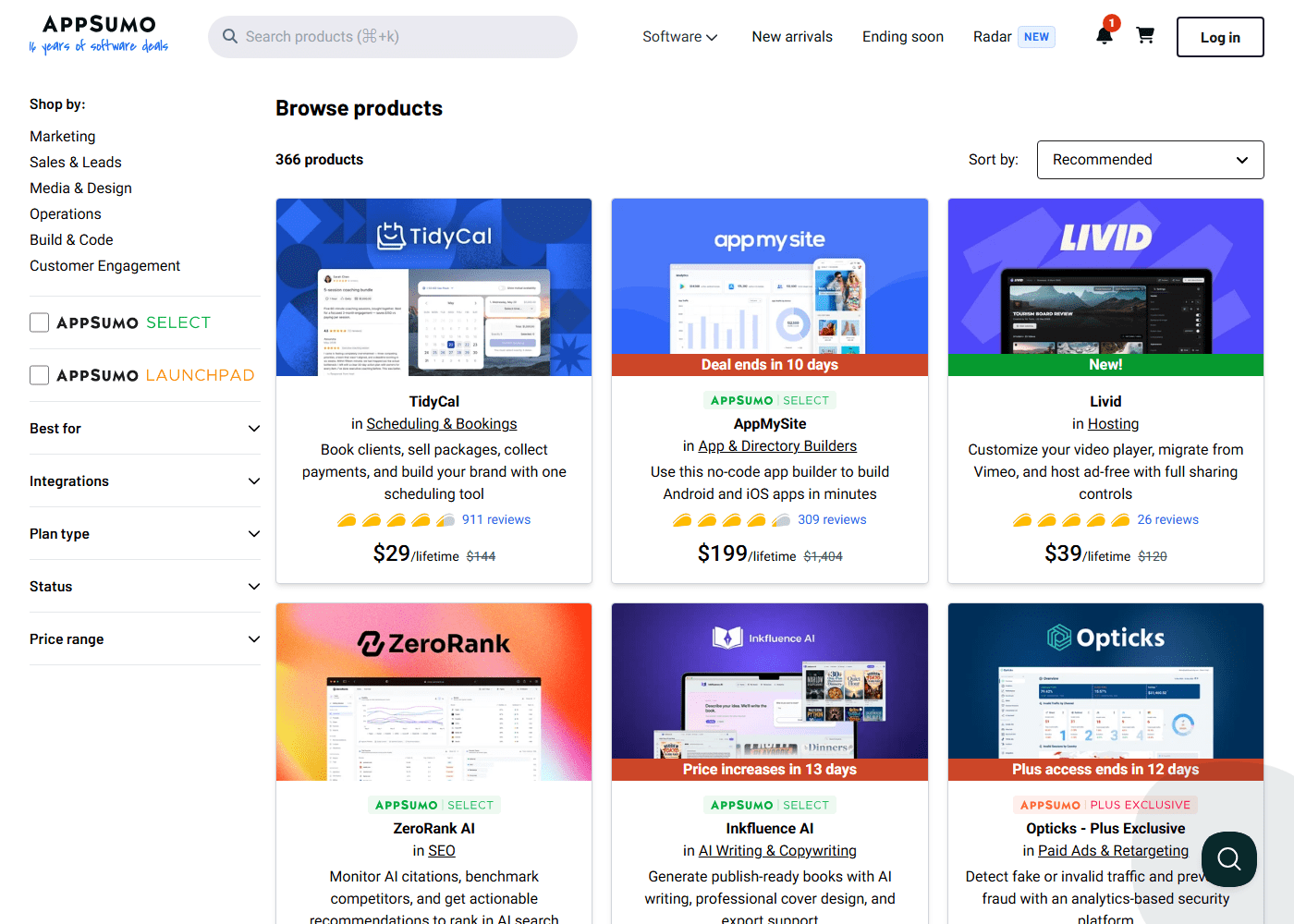
🥇 TidyCal — $29: The Closest Thing to a Guaranteed Win
If a friend asked for one deal to test the whole lifetime-deal concept, this is the answer. Every time.
TidyCal is AppSumo's own scheduling tool. A Calendly-class booking system covering calendar connections, booking pages, payment collection and package sales.
$29 once, against a $144 list price.
| Signal | TidyCal |
|---|---|
| Reviews | 911, holding five tacos |
| Status | AppSumo Original |
| Shutdown risk | Effectively zero |
| Break-even | ~10 weeks vs a $12/mo scheduler |
| With first-order discount | $26.10 |
The review corpus is the deepest on the platform. Accumulated over years of post-purchase reality, not launch-week enthusiasm.
And its Originals status changes the risk calculus completely.
AppSumo builds, owns and staffs TidyCal itself. The platform's one real hazard — vendor shutdown — effectively drops to zero.
You are buying scheduling software from the marketplace's landlord.
The economics
Calendly-style plans run $10 to $16 per user per month.
TidyCal's $29 one-time price breaks even before your third month, then compounds indefinitely.
My own copy replaced a $12-per-month plan years ago. It has silently banked several hundred dollars of avoided billing and still books every client call I take.
The honest limits. Power schedulers with elaborate team round-robin routing may find edges the big incumbents polish better. Its interface prioritises function over flash.
Neither caveat survives contact with the price.
For freelancers, coaches, agencies and anyone who sends "what time works for you" emails, this is the first purchase.
Ideally with the 10% first-order discount making it $26.10. There is no cheaper education in why this marketplace works. 📅
🥈 ZeroRank AI — $69: The Deepest Discount on the Board
The most interesting deal on the current board sits in the SEO shelf.
ZeroRank AI monitors your visibility in AI search. It tracks citations of your brand across AI answers, benchmarks against competitors, and recommends actions to rank in the answers themselves.
$69 against a $598 list. An 88% discount, currently among the steepest on the platform.
The strategic timing is the real story.
Search behaviour is migrating into AI assistants faster than most small businesses' tooling budgets can follow.
The incumbent SEO suites price their AI-visibility modules at enterprise tiers. A lifetime license here means owning the monitoring layer for a shift that is still early.
It carries the Select badge. Its 27 reviews skew detailed and technical — the pattern I associate with practitioner buyers rather than hype waves.
Apply AI-shelf discipline first
This shelf's rules differ, because AI products carry real per-query compute costs.
Check the tier chart's metering honestly against your intended usage.
Favour the middle tier over "unlimited" promises.
Price the deal against eighteen months of value rather than forever.
Under those terms ZeroRank still clears break-even inside two months, against any $50-per-month SEO subscription it displaces.
My SEO tools roundup and AI tools guide hold the full category context.
The summary is plain. This is the board's best ratio of discount depth to strategic relevance, and the sixty-day guarantee makes testing that thesis free. 🔍
🎁 10% Off Your First Pick — Email Sign Up →
🥉 AppMySite — $199: The Big Ticket That Justifies Itself
The board's largest common price tag delivers its largest absolute saving.
AppMySite converts websites into native Android and iOS apps through a no-code builder.
$199 lifetime against a $1,404 annual list price. Select badge, 309 reviews.
The buyer this serves is specific and numerous. Any business whose customers return repeatedly.
Restaurants taking orders. Salons taking bookings. Stores running loyalty programs. Creators with communities.
For all of them, "we have an app" historically meant a five-figure agency quote or a $100-plus monthly builder subscription.
At $199 once, the entire category of mobile presence reprices.
Break-even against the subscription equivalent arrives in under two months. Against an agency quote it arrives before checkout finishes.
Diligence and honest caveats
The newest reviews trend strong on support responsiveness. The changelog shows steady shipping.
The deal periodically posts "ends in X days" banners. That matters — campaigns here genuinely close, and the $199 tier reappears rarely.
The honest caveats belong to the category, not the product.
App-store publishing involves Apple and Google review processes, with their own fees and patience requirements.
A converted app is only as good as the website underneath it.
For the right buyer — and my small business guide profiles exactly who — this is the board's most consequential purchase.
The one that changes what the business is, not just what it pays. 📱
💎 Livid — $39: The Sleeper Nobody Budgets For
Video hosting is the bill nobody remembers agreeing to.
Course platforms, marketing sites and client galleries all need player-grade video that does not carry a competitor's logo.
The incumbent solutions bill $10 to $75 monthly for the privilege.
Livid hosts and customises your video player — migration from Vimeo included, ad-free, full sharing controls — for $39 against a $120 list.
Its "New!" shelf position and 26 early reviews at strong tacos make it this quarter's classic sleeper. Too new for fame, priced before its audience finds it.
The pattern I have watched across years of Monday scans: hosting-adjacent utilities under $50 become the deals people mourn most loudly after close.
Their subscription counterparts bill forever. Their use case never expires.
My position, and yours
Bought during week one. Migrated two client galleries off a $19-per-month plan. Break-even scheduled for week nine.
The day-45 review already passed as "keep", on the strength of the migration tooling alone.
The honest frame for you: newer deal, thinner review base.
So weight the 60-day guarantee more heavily than you would for a TidyCal-class veteran.
Buy, deploy a real project onto it inside a fortnight, and let the guarantee absorb the residual uncertainty.
That is precisely what the guarantee is for. On utilities this cheap, the downside rounds to a calendar reminder. 🎬
📊 The current board: price vs list, break-even in weeks
Every headline pick clears break-even inside one quarter vs the bill it replaces.
🥧 Why deals leave this list
🗂️ The Rest of the Radar
Beyond the headliners, this quarter's category heat map shows where your particular bills might find their erasers.
| Shelf | Heat | Watch for |
|---|---|---|
| AI writing and content | Busiest | Credit metering sustainability |
| Paid ads and analytics | Quietly strong | Plus-exclusive gems |
| Customer engagement | Constant refresh | Utilities that sell out quietly |
AI writing and content tools remain the busiest shelf.
Inkfluence AI's book-generation deal is drawing Select-badge attention and "price increases" banners — the classic signature of a campaign heating up.
My AI writing roundup tracks which of these meter their credits sustainably.
Paid-ads and analytics tools are quietly strong. Opticks, a Plus-exclusive fraud-detection deal, exemplifies the members-only shelf's occasional gems and one argument in the Plus math.
Customer engagement — chat widgets, support inboxes, review collectors — refreshes constantly and pairs with the chatbot tools guide.
Two shelf-reading habits
Watch the badges. Select marks vetted quality. Plus-exclusive marks members-only access. "Ends in X days" ribbons mark genuine deadlines.
AppSumo campaigns do not extend for stragglers.
Watch the countdown pattern on prices. "Price increases in 13 days" banners are the platform telling you the golden window is closing on launch terms.
The full navigation method lives in my new deals guide.
The compressed version fits in a sentence. The best deal on any given day is the one from your bills-list whose campaign is in days four through fourteen.
Everything else is browsing. 🧭
⚡ How to Buy From This List: The Ten-Minute Protocol
Turning a pick into a purchase deserves the same brief discipline every time.
Here is the protocol that has produced my 80-plus-percent keeper rate.
| Minute | Do this |
|---|---|
| 1 | Name the bill or bottleneck it replaces |
| 2–6 | Tier chart, newest ten reviews, founder replies |
| 7 | Claim the 10% first-order discount |
| 8–9 | Check out, set day-30 and day-45 reminders |
| 10 | Cancel the subscription it replaces |
Minute one: confirm the bill the deal replaces. Name the actual monthly number, because that number is the entire investment case.
Minutes two through six: open the deal page and run three checks.
Tier chart against your twelve-month needs — buy next year's tier, not today's. Newest ten reviews for post-launch honesty. Founder's recent replies for team pulse.
Minute seven: if this is your first order, claim the 10% email sign-up discount before checkout rather than after.
It binds to the account and applies automatically. Skipping it donates money to nobody.
Minutes eight and nine: check out, then set the two calendar reminders that do more for outcomes than any research.
Day 30: "am I actually using this?" Day 45: "keep or refund?"
The 60-day guarantee converts every purchase on this page into a reversible experiment. My two lifetime refunds both processed inside three days.
Minute ten: cancel the subscription the new tool replaces. Today.
A lifetime deal duplicating a live subscription is a cost, not a saving.
Ten minutes, five habits, and the list above stops being content and starts being a stack. 🏗️
🧱 Building a Full Stack From This Board
The picks above are strongest bought as a system rather than souvenirs.
| Buy | When | Price |
|---|---|---|
| TidyCal | Always — the foundation stone | $29 |
| ZeroRank AI | If search feeds your pipeline | $69 |
| Livid | If any course or gallery needs video | $39 |
| AppMySite | Only if customers return repeatedly | $199 |
| Full four | ~$302 with the discount | $336 |
Against a subscription-equivalent burn of $150 to $250 per month for the same functions.
The complete stack breaks even inside its first ten weeks, then runs free permanently.
Two assembly principles
Sequence by bill size, not excitement. Buy first whatever erases your largest current subscription, because that purchase funds the rest.
My own stack was built entirely on recovered subscription money after the first two purchases.
Stagger purchases across a few weeks rather than one splurge.
Each tool gets deployed into real work inside its own 60-day window. Each day-45 review gets honest attention.
Four simultaneous evaluations produce four shallow ones.
A stack assembled this way — sequenced, staggered, audited — is how the marketplace's headline numbers become boring monthly reality.
The board refreshes weekly. The method never has to. 🧱
📉 What Fell Off the List, and Why That Matters
Transparency about exits teaches more than celebrations of entries.
Deals leave this list for four reasons, in rising order of instructiveness.
Campaigns end. The most common exit, and the reminder that every pick above carries a real clock.
When a listed deal shows "Ends in 10 days," that is the list telling you your decision window has a date.
Prices rise mid-campaign. The "price increases" banner exits a deal from best-value status even when the tool remains excellent.
This list ranks deals, not products.
Review trajectories sag. A launch at 4.8 tacos that settles below 3.5 on volume is the crowd completing its due diligence in public.
I trust the settled number over my own first impression every time.
The fourth exit is the one to internalise: my own day-45 reviews fail a pick I bought.
It has happened. A tool that demoed brilliantly, survived my three tests, and still sat unopened by week five got refunded and quietly delisted.
That exit path is the whole system working. The picks are hypotheses. The 60-day guarantee is the laboratory. The refund button is how wrong hypotheses cost nothing but calendar space.
Any best-deals page that never retracts is selling. This one audits.
Follow the same discipline on your own purchases and your personal list will outperform every public one, including mine, within a year.
Nobody can rank your bills better than your ledger can. 📖
🚫 When You Should Skip a Deal Entirely
I earn a commission here. That is exactly why this section exists.
When it does not replace a bill you already pay. A cheap tool for a job you were not doing is not a saving. It is a new expense with a discount on it.
When the changelog is silent. That is the single best predictor of the roughly one-in-ten deals that eventually sunset.
When you are buying on launch day. Days one to three are the hype window. Days four to fourteen are when reviews get honest and tiers are still stocked.
When break-even runs past a quarter. Unless the strategic case is exceptional, slower payback means you are buying a nice-to-have.
When you will not deploy it inside a fortnight. The guarantee only protects you if you actually test the tool while it runs.
When you already own something that does the job. Stack duplication is the most common quiet waste among enthusiastic buyers.
🏁 Verdict: Buy the Bill-Killers, Skip the Rest
The honest summary of the current board.
TidyCal remains the platform's single safest purchase, and the correct first order for anyone new.
ZeroRank AI is the quarter's best discount-to-relevance ratio for anyone whose customers arrive through search.
AppMySite is the transformative big ticket for repeat-customer businesses.
Livid is the sleeper for anyone paying video hosting's quiet toll.
All four clear break-even inside a quarter. All four carry the platform's quality signals. All four sit under the 60-day guarantee that makes conviction cheap.
Around them, 360-odd other products range from excellent to forgettable. The three-test method sorts them faster than any listicle refresh cycle could.
The move that beats reading another roundup
Pick the one deal here that names a bill you paid this month. Run the ten-minute protocol. Buy it with the first-order discount.
My Monday-coffee shortlist will keep updating. Your subscription bills, left alone, will too.
Only one of those compounds in your favour. 🌮
A last note on timing
The picks above reflect the steady season, when the golden-window rhythm and first-order discount are your levers.
From September onward the calculus shifts.
Deferrable purchases belong on a Black Friday wishlist, where the year's floor prices and encore returns concentrate.
But urgent bill-killers should still buy now. A quarter of extra subscription billing usually outweighs a November discount delta.
And whatever the month, the deals-end-forever rule stays sovereign.
When a pick shows its ending banner and your diligence is done, the correct wait is zero.
The list can be patient. Campaigns are not. ⏰
🎁 Get 10% Off First Order with Email Sign Up →
❓ FAQ
What is the single best AppSumo deal right now?
For most buyers, TidyCal at $29. An AppSumo Original with 911 five-taco reviews, near-zero shutdown risk, and ten-week break-even against any paid scheduler. It is the standard first purchase for a reason.
How often do the best deals change?
Continuously. Campaigns typically run weeks to a few months and rarely return outside Black Friday encores. The durable skill is the three-test method, not any static list.
Are expensive deals like AppMySite riskier?
The risk scales with price only if diligence stays flat. A $199 Select-badge deal with 309 reviews and an active changelog is safer than a $29 launch-day unknown. Size diligence to price.
Should I wait for deals to get cheaper?
Within a campaign, prices rise more often than fall. The reliable cheap moments are a campaign's launch terms — days 4 to 14 — and Black Friday. Waiting past a golden window usually costs money.
Do these picks work with the 10% discount?
Yes. The first-order offer applies to whatever a new customer buys first. Spend it on your largest planned pick, not your smallest.
What if a deal I buy from this list disappoints?
Refund it inside the 60-day guarantee. Self-serve, and in my two experiences the money returned within three days. Set the day-45 reminder at purchase and the decision makes itself with evidence.
How many deals should I buy at once?
One, then another a few weeks later. Four simultaneous evaluations produce four shallow ones, and the guarantee only helps if each tool gets real usage inside its own window.
What does the Select badge actually mean?
It marks deals AppSumo has vetted more closely. It is a genuine signal, not a guarantee, and it matters most on larger purchases where diligence should scale with price.
Is there a best day of the week to check?
Monday works for me, because new campaigns and ending banners both surface at the start of the week. The habit matters more than the day.
Related reading: Full AppSumo review · Lifetime deals guide · New deals radar · The buying guide

- Video Content in 2026: What the Engagement Data Shows - October 21, 2026
- Monetising a Channel That Uses AI: The Rules That Bite - October 21, 2026
- SEO or Paid Ads? The Cost-Per-Acquisition Data - October 18, 2026