
Plays in the language you are reading. Tap any paragraph to start from there.
SEO tooling is the most punishing subscription line in small-business software.
The big suites start near $100 a month. They climb past $400. That is why "SEO tools" and "AppSumo" belong in the same sentence more than any other category I cover.
My own search stack once billed $148 every month. Today the same functions run on lifetime licenses. Total cost: less than six weeks of that old bill.
This guide is the map I wish I had before the migration. First-timers start with 10% off the first order. 🔍
🌮 Browse SEO Deals on AppSumo →
🧾 Key Takeaways
| Question | Short answer |
|---|---|
| Why buy SEO tools on AppSumo? | The category's subscriptions ($100–$400/mo) are the costliest to rent |
| Current headliner | ZeroRank AI — $69 lifetime vs $598 list (88% off, Select badge) |
| The stack architecture | Audit → keywords → rank tracking → AI-search visibility |
| What LTDs do best | Audits, tracking, on-page, AI visibility for small sites |
| Where incumbents keep a moat | Massive link indexes and enterprise-scale crawls |
| Total stack cost | ~$150–$250 one-time vs $1,200–$4,800/year subscribed |
| Break-even | Before the second monthly invoice would have landed |
| First move | 10% off your first order 🎁 |
⚖️ Why SEO Is the Perfect LTD Category
Category economics decide where lifetime deals shine. SEO's economics are almost engineered for them.
The incumbent suites price for agencies and enterprises. $99 to $449 monthly is the standard ladder.
But look at what a small site owner actually uses. A few audits a month. A keyword list in the hundreds, not millions. Rank tracking for dozens of terms. On-page checks per published article.
That is the gap challenger tools fill through AppSumo campaigns. Purpose-sized SEO software at $49–$79 lifetime.
Break-even against even the cheapest incumbent tier arrives inside three weeks.
My own arithmetic was typical.
| My migration | Number |
|---|---|
| Monthly subscription cancelled | $148 |
| Lifetime licenses purchased | ~$210 one-time |
| Break-even | Before invoice two |
| Cost per month since | $0 |
| Three-year saving | ~$5,100 |
🏰 The Caveat: The Moat Is Real
Here is the honest boundary, stated before the sales pitch rather than after it.
The incumbents' moat is real, and it lives in their indexes.
Building a link database that crawls the entire web costs millions every year. No $69 lifetime tool will match the backlink intelligence of the giant suites.
If your work is competitive link-gap analysis across enterprise SERPs, you are the incumbents' rightful customer. Pay them.
But that describes a small minority of the people paying them.
Everyone else does audits, content optimization, rank tracking, and increasingly AI-search visibility. The LTD shelf covers that workflow at a fiftieth of the three-year cost.
The free tiers of major tools plus search-console data fill the occasional index-shaped gap.
Know which buyer you are. The shelf serves the second kind spectacularly. 🗺️
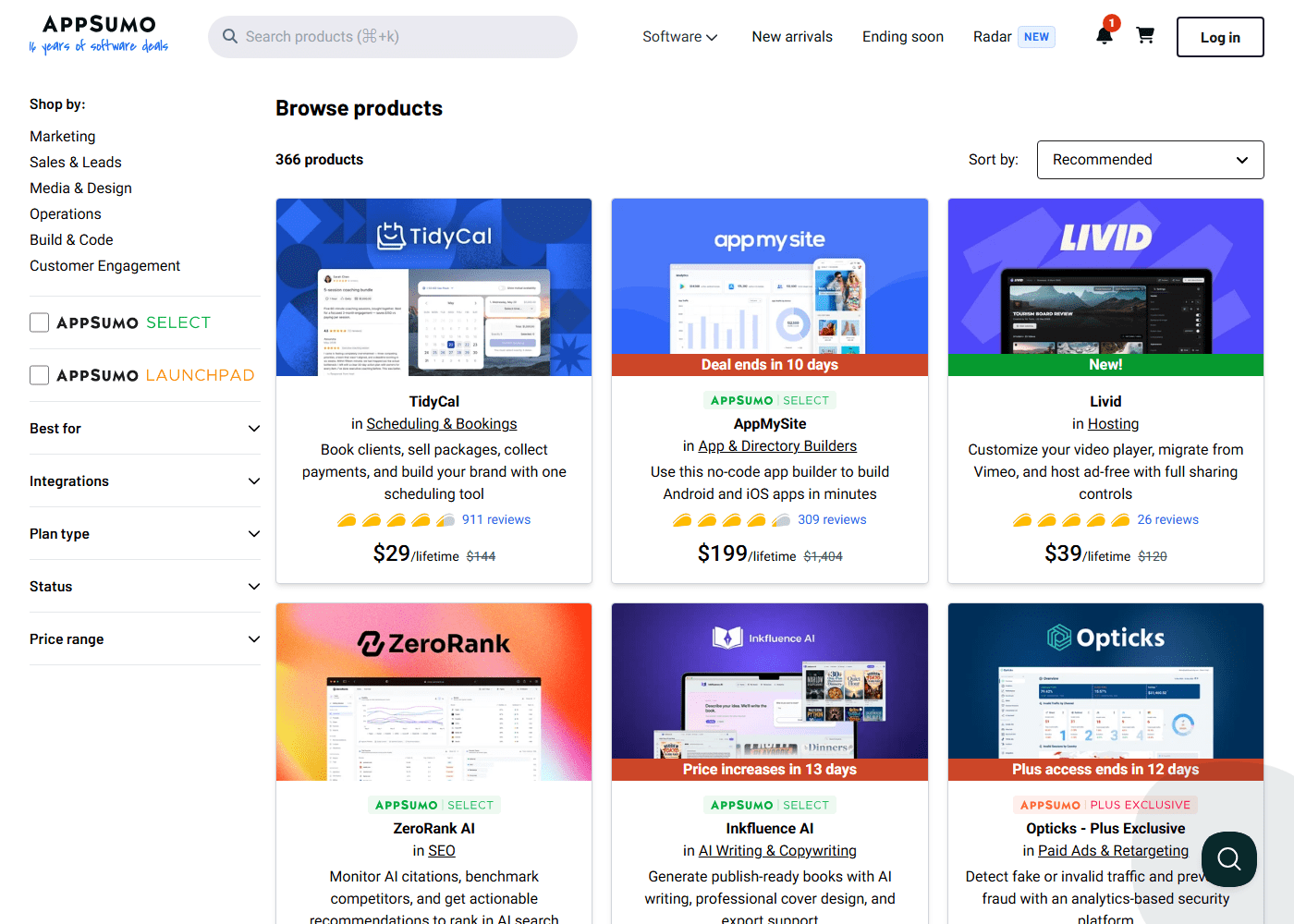
🥇 ZeroRank AI — $69: Owning the AI-Search Shift
The shelf's current headliner earns its position twice over.
ZeroRank AI — $69 lifetime against a $598 list. Select-badged. 88% off, the steepest meaningful discount on the board.
It answers the question every site owner started asking this year: does AI search cite me?
The tool monitors your brand's visibility across AI-generated answers. It benchmarks competitors' citation share. Then it recommends concrete actions to become source material for the answers themselves.
The strategic logic is the purchase case.
Search behaviour is migrating into AI assistants at consumer scale. The incumbents price their equivalent AI-visibility modules into enterprise tiers.
Sites establishing citation presence now are running the same land-grab that early traditional SEO rewarded a generation ago. Most competitors still track only blue links.
Diligence notes
Per my AI-shelf rules, three things check out.
| Check | Finding |
|---|---|
| Metering structure | Credit-metered, not "unlimited" — the trustworthy shape |
| Review base | Skews technical practitioner |
| Tier scaling | By tracked brands and query volume |
| Which tier | Size to your real portfolio; middle tier when torn |
| Risk | 60-day guarantee prices the test at zero |
Amortise over eighteen months, per the AI norm. The maths still embarrasses the alternatives.
Six weeks to break even against a $50-monthly SEO line. The AI-search monitoring function is effectively free on top.
For agencies, the higher tiers' multi-brand tracking converts into a billable deliverable. "AI search visibility report" is a line item almost nobody's competitors offer yet.
This is the deal I point to when people ask what a golden-window purchase looks like. 🎯
🏗️ The Working Stack: Four Functions
One tool never was an SEO strategy. Here is the four-function architecture the shelf assembles.
| Function | What it does | LTD band |
|---|---|---|
| 1. Technical audits | Broken links, speed, meta, crawlability | $49–$69 |
| 2. Keyword intelligence | Suggestions, difficulty, clustering, briefs | $49–$79 |
| 3. Rank tracking | Daily positions on your term set | $49–$69 |
| 4. AI-search visibility | Citation share in AI answers | $69 |
Function one: technical audits. Site crawlers that surface broken links, speed issues, meta problems and crawlability blockers.
The shelf reliably carries audit tools in the $49–$69 band. Their reports cover everything a non-enterprise site needs monthly. Pair with the free search-console data every site already owns.
Function two: keyword intelligence. Challenger tools trade billion-term databases for focused suggestion, difficulty and clustering workflows.
For a small site publishing weekly, the focused version is genuinely the better product. Less paralysis. More briefs.
Function three: rank tracking. Daily position monitoring for your term set.
This is where LTD tools most completely match incumbent functionality. The underlying job commoditised years ago. Check SERPs, log positions, chart trends. Paying $100 monthly for it inside a suite is the classic bundling tax.
Function four: AI-search visibility. The new fourth pillar, anchored by ZeroRank.
Within a year or two this will be as standard as rank tracking is today. Buying it at lifetime pricing before the incumbents finish premium-tiering it is the shelf's clearest current arbitrage.
Assembly economics
The full stack typically runs $150–$250 one-time across three or four deals. Incumbent suites run $1,200–$4,800 yearly.
Each function is purchasable independently as its campaign appears. That is why the new-deals radar habit matters more in this category than most.
Sequence by current pain. Sites with technical debt start at audits. Content-velocity sites start at keywords. Everyone adds visibility tracking before their competitors read this paragraph. 📐
🎁 Build Your SEO Stack — 10% Off First Order →
🏰 What the Incumbent Subscriptions Actually Buy
Fair comparison demands itemising the moat precisely. "The big tools are better" is both true and mostly irrelevant to the buyers reading this.
Here is what the suites genuinely own.
| Incumbent advantage | Decisive for |
|---|---|
| Web-scale link indexes | Competitive backlink analysis, digital PR |
| Historical SERP databases | Decade-long trend research at agency scale |
| Enterprise crawl budgets | Million-page site audits |
| Integrated everything | One login, one bill, one export format |
If your daily work consumes those four, the subscription is your cost of doing business. This guide's honest advice is to pay it.
Now itemise what the typical small-operator workflow actually touches.
| Real workflow | Frequency | LTD covers it? |
|---|---|---|
| Site audit | Monthly | ✅ Yes |
| Keyword briefs | Weekly | ✅ Arguably better-sized |
| Rank checks | Daily | ✅ Completely |
| On-page optimisation | Per article | ✅ Yes |
| AI-visibility questions | Weekly | ✅ At $69 lifetime |
| Enterprise link-gap analysis | Rarely, if ever | ❌ Incumbent moat |
The overlap between what the subscription bills for and what the small operator uses runs, in my measured experience, under twenty percent.
Meaning the $148 I paid monthly bought roughly $30 of consumed value. And $118 of enterprise infrastructure I never touched.
That ratio, not tool quality, is the entire case for the shelf. Stop renting the moat you never cross.
The lifetime-vs-subscription math generalises the argument. SEO is simply its most extreme instance. 💸
📊 3-year SEO tooling cost: incumbent suite vs LTD stack
Typical small-site workflow consumes <20% of what suite pricing meters.
🥧 Where your $148 subscription actually went
💼 Agency Angle: LTDs as Billable Infrastructure
The shelf's highest-leverage buyers are agencies and freelance SEOs. Lifetime licenses convert directly into deliverable margin.
Here is the arithmetic that makes veterans grin.
A stacked higher tier of an audit tool — say $138 across two codes — unlocks white-label reports and multi-site capacity.
Those client-facing audit deliverables bill $300–$800 each. Indefinitely. With zero marginal software cost.
| Deliverable | Tool cost | Bills at |
|---|---|---|
| White-label site audit | ~$138 once | $300–$800 each |
| Monthly rank report | ~$69 once | Retainer line item |
| AI-visibility report | ~$69 once | Novel — few offer it |
| Content brief pack | ~$59 once | Per-article billing |
One reasonably-priced client retainer covers the entire stack's one-time cost in its first month. Every month after is margin the subscription-paying competitor structurally cannot match.
Execution notes
From the agency playbook, three rules.
Buy agency tiers during campaigns. White-label and multi-workspace rights are the features most brutally repriced afterwards.
Verify report-export quality inside the guarantee window. Use a real client file, not a demo.
Mind the compliance line. Client-facing claims should match what the challenger tools actually do. Sixty days of real usage establishes that honestly.
The code-stacking guide covers tier mechanics in depth. The category summary is simple: in SEO, stacked codes are not capacity. They are inventory. 📈
📍 Local SEO: The Shelf's Quiet Specialty
One sub-category deserves its own spotlight. It serves the readers with the least tooling budget and the most to gain.
Local SEO runs on a different playbook than national content SEO. Google Business Profile optimisation. Citation consistency. Review velocity. Map-pack rankings.
The incumbent suites price local tooling as an afterthought add-on. Dedicated local platforms bill $30–$80 monthly for what is fundamentally monitoring and checklists.
The LTD shelf carries exactly this function, periodically. Citation scanners. Review-collection widgets. GBP audit tools. Local rank trackers that grid-check positions across a service area.
For a salon, restaurant, plumber or clinic, one $49–$69 local-SEO lifetime license typically covers the entire discipline.
The small business guide pairs it with the rest of the local stack.
Why local makes AI visibility urgent
"Best plumber near me" is precisely the query class migrating fastest into AI assistants.
Local businesses cited in AI answers are capturing customers whose search never rendered a traditional map pack at all.
A local operator running ZeroRank-class monitoring is competing in a channel most rivals do not know exists. That information asymmetry historically closes within a couple of years. The lifetime license outlasts the closing.
If your business serves a geography rather than a niche, weight this section double. 🗺️
🗓️ The 90-Day Migration Plan
Theory converts through sequence. Here is the migration exactly as I would run it again.
| Phase | Days | Job |
|---|---|---|
| Inventory | 1–14 | Baseline usage, export everything, claim the discount |
| First purchase | 15–45 | Buy most-used function, run it in parallel |
| Complete and cancel | 46–90 | Add remaining functions, kill the subscription |
Days one to fourteen: inventory and baseline.
List what your current subscription actually did last quarter. Honestly, from usage logs, not feature pages.
Export everything. Keyword lists. Tracked terms. Historical rankings. Audit configurations.
This fortnight also claims the 10% first-order discount and starts the deal-alert scan for your first target function.
Days fifteen to forty-five: first purchase and parallel running.
Buy the function you use most. Audits or tracking, for most people. Buy it in its campaign's golden window.
Deploy against your real site the same day. Then run it alongside the incumbent subscription for one full monthly cycle, comparing outputs where they overlap.
The day-45 review decides with parallel evidence. That is the most confident keep-or-refund decision the guarantee allows.
Days forty-six to ninety: complete and cancel.
Add the remaining functions as campaigns permit. Keywords, then visibility. Each with its own reminders. Each deployed immediately.
Cancel the incumbent subscription the day your stack covers your logged workflow. Not the imagined one — the week-one usage inventory is the referee.
Bank the first cancelled invoice visibly. Mine went into a note titled "the stack paid for itself".
That receipt funds the psychological shift this category needs most. SEO tooling is now equipment, not rent.
Maintenance afterwards is a standing rhythm. Monday radar scans. Golden-window additions. Black Friday for deferrable upgrades. 🏁
🔄 The Weekly Loop the Stack Runs
Tools earn their keep through routines. Here is the weekly loop my migrated stack actually runs.
| Day | Job | Time |
|---|---|---|
| Monday | Rank digest + weekly crawl report | 20 min |
| Wednesday | Keyword brief + pre-publish on-page checks | Per article |
| Friday | AI-visibility citation check | 10 min |
| Monthly | Ledger: rankings trended, traffic correlated | 15 min |
Monday, twenty minutes. The rank tracker's weekend digest, reviewed over coffee. Position movements on the tracked set. Winners to reinforce, sliders to investigate.
Simultaneously, the audit tool's weekly crawl report. It surfaces anything the week's publishing broke — a redirect chain, a missing meta, an orphaned page — while fixes cost minutes instead of rankings.
Wednesday, per article. The keyword tool generates the brief. Target term. Cluster of related phrases. Difficulty sanity-check. Questions the SERP rewards answering.
On-page checks run before publication, not after. Pre-publication optimisation is free. Retrofitting is a task list.
Friday, ten minutes. The AI-visibility check. Which pieces are earning citations in AI answers. Which competitor content is cited instead. What the gap suggests for next week's briefs.
This is the loop's newest station and its compounding one. Citation presence feeds authority feeds further citation.
Total weekly time: under an hour. Total monthly software cost: nothing.
The subscription era's real toll was never just the $148. It was treating SEO as an expensive department instead of an hour's routine. The stack fixed both. ⏰
🚫 When You Should Not Buy These
I earn a commission here. That is exactly why this section exists.
If you run competitive link-building at national scale. You need the web-scale index. Pay the incumbent and stop reading.
If you audit million-page properties. Enterprise crawl budgets are not something a $69 license replicates.
If your clients demand suite-native reports by name. Some contracts specify the tool. That is a commercial constraint, not a technical one.
If you will not actually deploy the tool. An unused lifetime license is cheaper than an unused subscription, but it is still waste.
If you have not exported your current data. Cancel first and you lose years of ranking history. Export, then migrate, then cancel.
If the deal has no clear metering. "Unlimited" on an AI-powered tool is a promise nobody can keep at $69. Credit-metered is the trustworthy structure.
🥊 Verdict: The Category Where LTDs Hit Hardest
SEO is the single highest-yield category on AppSumo.
It pairs the software industry's most aggressive subscription pricing — $100 to $400+ monthly — against lifetime licenses covering the actual small-operator workflow for $150–$250 total, once.
The current board rewards immediate action twice over.
ZeroRank AI's 88%-off AI-search play is both the deal of the shelf and a genuine strategic land-grab. The audit-keyword-tracking core rotates reliable $49–$79 campaigns for stack completion.
The honest boundary stands. Enterprise link intelligence and web-scale indexes remain the incumbents' moat. The minority who cross that moat daily should keep paying the toll.
Everyone else has been renting a castle to use its mailbox.
What to do this week
Claim the discount. Inventory your real usage. Put the first function on the radar.
Ninety days from now the subscription line in your budget reads zero. The stack answers to nobody's renewal calendar.
And if you moved on the visibility pillar early, your site is accumulating AI-search presence while competitors still refresh their rank trackers. 🌮
One note on trajectory
SEO tooling is mid-transformation. Your purchases should anticipate it.
The traditional pillars — audits, keywords, rankings — are commoditising steadily. Their LTD prices keep drifting down. Their campaign frequency keeps rising. Patience is affordable on those functions.
The AI-visibility pillar runs the opposite direction. As AI search consolidates consumer behaviour, monitoring it migrates from novelty to necessity.
Today's $69 lifetime entries are the category's cheapest tickets before the incumbents finish premium-tiering the function.
The asymmetry writes its own strategy. Defer the commodity pillars. Accelerate the visibility pillar to this quarter.
Buyers who invert it pay the difference twice. Once in subscription tolls. Once in citation share their competitors banked first. 🚀
🎁 Get 10% Off First Order with Email Sign Up →
❓ FAQ
What's the best SEO tool on AppSumo right now?
ZeroRank AI at $69 (88% off $598, Select badge). AI-search visibility monitoring at lifetime pricing, while incumbents enterprise-tier the same function. For stack foundations, the rotating audit and rank-tracking deals in the $49–$79 band.
Can AppSumo SEO tools really replace the big suites?
For the typical small-site workflow, yes. Audits, keywords, tracking and on-page, at under 5% of three-year cost. For enterprise link intelligence, no. That moat is the incumbents' legitimate business.
How much does a full LTD SEO stack cost?
Typically $150–$250 one-time across three or four tools. Versus $1,200–$4,800 yearly subscribed. Break-even arrives before the second monthly invoice would have.
Are SEO lifetime deals sustainable for vendors?
The credit-metered, Select-badged ones with parallel subscription businesses, yes. Standard AI-shelf diligence applies to the AI-powered entries. Rank tracking and audit tools carry classic low-marginal-cost utility economics.
Should agencies buy these tools?
More aggressively than anyone. Stacked white-label tiers convert into $300–$800 billable deliverables with zero marginal cost. Buy agency tiers in-campaign — they are repriced most brutally afterwards.
How do I migrate off my current SEO subscription safely?
Use the 90-day plan above. Inventory real usage, buy the most-used function first with the 10% discount, parallel-run one full cycle, then cancel when the stack covers your logged workflow. The 60-day guarantee referees each step.
Do these tools work for local SEO?
Yes. The shelf periodically carries citation scanners, review widgets, GBP audit tools and local rank trackers at $49–$69 lifetime. That covers a local business's entire SEO tooling need. AI-visibility monitoring is doubly urgent for "near me" queries.
How often do new SEO deals appear on AppSumo?
Continuously. The commodity pillars cycle campaigns every few weeks, which is why the new-deals radar habit completes stacks efficiently. Novel functions like AI visibility appear less often — buy those when seen.
What happens if the vendor shuts down?
You lose the tool. That is the real LTD risk, and it is why metering structure and vendor track record matter more than discount percentage. Export your data periodically regardless of which tool you use.
Should I cancel my subscription before buying?
No. Parallel-run for one full cycle first. Cancelling early costs you the comparison evidence that makes the decision safe.
Is stacking codes worth it for SEO tools?
For agencies, almost always — higher tiers unlock white-label and multi-site rights that bill directly. For a single site owner, usually not. Buy tier one and see.
Related reading: Best AI tools on AppSumo · Best deals this month · Lifetime deal vs subscription · The buying guide

- Video Content in 2026: What the Engagement Data Shows - October 21, 2026
- Monetising a Channel That Uses AI: The Rules That Bite - October 21, 2026
- SEO or Paid Ads? The Cost-Per-Acquisition Data - October 18, 2026