
Plays in the language you are reading. Tap any paragraph to start from there.
Agency economics run on a spread. What clients pay for outcomes, minus what delivery costs you. Software sits squarely in the cost column, multiplied by every client you win and every teammate you add.
Per-seat, per-workspace, per-client pricing merely annoys a freelancer. For an agency it is a structural tax. Ten clients on incumbent tooling means ten workspaces billed monthly. Your software line grows in lockstep with revenue, forever.
AppSumo inverts that exactly where agencies live. White-label rights and multi-workspace tiers, bought once via stacked codes, convert client delivery from a recurring cost into owned inventory. Inventory this cheap changes what you can profitably sell.
I have watched the model from both sides, running client work on stacked licenses and documenting every category's agency angle across this series. This guide consolidates the playbook: the stacking mathematics, the deliverable catalog, the white-label diligence checklist, and the client-lifecycle stack.
Agencies take the 10% first-order discount like everyone else. Just spend it on an agency tier, where 10% is real money. 💼
🧾 Key Takeaways
| Question | Short answer |
|---|---|
| Why is AppSumo built for agencies? | White-label + multi-workspace tiers convert client costs to owned inventory |
| The stacking math | ~$138 of stacked codes ≈ capacity that bills $50–$100/mo per client elsewhere |
| The deliverable catalog | Audits, dashboards, support bots, sites, reports — billable at zero marginal cost |
| The critical diligence | White-label completeness + workspace isolation, verified in week one |
| Timing priority | Agency tiers sell out first — execute early in campaigns and events |
| First move | 10% off your first order 🎁 |
The Margin Inversion: Why Stacking Changes the Business 🧮
Run the two software models against a ten-client roster. The divergence explains this entire guide.
The per-seat model. A white-label reporting tool at $49 monthly per client workspace bills $490 a month. That is $5,880 a year, and every client win raises it. The vendor is effectively a silent partner taking a percentage of your growth, without the decency of appearing on the cap table.
Scale that across the four or five tools a delivery stack actually needs. The silent partnership compounds into five figures annually, before the first salary is paid.
The stacked model. The same category's lifetime deal, stacked to its agency tier during a campaign, typically runs two to three codes for $118 to $207 total. That carries the ten workspaces, and usually more, at zero marginal cost. Forever. Client eleven costs nothing, and delivery margin widens permanently on every engagement.
The code-stacking mechanics are the same ones any buyer uses. The agency difference is that each stacked tier multiplies across a roster. That is why agencies are the platform's highest-ROI buyer class per dollar spent.
The inversion's second-order effect matters more than the savings: owned capacity changes what you can profitably pitch. The audit you could not justify at $49-per-client-monthly becomes a $500 one-time deliverable riding a $138 license. The managed-support line — "24/7 AI answering for your business" — becomes a $200-monthly retainer item against zero marginal software cost, per the support guide's white-label angle. The small client whose budget never fit incumbent tooling economics becomes servable at margin. Agencies on per-seat stacks price their services around their software's appetite; agencies on owned stacks price around value, and the difference compounds into the service catalog itself. The software stopped being a cost center the day it became inventory. 📦
The Deliverable Catalog: Licenses That Bill 💰
Walk the shelf as a service designer and each category's agency tier is a productized offering waiting for a price tag.
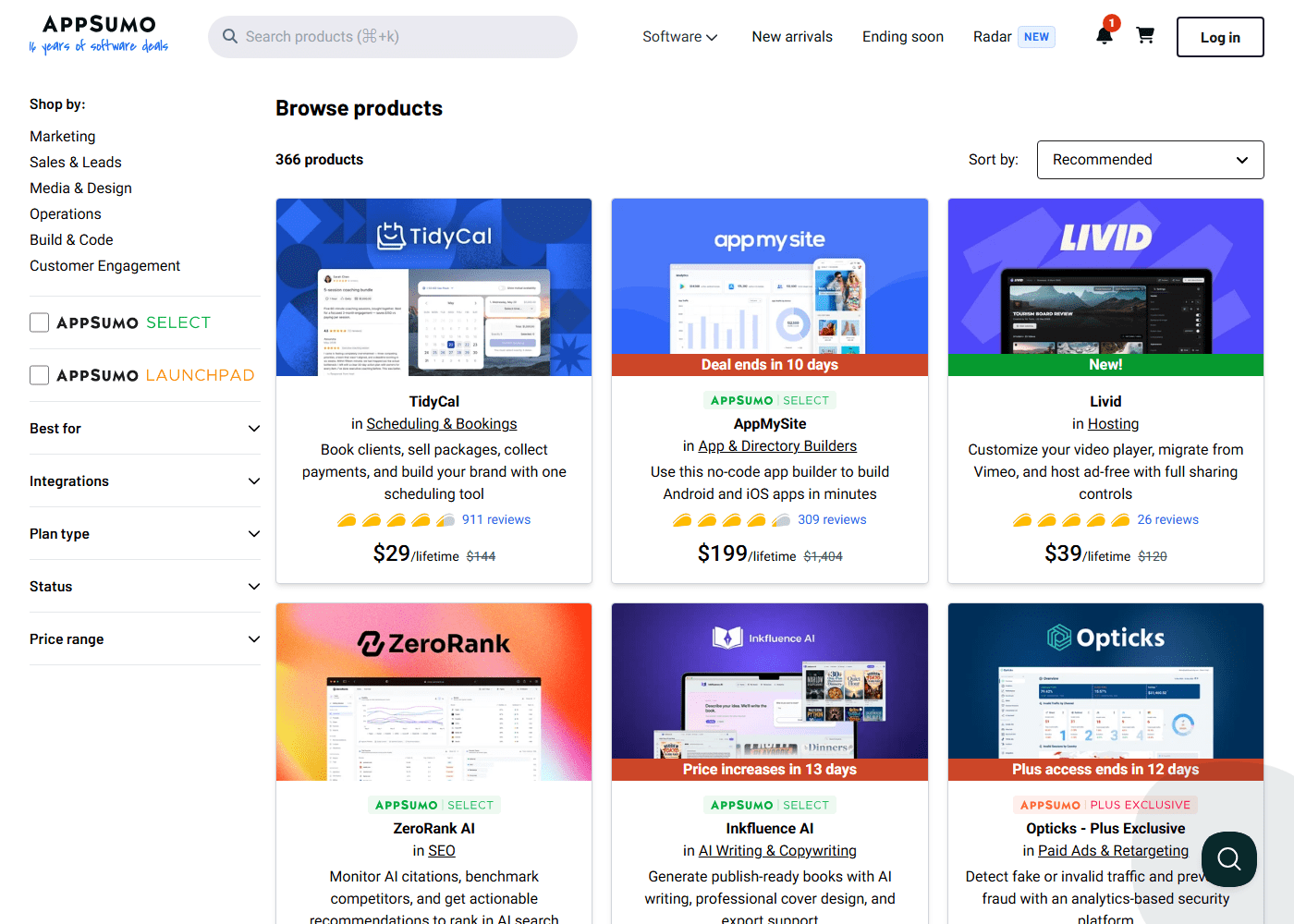
SEO deliverables. The audit-and-visibility stack at white-label tiers produces branded site audits at $300 to $800 each, plus monthly rank-report retainer lines. Then the genuinely novel one: AI-search visibility reports via ZeroRank-class multi-brand tiers, which most competing agencies cannot yet offer at any price.
Support-as-a-service. The doc-bot agency play retails at $100 to $300 monthly per client. A bot trained on the client's corpus, with the training sprint itself billable. A white-labeled widget. A monthly insight report from the unanswered-question log.
Web properties. Multi-site builder tiers convert client sites from cost to margin. The AppMySite-class app conversion is a $1,500 to $3,000 deliverable riding a $199 license.
Content operations. The repurposing and writing stack at agency tiers powers content-retainer packages. The client's monthly long-form asset becomes their platform-native fragment calendar, and your delivery cost is mostly the editing pass.
Reporting and dashboards. Time-tracking and analytics tools with client-visible surfaces turn transparency itself into a differentiator.
The catalog's construction rule is uniform across categories. The license must survive white-label diligence. The deliverable must survive a real client's scrutiny inside the guarantee window. The pricing must reflect the outcome's value, not the tooling's cost.
That last one matters most. The whole inversion collapses if you pass the savings through instead of banking the margin. Clients buy outcomes. The shelf just stopped charging you rent on producing them. 🏷️
🎁 Stack Your First Agency Tier — 10% Off →
White-Label Diligence: The Checklist That Protects Your Brand 🔍
Agency purchases carry a diligence layer no other buyer needs. The tool wears your brand in front of their stakeholders, and a leak in the white-labeling is a professionalism incident you cannot refund.
Check one: white-label completeness, verified not assumed. The tier chart says "white label". Week one confirms what that means in practice. Check the client-facing widget, the report PDFs, the notification emails, the login page, the URL structure.
Any surface showing the vendor's brand to your client is a gap. Catalog every one before the first client deployment. "Mostly white-labeled" is a phrase you discover in front of a client.
Check two: workspace isolation. Client data must be cleanly separated across access, exports and deletion. Your contracts almost certainly promise it. Test the isolation in week one by attempting to leak yourself across workspaces.
Check three: the offboarding path. Clients leave, and the tier chart never mentions what leaving looks like. Can a workspace be exported and handed over, deleted cleanly, or transferred? Know before the first engagement ends, not after.
Check four: vendor pulse at double weight. Your deliverables' reliability rides the vendor's survival, and an agency's sunset exposure multiplies across every client on the affected tool.
So the changelog check, the parallel-revenue check and the Select-badge preference all carry agency multipliers. The category guides' red flags are disqualifying here, not merely cautionary.
Check five: capacity math against the roster's growth curve. Project eighteen months of client wins and stack during the campaign. Agency tiers after the campaign revert to exactly the per-client pricing you escaped.
The checklist runs in a week inside the guarantee window. Your brand is the agency's whole balance sheet. The checklist is its insurance. 🛡️
📊 10-client roster, 3 years: per-seat vs stacked ownership
Client #11 costs the left column more. It costs the right column nothing.
The Client-Lifecycle Stack: Agency Operations, Owned 🔄
Beyond deliverables, your own operating spine converts on the same economics. Organise it by the client lifecycle.
Acquisition. The CRM at stacked seats runs the pipeline. TidyCal books the discovery calls. Proposal-and-e-sign tools close. It is the freelancer core stack, sized up.
Delivery. The PM tool's client-guest tiers give every engagement a visible board, which is the transparency clients cite in renewals. Time tracking feeds both invoices and the margin analysis agencies chronically skip. The meeting-capture layer turns every client call into a logged, summarised, action-itemed record. Nobody prices that dispute-prevention until they need it.
Retention. The reporting cadence rides the white-label dashboards. The support bots generate their monthly insight reports. The proof machinery harvests testimonials at project close, feeding your own acquisition loop.
Assembly economics at agency scale. The full lifecycle stack — CRM, PM, tracking, capture, proposals — stacks to team-and-client capacity for $400 to $700 one-time. Per-seat equivalents bill that quarterly at even five people and ten clients.
Sequencing follows the standard cascade with one agency modification. Deliverable-producing tiers first, because they bill immediately. Lifecycle spine second, because it compounds quietly.
Activate the Plus membership from purchase one rather than deferring it. Agency volume clears the four-purchase threshold in the first quarter. The 10% rides every stacked tier. The extended-buy windows matter most to the buyer whose diligence checklist takes a full week.
The agency is the one profile for whom Plus is simply correct on day one. 📈
Scaling the Team on Owned Rails 🧑🤝🧑
The roster is one multiplier. Headcount is the other, and the stacked model changes hiring economics in ways worth pricing before your next contractor conversation.
On per-seat rails, every hire triggers a software cascade. The PM seat, the CRM seat, the reporting login, the time tracker. That adds $60 to $120 monthly per head across a typical agency stack.
The tax quietly shapes staffing decisions. The overflow contractor kept outside the systems, and outside visibility. The junior hire deferred a quarter. The seasonal surge handled by heroics instead of hands.
On stacked team tiers, the cascade is just a set of logins. The contractor joins the PM board and the tracker for the project's duration. The junior gets full-system access on day one. Surge staffing becomes purely a labour decision, which is what it always should have been.
The onboarding dividend rides along. Tool sprawl is historically an agency's worst first-week experience.
The owned stack's challenger-tool simplicity — the four-capability PM, the ceremony-free CRM — compresses orientation from days to hours. That is the family-and-staff logic the small-business guide documents at smaller scale.
Offboarding is the moment agencies handle worst, and it becomes clean too. Access revoked per system in minutes. No shared-login password scrambles. No orphaned per-seat charges billing for departed humans, which was the subscription era's most embarrassing recurring audit finding.
Team scale was the second place the per-seat model taxed growth. The stack retires both taxes with the same purchase. That is why the capacity math projects headcount alongside the roster. Buy the team you are building, not the one you have. 🚀
Timing and the Sell-Out Asymmetry ⏰
Agency buying carries the platform's sharpest timing pressure, and the mechanism deserves stating plainly. Top tiers sell out first, and agency tiers are the top tiers.
On hot campaigns the Tier 4s and 5s empty while Tier 1 lingers. Those are the white-label, multi-workspace, agency-defining configurations, and every agency reading the same deal page needs the same capacity. At Black Friday, where encore deals return at the year's floor prices, that sell-out race concentrates into days.
So agencies run the golden-window rhythm compressed. Diligence starts day one of a relevant campaign, not day four. The white-label checklist runs during the truth window rather than after it. Decisions execute early in the window rather than late.
Plus membership's extended-buy windows and members-only early access exist for precisely this buyer, with precisely this problem.
The annual calendar sharpens the same way. Agency wishlists build from September with roster growth projected. Black Friday executes the deferred capacity purchases in one sweep. The January quiet season runs the stack audit.
That audit checks every tier's utilisation against the client count, flags gaps for the year's campaigns, and re-prices the deliverable catalog against what last year's engagements actually billed.
Its output doubles as sales planning. Underutilised tiers are deliverables your pipeline should be pitching. The gap list is next year's campaign-watching brief. That closes the loop between what you own and what you sell.
One more timing note. Buy capacity ahead of the pitch, not behind the win. The agency that owns the audit tool pitches audits. The one that plans to buy it after the client signs pitches hesitantly, and loses to the first one.
Owned inventory is pitch confidence, and campaigns do not wait for your sales cycle. The asymmetry cuts both ways. It is also why the agency that moves this quarter owns capacity its competitors will price monthly forever. ⚡
A Worked Engagement: One Retainer on Owned Inventory 📔
Concreteness closes arguments, so here is a representative engagement assembled entirely from stacked licenses, margin math visible.
The client: a twelve-location service brand wanting local visibility and responsive customer touch.
The proposal, priced on outcomes: $1,400 setup covering a site audit, local SEO baseline and support-bot training on their corpus. Then a $650 monthly retainer. It covers rank and AI-visibility reporting, plus bot management with the monthly insight report. Add a review-velocity program and a content-repurposing calendar from their existing video assets.
Here is the delivery inventory behind it. The white-label audit stack at $138 stacked. The doc-bot agency tier at $158 stacked. The repurposing engine at $79, and the review machinery at $59. That is $434 of licenses, all owned before this client existed, all serving the rest of the roster simultaneously.
The engagement's software cost column reads zero, because the licenses were sunk inventory. So the retainer's margin is labour-only, and the labour is precisely what the tools compress.
The audit generates in minutes and gets an hour of expert annotation. The bot's insight report assembles itself from logs. The repurposing calendar is an editing pass on machine output.
Net delivery time: six to eight hours monthly against $650. The per-seat era's software tax would have cut that effective rate by a third.
Multiply across a roster and the inversion's full shape appears. The same $434 of inventory backs every comparable engagement signed this year, next year and after. The incumbent-tooled competitor re-buys their capacity monthly, client by client, forever.
One engagement paid for the inventory three times over. The rest is spread. ✍️
Verdict: The Platform's Highest-ROI Buyer 🏆
The consolidated verdict. Agencies extract more value per AppSumo dollar than any other buyer class, because white-label and multi-workspace tiers multiply across client rosters and headcount simultaneously.
Roughly $600 of stacked licenses replaces five figures of per-client tooling over three years. Meanwhile the deliverable catalog — audits, bots, sites, dashboards, content operations — converts each license into billable inventory at zero marginal cost per engagement.
The price of admission is the agency diligence layer, run without shortcuts. White-label completeness verified surface by surface. Workspace isolation tested by attempting to break it. Offboarding mapped before the first engagement ends. Vendor pulse weighted double. Capacity stacked against the roster's eighteen-month curve.
All of it inside the guarantee window, all before the first client deployment carries your brand. The timing rules are compressed but simple: agency tiers first, campaigns early, Plus from day one, Black Friday planned from September.
Start with the deliverable your pipeline already wants to sell. The audit, the support retainer, the app conversion.
Take its category's current agency tier, check it against the five-point list, and use the discount below. One client engagement covers the license. Every engagement after is the margin the per-seat era was quietly keeping. 🌮
A closing note on the competitive window, framed honestly.
The stacked-inventory model is not a secret. Every agency reading this series sees the same math. But adoption lags badly behind awareness, because established agencies carry incumbent-tool inertia, procurement habits and team retraining costs that a leaner competitor does not.
That lag is the window. The agency that converts this year pitches AI-visibility reports and managed support bots at margins the incumbent-tooled competitor literally cannot match. By the time tooling norms catch up, the early mover's client relationships are already compounding.
Arbitrage windows in service businesses close through competition, not expiry. This one is open, measurably, now. The shelf's campaigns are the clock. ⏳
🎁 Get 10% Off First Order with Email Sign Up →
FAQ ❓
How does code stacking work for agencies?
Buying multiple codes of a deal unlocks higher tiers — white-label rights, multi-workspace capacity, team seats — during the live campaign only. Two to three codes ($118–$207 typical) carry a ten-client roster with room to grow; post-campaign expansion reverts to exactly the per-client pricing the stack escaped. Full mechanics in the stacking guide.
What's the essential agency diligence beyond normal checks?
Five points, all verified in week one inside the guarantee window. White-label completeness on every client-facing surface: widgets, PDFs, emails, login pages. Workspace isolation, tested by attempting to cross it. The client-offboarding path, mapped before the first engagement ends. Vendor pulse weighted double. And capacity stacked against eighteen months of roster and headcount growth.
Which deliverables should an agency productize first?
Whatever the pipeline already wants to buy. SEO audits at $300 to $800 each, riding white-label audit tiers. Managed support bots at $100 to $300 monthly per client. Client sites and $1,500-plus app conversions. Or content-repurposing retainers built on the client's existing assets. One engagement covers each license. Every engagement after is spread.
Is AppSumo Plus worth it for agencies?
From day one, uniquely among buyer profiles. Agency volume clears the four-purchase threshold in the first quarter. The 10% member discount rides every stacked tier's larger tickets. And the extended-buy windows plus early access matter most to exactly this buyer: the one racing agency-tier sell-outs with a week-long diligence checklist to run.
What if a tool my clients depend on sunsets?
The agency multiplier cuts both ways, which is why vendor-pulse checks are disqualifying-grade here and Select badges near-mandatory. Keep quarterly exports per workspace, and the worst case becomes a managed migration, not a client crisis.
How do I price deliverables built on cheap licenses?
On outcome value, never on tooling cost. The $500 audit is worth $500 because of what it finds and what your annotation adds, regardless of the $138 license behind it. Passing the savings through instead of banking the margin defeats the entire inversion.
Can a solo freelancer use the agency playbook?
Yes, the moment client-facing resale is plausible within eighteen months. The freelancer guide's growth-option logic is this playbook's on-ramp. One stacked tier plus one productized deliverable is a one-person agency in every way that matters.
When should agencies buy?
Early in campaigns, because agency tiers sell out first. Start diligence on day one rather than day four. Execute deferred capacity at Black Friday's annual floor, from a September wishlist. And always ahead of the pitch rather than behind the win, because owned inventory is pitch confidence and campaigns do not wait for sales cycles.
Related reading: Code stacking explained · Chatbot & support tools · SEO tools · Website builders · The buying guide

- Video Content in 2026: What the Engagement Data Shows - October 21, 2026
- Monetising a Channel That Uses AI: The Rules That Bite - October 21, 2026
- SEO or Paid Ads? The Cost-Per-Acquisition Data - October 18, 2026