
Plays in the language you are reading. Tap any paragraph to start from there.
Every startup hits the same slide eventually. The burn table. Monthly software costs stacked against months of runway, with the tool stack quietly eating a founder's salary.
Subscriptions were built for companies that have revenue. Startups sign up before they have any. You convert scarce runway into someone else's MRR, in the exact months survival matters most.
This guide is the other way to do it. How pre-revenue teams run real operations on AppSumo's free tiers. How lifetime deals turn a burn-rate line into a one-time cost. The launch stack under $500 that covers your go-to-market spine. And where the shelf honestly stops working.
Most founders start where every buyer does: the 10% first-order discount. For a startup, that saving is measured in weeks of life. ⏳
🧾 Key Takeaways
| Question | Short answer |
|---|---|
| Why LTDs for startups? | Recurring burn becomes one-time capital; runway extends measurably |
| Pre-revenue play | Free tiers (TidyCal, SendFox) run real operations at $0 |
| The launch stack | Site, email, CRM, support, analytics — under $500 one-time |
| Runway math | $250/mo of tool burn = ~1 week of runway per month at seed scale |
| When to switch | Venture-scale credits and enterprise needs have their own rails |
| First move | 10% off your first order 🎁 |
The Runway Math: Burn Lines vs Capital Lines 📉
Startup software deserves startup math. So let me run the numbers the burn table hides.
A modest early stack covers site, email, CRM, support, analytics, scheduling and content. At incumbent pricing that runs $200 to $350 a month. Call it $2,400 to $4,200 a year of pure burn, spent while revenue is zero.
Now frame it as runway. A two-founder team burning $12,000 a month loses roughly one week of life per month to the tool stack alone. Unlike salaries or hosting, that burn buys commodity functions. The lifetime versions cost one to two months of the subscription price. Once.
Convert the stack and those same functions become a $400 to $500 capital line. Under half a week of burn, paid a single time. Your recurring table loses its ugliest discretionary block.
The deeper argument is optionality.
Recurring costs punish pivots. Change direction and you eat the unused annual plans, the per-seat commitments, the integration work you already paid for. One-time licenses pivot free. The 60-day guarantee covers the near-term misjudgments, and a $59 tool you abandon cost you $59.
Structurally, the lifetime model fits startup uncertainty. Pay when you have conviction. Own it through the chaos. Let the roughly 1-in-10 sunset odds be someone else's actuarial problem, because they are trivial next to your own mortality curve.
Founders hedge everything else. The tool stack was always the cheapest hedge available. 📐
Phase Zero: The $0 Operating System 🆓
Before you buy anything, give the freebies shelf your full attention. A pre-revenue team can run a genuinely working operation at zero software cost. You should, as a discipline as much as a saving.
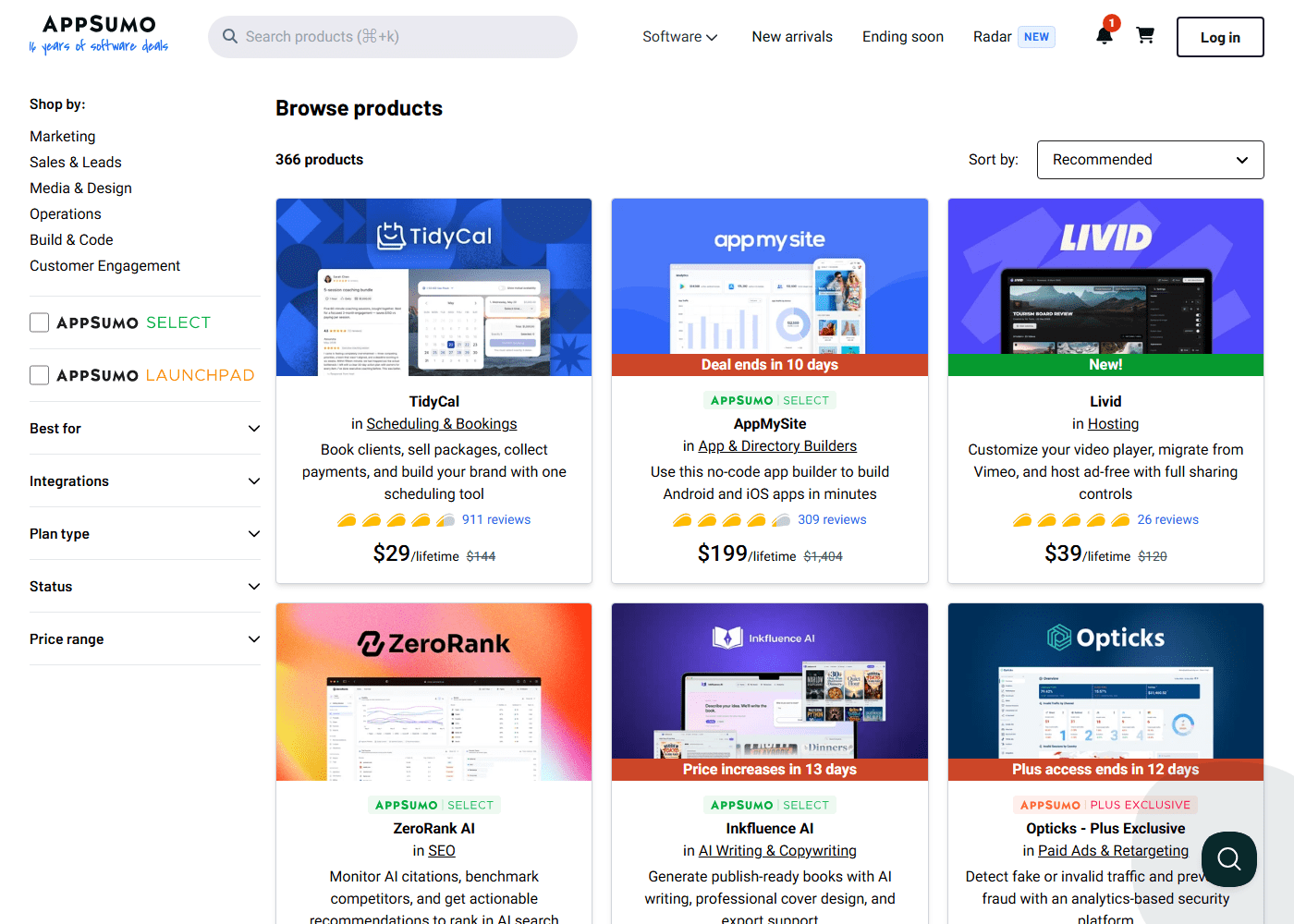
Here is the core. TidyCal's free tier books the customer-discovery calls that are a pre-launch startup's actual job. SendFox's free tier collects the waitlist and sends the launch updates. The e-sign freebies handle your early agreements.
Then there is the rotating giveaway layer, announced through the same email list that carries the 10% offer. It drops real licenses into the pile periodically.
The free stack's caps on volume, branding and automation sit comfortably above validation-stage needs. The freebies guide maps them honestly. Graduation moments arrive with your own traction data attached.
The discipline argument outweighs the savings. A startup that cannot validate on free tiers is usually not blocked by tooling. The constraints expose the difference.
Reaching for a $99-monthly marketing suite before your first hundred waitlist signups is optimizing the wrong layer. The free tier's ceiling is the milestone list. Outgrow the send cap and you have a list worth emailing. Outgrow the booking types and you have a calendar worth structuring.
My own quarter on the free stack ran client validation at literal zero. The pattern generalizes. Phase zero costs nothing, teaches the usage patterns that make every later purchase precise, and banks the first-order discount for the graduation traction earns.
Runway spent on tools before validation is runway spent guessing. Don't guess. 🎯
🎁 Bank the 10% for Graduation Day →
The Launch Stack: Go-to-Market Under $500 🏗️
Traction arrives, phase zero's ceilings bite, and the launch stack assembles. This is the startup-weighted version of the architecture used across this series.
Presence: the hosted builder at $59 to $99, plus a landing-page tool at $49 for the launch pages and variants you ship weekly. Speed-to-page is a startup metric, and owned tools make iteration free.
Pipeline: the CRM at Tier 1-to-2 at $49 to $99, the day your first ten prospects exist. Early customer conversations are your most valuable dataset, and inbox archaeology destroys them.
Voice: the email platform's lifetime tier as the waitlist becomes a launch list. Add the AI writing license at $49 to $69 so two people can publish like a content team.
Ears: the support doc-bot at $59 to $79, trained on your young docs. Its unanswered-question log is product-discovery instrumentation. Then the capture layer turns every customer call into searchable record.
Total at current shelf prices: $380 to $480, one time, for the complete go-to-market spine. The incumbent version bills $200 to $350 every month. The stack pays for itself before the second month closes, then hands back a week of runway every month, permanently.
Sequencing follows traction, not ambition. The standing rule applies: each purchase triggered by a free-tier ceiling or a logged bottleneck, each golden window timed, each day-45 audited.
Startups just run it faster. Week-two usage data is decisive, and pivots refund without sentiment. The 10% discount lands on your largest ticket, and the whole build fits inside one focused month. 🚀
📊 18-month tool cost: subscription burn vs launch stack
The delta is roughly two weeks of seed-stage runway — returned annually.
Investor Optics: What the Owned Stack Signals 📑
There is a subtler dividend if you are raising. Your tool stack shows up in diligence, and what it says about the team matters more than founders expect.
A burn table with a lean, one-time-capitalized operations line signals a team that treats money as runway rather than budget. Early-stage investors screen for that instinct, and they read it fluently from expense structure.
A $250-monthly subscription block reads as default behaviour instead. Not disqualifying. Just not the operational-discipline story either.
At pre-seed scale every signal gets scrutinised. "We run go-to-market on $450 of owned licenses and spend the difference on growth experiments" is a sentence that lands. I have heard versions of it land, in rooms where it mattered.
The signal compounds inside the data room. An owned stack produces a one-page tool inventory: license, cost, function, custody. That is the small-business sellability logic at startup scale.
Compare it to the subscription sprawl audit most startups submit, complete with duplicate tools and orphaned seats nobody can explain.
None of this is a reason to buy anything. Optics follow substance, and the substance is the runway math. But it is a reason not to dismiss the stack as beneath investor attention.
Capital efficiency is the era's fundraising theme, and the tool stack is its cheapest demonstrable proof. Founders who can narrate theirs in one confident paragraph usually have the rest of the operational story straight too. The stack is small. What it evidences is not. 🎤
The Honest Boundary: Where Venture Rails Take Over 🛤️
Every category in this series has an incumbent minority, and the startup boundary deserves the sharpest drawing. Funded startups have an alternative no other buyer class enjoys: the venture credit ecosystem.
Cloud platforms, payment processors and enterprise SaaS vendors hand funded teams five- and six-figure credit programs. That is genuinely free enterprise infrastructure for one to two years. If you have institutional backing, harvest those programs fully before this guide's economics even apply. The alternatives survey covers the landscape.
The second line of the boundary matters more. Core product infrastructure never comes from the deals shelf. Your production database, auth system, payment rails and anything touching customer data or money runs on boring, SLA-backed, enterprise-supported infrastructure at whatever it costs.
The lifetime shelf furnishes the go-to-market and operations spine. Never the product's load-bearing walls.
Here is the synthesis most funded founders miss. The strategies stack rather than compete.
Venture credits cover the infrastructure layer. The lifetime stack covers the commodity operations layer credits never touch, including scheduling, content, support and CRM. The burn table thanks both.
Meanwhile the bootstrap majority, which is most startups, runs this playbook without the asterisk. Their runway math has no venture cushion, and the week-per-month tool tax is real survival time.
Know which startup you are. Harvest what your position offers. Let the shelf cover what it covers best either way: the generic spine, owned, at capital prices. This is a sorting question, not a warning. 🧭
The Team Question: Co-founders, Contractors, and Early Hires 👥
Startup teams change shape monthly, and the shelf's tier economics handle that churn better than anything else. Plan around it explicitly.
A co-founder joins. On subscription rails that is four or five new seats billing immediately. On the launch stack it is just logins, because the Tier 2 CRM and PM configurations you already bought cover the second and third human.
Your first contractor arrives for a three-month sprint. The per-seat model bills them like a permanent employee, and offboarding forgets to cancel. The owned stack grants and revokes access at zero cost in both directions.
Early hires land after launch. Stacked seats bought during campaigns at $40 to $60 per capacity jump absorb them. The incumbent cascade would charge $60 to $120 monthly per head. That is a hiring tax retired before the hiring starts.
Which produces the startup planning rule. At every purchase, buy for the team your eighteen-month plan hires, not the team standing in the room.
Plans miss. The guarantee and the modest tier deltas price that miss at lunch money. Under-buying prices it at post-campaign upgrade rates, exactly when you are scaling and busiest.
One governance note young teams skip until it hurts. Put every license on a company account with shared credential management from day one. The departing-cofounder scenario is unpleasant to imagine and operationally trivial when the licenses live with the company. It is miserable when they live in someone's personal email.
Owned tools deserve owned custody. Two minutes of setup. One awkward scenario, pre-solved. 🔑
Speed as the Startup's Edge on This Shelf ⚡
One startup property inverts a standing rule of this series, so it gets its own flag.
Every category guide preaches patience: golden windows, deferred purchases, Black Friday wishlists. Startups run on compressed clocks. For you, the shelf's speed matters more than its price floors.
Instant deployment: lifetime licenses activate in minutes. A launch-week team can assemble its entire missing spine in an afternoon. No procurement, no sales calls, no annual contracts, no waiting on an onboarding cohort.
Experiment velocity: owned tools make every growth experiment free at the margin. The fifth landing variant. The new outreach sequence. The podcast trial. Startup learning rate is a function of experiment count, and the behavioral dividend this series keeps recording is, for you, the actual product.
The guarantee compresses beautifully too. Sixty days is a startup epoch. Long enough to validate a tool against a full growth cycle, refund the misfits from a pivot, and re-buy for the new direction, all inside one window.
So here is the timing synthesis. Use the golden-window rhythm when the calendar allows, because the discipline is free. Never let deal-timing optimisation delay a launch-critical capability.
The deals-end-forever rule and your own clock both argue for decisiveness. A week of launch delay costs more than any campaign's price delta. Veterans optimise price. Founders should optimise time, and the shelf happens to sell both. 🏎️
A Founder's Log: Phase Zero to Launch Stack, Six Months 📔
Here is the composite log this method produces, drawn from my own validation quarter and the founder conversations that shaped this series.
Months one and two, phase zero. Discovery calls booked through TidyCal's free tier: forty-one conversations, zero software cost. The waitlist grew on SendFox free, with the send cap comfortably distant at 300 subscribers. Agreements signed on freebie e-sign. The only spend was a domain.
The free stack's quiet contribution was that the caps were the metrics dashboard. Every ceiling approached was traction measured.
Month three, the first graduations. The waitlist crossed the send comfort zone the same week landing experiments demanded variant velocity. So the email lifetime tier at $49 and the landing tool at $49 converted together. Eighty-nine dollars total, both ceilings gone permanently.
Months four and five, the pipeline phase. The first paying conversations earned the CRM at $59. Its week-two verdict came down to one recovered follow-up that became customer number six. The writing license at $69 let a solo founder ship the content cadence the launch needed.
Month six, launch month. The doc-bot at $79, trained on the young docs, caught launch-week questions around the clock. Its unanswered-question log rewrote the onboarding flow twice in a fortnight. Product discovery, free, out of support instrumentation.
Total six-month software spend: $345. The subscription equivalent runs $1,400-plus and keeps climbing into month seven, forever.
The runway delta funded the launch ads. The ownership funded the calm. Both showed up in the metrics that mattered. ✍️
Verdict: The Pricing Model Startups Deserved All Along 🏆
The startup verdict, compressed. The lifetime model converts your tool stack from recurring burn into one-time capital, returning roughly two weeks of seed-stage runway a year. Free tiers run the pre-revenue phase at literal zero, and the guarantee absorbs pivot-driven misjudgments.
The launch stack under $500 covers the complete go-to-market spine. The venture-funded minority stacks credits on infrastructure while running this playbook on operations. Your product's load-bearing walls stay on enterprise rails regardless.
The startup edge is speed: instant assembly, free experiments, and a guarantee window that outlasts most pivots. The discipline is the same bills-and-traction gating that runs every stack in this series, just at startup tempo.
Phase zero starts tonight: the free tiers, the 10% banked, the discovery calls booked on a $0 scheduler. The launch stack waits for traction, and traction, when it comes, will find the shelf ready in an afternoon. The subscription era taught startups to rent their own go-to-market. Own it instead — you are going to need the runway. 🌮
A final reframe for the founder who reads savings guides as a distraction from the real work. That is a fair instinct, mostly.
This one is not about the money. $450 against $4,500 is real, but it is small next to your actual risks.
It is about what the burn table does to decision-making. Every recurring line is a monthly re-justification, a background negotiation with the runway, a quiet vote for caution in a business that dies of caution.
The owned stack removes that whole category of negotiation permanently. The tools are paid. The experiments are free. And your decision budget spends where it should.
Startups fail from running out of money, but they stall from running out of decisiveness. The shelf, oddly, sells both fuels. Fill up once. 🛢️
🌮 Browse Startup-Ready Deals →
🎁 Get 10% Off First Order with Email Sign Up →
FAQ ❓
Should a pre-revenue startup buy anything on AppSumo?
Mostly no — run phase zero on the free tiers (TidyCal, SendFox, e-sign freebies) and let traction's ceilings trigger purchases. The discipline is worth more than the savings, and the 10% offer banks for graduation day.
How much runway does the lifetime stack actually save?
A $250-monthly subscription stack costs roughly a week of runway per month at typical seed-stage burn rates. The $450 launch stack pays for itself before the second month closes and returns that week monthly, permanently — about two weeks of extra life per year.
What should never come from the deals shelf?
Core product infrastructure — database, auth, payments, anything touching customer data or money. Those run on SLA-backed enterprise rails. The shelf covers the go-to-market and operations spine.
Do venture credits make AppSumo irrelevant for funded startups?
No — the strategies stack rather than compete. Credit programs cover cloud and enterprise infrastructure the shelf never sold; the shelf covers the commodity operations spine (scheduling, content, support, CRM) that credit programs universally exclude. Funded teams harvest both and their burn tables thank them twice.
How does the guarantee interact with pivots?
Generously. Sixty days outlasts most pivot cycles. Tools bought for the old direction refund cleanly while the new direction's needs re-buy. That is the pricing model's uncertainty-alignment working as designed.
Should startups wait for Black Friday like other buyers?
Only for deferrable capacity. Launch-critical capabilities buy now — a week of launch delay costs more than any campaign delta, and startup time beats deal timing every round.
How should a startup team manage license custody?
Company account from day one, with credentials in shared founder custody. The departing-cofounder scenario is trivial when licenses live with the company. It is miserable when they live in personal email. Two minutes of setup, one awkward scenario pre-solved.
What if we pivot after building the stack?
The stack mostly survives. Scheduling, email, CRM, support and content serve any direction. The direction-specific misfits refund inside the 60-day window, or write off at $59-grade prices. One-time licenses are the pricing model aligned with uncertainty. That is the whole thesis.
Related reading: Freebies guide · For freelancers · Lifetime vs subscription · The buying guide

- Video Content in 2026: What the Engagement Data Shows - October 21, 2026
- Monetising a Channel That Uses AI: The Rules That Bite - October 21, 2026
- SEO or Paid Ads? The Cost-Per-Acquisition Data - October 18, 2026