
Plays in the language you are reading. Tap any paragraph to start from there.
CRM pricing runs on the industry's most cynical unit. The seat.
Every teammate who needs to see a customer record becomes a monthly line item. Every growth hire raises the software bill before they close their first deal.
And the incumbent platforms' famous "free tiers" are engineered runways onto exactly this treadmill.
Free until your data, workflows and muscle memory are captive. Then $15 to $65 per user per month, forever.
I ran a three-seat sales operation on that treadmill for a year. $87 monthly and climbing.
This guide is the full exit map. New buyers start with the 10% first-order discount. On multi-seat tier purchases it earns its keep instantly. 📊
🌮 Browse CRM and Sales Deals →
🧾 Key Takeaways
| Question | Short answer |
|---|---|
| Why CRM LTDs? | Per-seat pricing taxes team growth; lifetime tiers end it |
| Typical deal shape | $59–$99 lifetime, tiered by users/contacts, Sales & Leads shelf |
| Per-seat escape math | 3 seats × $29/mo = $1,044/yr vs ~$138 stacked once |
| What challengers do well | Pipelines, contacts, deals, email sync, automation |
| Incumbent moat | Enterprise ecosystems, app marketplaces, admin bureaucracy |
| Migration time | ~5 hours from an incumbent, ~1 hour from a spreadsheet |
| First move | 10% off your first order 🎁 |
💺 Per-Seat Pricing: The Growth Tax on Teams
Understand the mechanism precisely. It is subtler than the subscriber tax email runs.
CRM vendors price per user per month. That sounds proportionate until you examine what a "user" actually consumes.
The fourth teammate added to a CRM does not cost the vendor a fourth server. Marginal cost per seat rounds toward zero.
But they pay the full seat rate anyway.
More importantly, the pricing converts your hiring plan into the vendor's revenue forecast.
| Who you add | What they do | What you pay |
|---|---|---|
| Part-time VA | Updates records twice a week | Full seat |
| Bookkeeper | Read-only on deal values | Full seat |
| Summer intern | Three months of data entry | Full seat |
| Contractor | One quarter of outreach | Full seat |
The model's genius is that headcount is the one number growing companies cannot minimise.
Gating visibility of your own customer data behind per-head tolls means the bill scales with your ambition rather than your usage.
The free-tier runway completes the trap
The incumbents' generous free plans capture early-stage teams precisely because migration pain compounds with data depth.
Every contact enriched. Every pipeline stage customised. Every automation built. Another strand of the web.
Then you cross the free threshold. Users, contacts, or the one critical feature held hostage.
The meter starts against an operation now too entangled to leave cheaply.
The lifetime shelf's answer is structural.
Challenger CRMs sell tiers by user count bands at one-time prices. Tier 1 for solo operators. Tier 3 for five-to-ten-seat teams. Stacked codes scaling beyond.
That converts the growth tax back into a capital purchase.
My three-seat escape ran $138 in stacked codes, against the $1,044 the treadmill billed annually.
The lifetime-vs-subscription math was never more lopsided than in this category. 🪤
✅ What Challenger CRMs Actually Deliver
Strip the enterprise theatre from CRM and the job description is short.
Keep every contact and conversation findable. Show the pipeline's truth at a glance. Nag the right person at the right moment. Sync with the inbox where selling actually happens.
The challenger CRMs cycling through AppSumo's Sales and Leads shelf deliver precisely this core.
| Capability | Coverage | Verify |
|---|---|---|
| Visual pipeline boards | Universal | Stage customisation |
| Contact and company records | Universal | Activity timelines |
| Two-way email sync | Make-or-break | Your specific provider |
| Task and follow-up automation | Common | Trigger flexibility |
| Deal-value reporting | Common | "What closes this month" |
| AI enrichment and drafting | Increasing | Credit metering |
Two-way email sync is the feature that separates real CRMs from glorified spreadsheets. Verify it supports your mail provider in the tier chart, not the feature list.
What challengers do better than incumbents
It is the part nobody expects. Absence of bureaucracy.
The enterprise platforms carry permission hierarchies, admin consoles, mandatory fields and workflow approval layers built for hundred-seat compliance.
Small teams pay for that friction twice. In seat fees, and in every record update that takes four clicks too many.
A challenger built for the five-seat world does the same job with a fraction of the ceremony.
Which is why my team's usage went up after migration. The tool stopped charging attention tolls.
The honest gaps run the other direction. Deep ecosystem integrations, marketplace apps and territory-management complexity remain incumbent territory.
The minority running revenue operations across departments should stay there.
The sorting question: does your sales motion need a pipeline or a bureaucracy? The shelf serves the first kind completely. 🎛️
🎁 Escape Per-Seat Pricing — 10% Off First Order →
🔍 Reading a CRM Deal Page: Five Checks
CRM deals reward a category-specific diligence layer on top of the standard buying rules.
This purchase carries your customer data's future.
| Check | What to confirm | Disqualifying if |
|---|---|---|
| 1. Seat and contact math | Both dimensions vs 18 months | Either curve outruns the tier |
| 2. Email sync depth | Two-way, your provider | "Email integration" only |
| 3. Import and export | CSV in, full data out | Export is partial |
| 4. Vendor's own sales motion | Real subscriptions elsewhere | LTD-only existence |
| 5. Review patterns | Search "sync", "import", "slow" | Recurring sync complaints |
Check one: the seat-and-contact tier math. Tier charts here meter two dimensions — users and contact records.
The trap is clearing one while tripping the other. Project both along your eighteen-month hiring and list-growth curves.
Stack codes in-campaign if either curve is steep. Post-campaign seat expansion reverts to exactly the per-seat economics you came here to escape.
Check two: email sync depth. The questions tab almost always contains someone asking about your specific setup.
Read the founder's answer, and its date.
Check three: import and export honesty. Your data must enter easily. CSV import with field mapping, at minimum.
And — this is the one buyers skip — it must leave easily too.
Export quality is your insurance against both product sunset and your own future migration. Test a full export inside week one.
Check four: the vendor's own sales motion. A CRM vendor selling subscriptions outside AppSumo at real prices has proven the infrastructure economics.
A CRM existing only as an LTD is betting your pipeline on campaign revenue.
Check five: category-specific review patterns. Search the reviews for "sync", "import" and "slow" — the three words where CRM disappointments cluster.
Recurring sync complaints are disqualifying. A CRM that misses emails is worse than no CRM.
Run the five checks in fifteen minutes. Let the 60-day guarantee underwrite the residual. 📋
💸 3-year CRM cost: per-seat treadmill vs stacked lifetime (3-seat team)
And the treadmill column grows with every hire; the lifetime column doesn't.
📈 What each new hire costs you, by model
🚚 Migration: From Spreadsheets or From Capture
CRM migrations divide into two species with opposite anxieties.
From spreadsheets — the majority path
Easier than feared. Your "CRM" is currently a contacts sheet, an inbox and guilt.
Which means there is no sync history to preserve. The migration is really an installation.
Export the sheet. Map columns to the importer's fields — one careful hour. Connect the inbox sync. Rebuild your pipeline stages from whatever column headers were pretending to be them.
The week-one wins are immediate and slightly embarrassing.
Follow-ups the sheet forgot. Deal values the sheet never totalled. An activity timeline making three months of inbox archaeology unnecessary.
Spreadsheet migrants should buy the moment the tier math clears. Every week of delay is unlogged pipeline.
From an incumbent — the captured path
This one needs the warm protocol.
Export everything the old platform allows. Contacts, companies, deals, notes.
Incumbents vary in export generosity, which is itself a lesson about the next platform's export check.
Import into the challenger during a parallel fortnight, where new activity logs in both. Verify the email sync against live threads.
Rebuild only the automations you actually used.
The migration audit reliably reveals that half the old workflow complexity was configuration archaeology nobody remembered building.
Cut over when a full week's activity lives correctly in the new system. Cancel the seats. Bank the first skipped invoice.
Both species share the closing ritual. A full export test of the new system inside the guarantee window.
The category's deepest lesson — your customer data must always have an exit — applies to the escape vehicle too. 🏗️
🧍 Solo Operators: The One-Seat Case
CRM guides chronically assume teams. Let me serve the reader the category ignores.
The solo freelancer or consultant, wondering whether a one-person operation needs a CRM at all.
The honest answer: you need the function before you think you do, and the shelf makes it nearly free.
A solo pipeline of even eight active conversations exceeds working memory's reliable capacity.
The follow-up you forgot is revenue that silently died.
And the standard solo workaround — inbox stars plus a notes app plus optimism — fails precisely at the moment of growth when its failure costs most.
A Tier 1 license at $59, or the free tier many challenger deals include, replaces that failure mode for less than one recovered deal's value.
The solo configuration takes an evening. Pipeline stages matching your actual motion: inquiry, call, proposal, won. Inbox sync. Follow-up reminders. Done.
The forward option
Your Tier 1 license is a cheap call option on your own growth.
If the operation stays solo, the license already paid for itself in recovered follow-ups.
If it grows, the campaign's stacking window upgrades seats at lifetime pricing. You skip the incumbent free-tier trap entirely.
Never entangled. Never taxed. Never migrating under pressure.
My own CRM life began exactly here. One seat, $59, three recovered deals in the first quarter that the spreadsheet era would have dropped.
The team came later. The habit came first, and the habit is the actual product. 🎯
🛞 The Owned Sales Stack: CRM as the Hub
A CRM alone is a filing cabinet. The shelf furnishes the full sales operation around it.
| Spoke | Job | Typical price |
|---|---|---|
| CRM hub | Pipeline, contacts, sync | $59–$99 |
| Lead capture | Forms, quizzes, magnets | $49–$79 |
| Scheduling | Booking link in every email | $29 |
| Outreach assist | AI drafting in your voice | $49–$79 |
| Proposals and e-sign | Closing documents | Free tier upward |
| Meeting capture | Calls become CRM notes | $49–$79 |
Lead capture: form builders, quiz funnels and lead-magnet tools feed the pipeline's top. GetLeadForms-class deals cycle regularly.
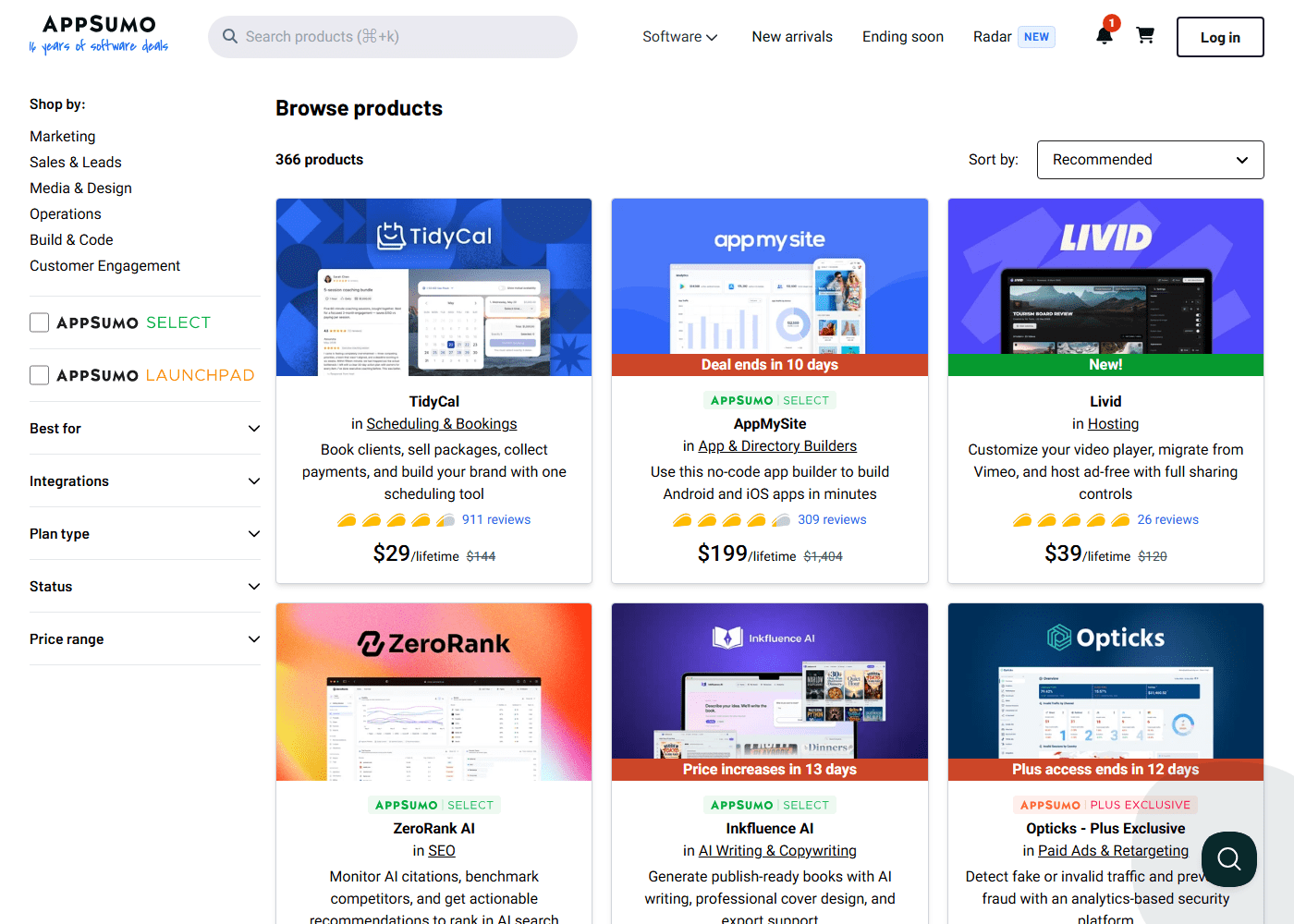
Scheduling: TidyCal at $29 puts the booking link inside every outreach sequence. The single highest-conversion integration a small sales motion owns.
Outreach assistance: the AI writing shelf drafts follow-ups against your voice. Sales-intelligence tools in the Substrata mould analyse conversation dynamics.
Proposals and closing: document builders and e-sign tools, often free-tier first, finish what the pipeline started.
Meetings: transcription tools from the AI stack's capture layer turn every sales call into logged CRM notes without typing.
Assembled at current shelf prices, the complete stack runs $250–$350 one-time. The subscription equivalent bills $150–$250 monthly at three seats.
Sequence by pipeline gravity. CRM first, because it is the schema. Capture second, because it feeds the schema. Scheduling immediately, because it is $29 and it converts.
Then outreach, proposals and meeting intelligence as campaigns permit.
Each spoke passes its own day-45 audit. Each replaced subscription funds the next purchase. The 10% first-order discount belongs on the stacked CRM tier.
The compounding here is operational as much as financial. Every spoke that plugs into the hub makes the hub's records richer, and richer records make every future sale slightly easier.
That flywheel used to bill monthly. Now it just spins. 🏁
📔 My Escape Log: Three Seats, One Quarter
The receipts, since this category's argument rests on them.
| Line | Number |
|---|---|
| Seats on the incumbent | 3 (me, salesperson, VA) |
| Monthly bill | $87, heading to $116 |
| Challenger tier bought | Five seats, stacked |
| Total paid | $138 once |
| Migration time | One Saturday morning |
| Fourth seat cost | $0 |
| Treadmill cost by now | $1,044 and rising |
I bought in week two of the campaign, after the five checks cleared.
Two-way sync confirmed for my mail provider, in the founder's own questions-tab answer. Export test noted for week one.
The migration consumed one Saturday morning. Export, mapped import, sync verification against that week's live threads.
Plus a pipeline rebuild that deliberately dropped two-thirds of the old automations. The audit revealed, as predicted, that most of the "workflow" was archaeological config nobody could explain.
Results, one quarter in
The fourth seat joined for $0. The tier absorbed them, and the hire decision never touched the software budget.
The growth tax's absence changed the very math it was designed to tax.
Team usage rose, because the challenger's four-click ceremonies became one-click.
The week-one export test passed, and gets re-run quarterly as standing data insurance.
The single surprise worth passing on: the day-45 review nearly voted refund over a mobile-app gap that mattered to my salesperson.
Until the changelog shipped the fix in week five. A live demonstration of why the founder-pulse check outranks the feature checklist.
Buy teams that ship. The features catch up. ✍️
🚫 When You Should Not Buy a CRM Lifetime Deal
I earn a commission here. That is exactly why this section exists.
If you run revenue operations across departments. Marketplace apps, territory management and ecosystem integrations are a genuine incumbent moat. Stay and pay.
If the reviews mention sync problems. This is the one disqualifying signal in the category. A CRM that misses conversations manufactures false confidence.
If the vendor has no subscription business. An LTD-only CRM bets your customer data's custody on campaign revenue alone.
If you will not test the export. Skipping that check is how a sunset becomes a data loss instead of an inconvenience.
If your contact list will outgrow the tier next year. Contacts and seats are metered separately, and clearing one while tripping the other is the classic mistake.
If you have no sales motion yet. A CRM organises a pipeline. It does not create one.
🏆 Verdict: The Category Where Ownership Means Most
The verdict carries extra weight here, because a CRM purchase is really a data-custody decision.
Challenger CRM lifetime deals deliver the small-team sales job completely. Pipeline, contacts, sync, automation. At $59–$99 once.
Against per-seat treadmills billing four figures a year by seat three.
The five checks above fence the category's specific risks. The migration is five hours from either origin. The stack around it assembles for a quarter of its subscription equivalent's annual bill.
And the ownership dividend is unique here.
Your pipeline, your customer records and your team's growth stop being someone else's revenue forecast.
That changes hiring math. It changes experiment appetite. And it restores the small but real dignity of not paying rent on your own relationships.
The incumbent minority — multi-department revenue operations, ecosystem-dependent teams — should stay and pay, rationally.
Everyone else: run the five checks on the current Sales and Leads shelf, stack the tier your hiring plan needs, and take the discount on the way in.
Your pipeline is the machine your business runs on. Own the machine. 🌮
One closing reframe
For the reader still hesitating at the migration effort.
Those five hours are not really the price of the new CRM.
They are deferred maintenance on a decision the free-tier runway made for you years ago, when entanglement was engineered to feel like convenience.
Every quarter you defer, the entanglement deepens and the per-seat meter runs.
Every quarter after the move, the same hours' worth of value accrues to infrastructure you own.
The arithmetic of switching never improves by waiting. It is the rare business decision that is cheapest today by construction.
The shelf's current campaigns, the guarantee's sixty days and the discount below are the full toolkit. Saturday morning is the schedule. 🗓️
🎁 Get 10% Off First Order with Email Sign Up →
❓ FAQ
Are there good CRM lifetime deals on AppSumo?
Yes. The Sales and Leads shelf cycles full-pipeline challenger CRMs in the $59–$99 band constantly, tiered by seats and contacts. Run the five-check diligence and stack codes for team capacity while campaigns run.
Can a lifetime CRM really replace the big platforms?
For small-team sales motions, yes. Pipeline boards, contact records, two-way sync, follow-up automation, deal reporting. Often with less daily friction than enterprise permission hierarchies impose. Multi-department revenue operations should stay subscribed.
How do seats work on lifetime CRM deals?
Tiers cover user bands. Tier 1 solo, Tier 3 typically five to ten seats, with code stacking during campaigns unlocking more. Buy the tier your eighteen-month hiring plan needs, not today's headcount.
Is migrating my CRM data risky?
Low-risk with the warm protocol. Full export, mapped CSV import, a parallel fortnight verifying sync against live threads, then cutover. Spreadsheet migrants skip most of that — theirs takes one careful hour.
What's the biggest red flag on a CRM deal?
Recurring email-sync complaints in the newest reviews. A CRM that misses conversations is actively worse than none, because it manufactures false confidence. Second: no visible subscription business behind the vendor.
What should surround the CRM in an owned stack?
Capture forms, TidyCal scheduling at $29, AI outreach drafting, e-sign proposals and meeting transcription. Around $250–$350 total, assembled hub-first with the 10% discount on the CRM tier.
Do solo freelancers need a CRM lifetime deal?
Earlier than they think. Eight active conversations exceeds reliable memory, and one forgotten follow-up costs more than a $59 Tier 1 license. It is also a cheap call option on growth.
What happens to my data if the CRM vendor shuts down?
That is why export honesty is check three. Test a full export in week one, re-run it quarterly, and your contacts and deals stay portable regardless. The sunset risk becomes an inconvenience, never a loss.
Should I keep my incumbent running during migration?
Yes, for one parallel fortnight. The overlap cost is a single invoice and it buys you certainty that sync, imports and reporting all work on live data before you cancel anything.
How many contacts do the tiers usually cover?
It varies widely, which is exactly why contacts are metered separately from seats. Read both columns of the tier chart, and project both curves before choosing.
Related reading: Best deals this month · AppSumo for agencies · AppSumo for small business · Code stacking explained · The buying guide

- Video Content in 2026: What the Engagement Data Shows - October 21, 2026
- Monetising a Channel That Uses AI: The Rules That Bite - October 21, 2026
- SEO or Paid Ads? The Cost-Per-Acquisition Data - October 18, 2026