
Plays in the language you are reading. Tap any paragraph to start from there.
Type "is AppSumo legit" into Google and you will find two camps shouting past each other.
One camp says it is the best-kept secret in software buying. The other calls lifetime deals a scam waiting to happen.
I have skin in this game. 27 purchases, over $2,000 spent, two refunds requested, and a spreadsheet tracking every dollar since my first order.
So instead of opinions, this article gives you evidence.
Short answer up front, because you deserve one.
Yes, AppSumo is legit — a 16-year-old company with millions of customers and a refund policy it actually honours.
La longa respondo, kun la avertoj kiuj gravas, estas sube. 🔍
🧾 Ŝlosilaj Konkludoj
| Demando | Evid-bazita respondo |
|---|---|
| Ĉu AppSumo estas vera kompanio? | Yes — operating since 2010, Austin TX |
| Ĉu mi ricevos tion, por kio mi pagas? | Yes — I'm 27-for-27 on delivery |
| Ĉu repagoj efektive funkcias? | Yes — both mine landed in under 3 days |
| Ĉu mia pago estas sekura? | Standard processors + PayPal; no issues across $2,000+ |
| La vera risko? | ~1 in 10 products shuts down — portfolio risk, not fraud |
| My shutdown losses | $187, against ~$250/month saved |
| Plej sekura unua movo | 10% rabato por la unua mendo + a Select deal 🎁 |
🌮 The Company Behind the Taco
Legitimacy starts with the basics. Who are you sending money to?
AppSumo was founded in 2010 by Noah Kagan — employee #30 at Facebook, #4 at Mint before that.
It has been selling software deals continuously ever since. The header of the site literally reads "16 years of software deals."
This is not a pop-up shop with a countdown timer and a burner domain.
It is an established Austin-based company with hundreds of employees, its own product line, and a customer community large enough to have its own nickname.
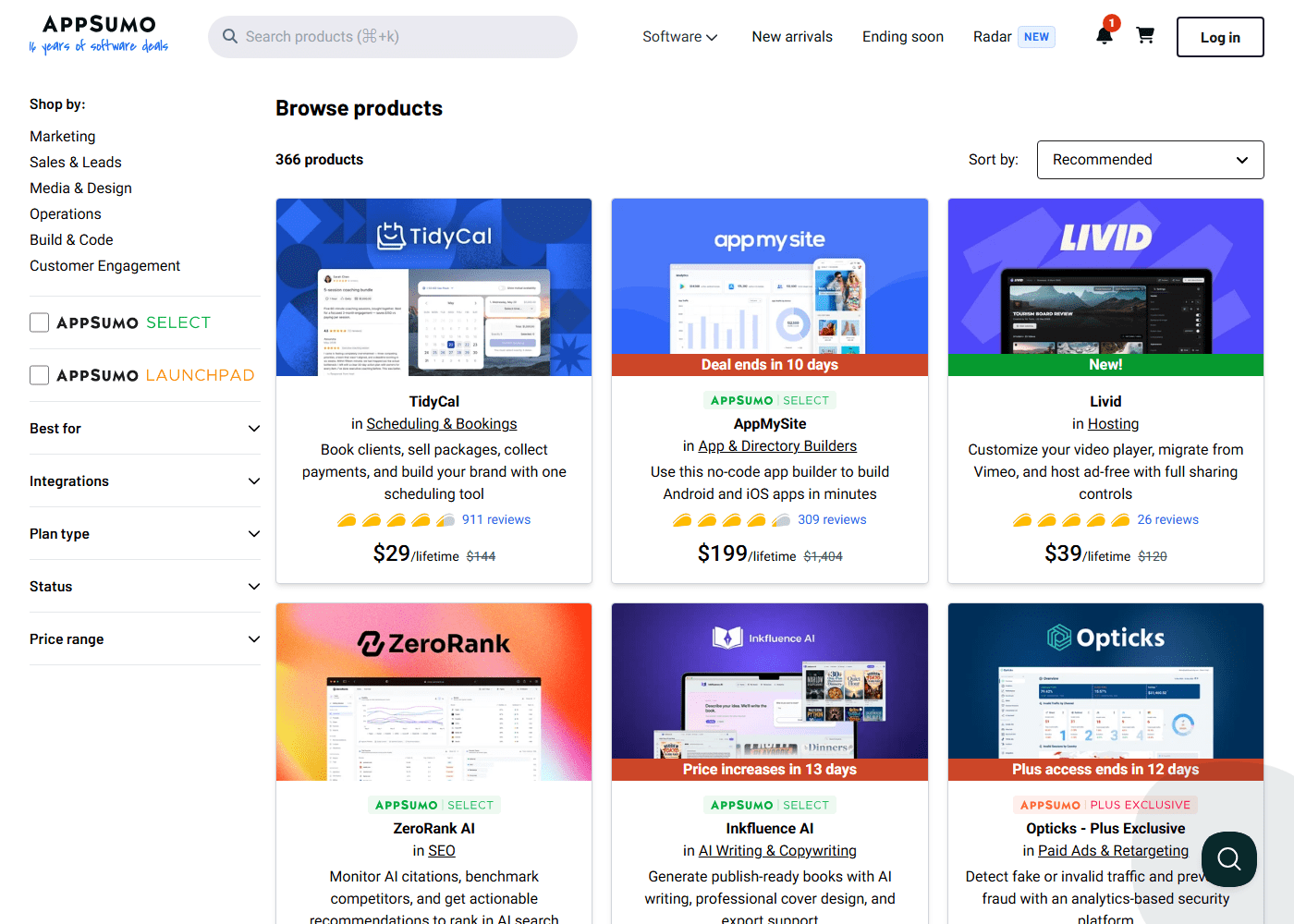
366 produktoj were live when I checked this week, across six categories.
The business model explains why the deals are real
Software startups need two things desperately. Cash and users.
AppSumo's audience of deal-hunting entrepreneurs provides both in a single launch.
The startup sells, say, 5,000 lifetime licences at $59. It banks roughly $300,000 minus AppSumo's cut, and gains thousands of active users whose feedback hardens the product.
AppSumo earns its commission. Buyers get software at a fraction of list price.
Every party's incentive is real and visible — which is precisely the structure a scam lacks.
A scam takes money and delivers nothing.
AppSumo's entire flywheel depends on delivering, because Sumo-lings are repeat buyers with long memories and a brutal public review culture.
That review culture is your first legitimacy signal
Every deal page carries taco ratings out of five, and unfiltered written reviews from verified buyers.
Founders answer hard questions publicly in the discussion tab.
I have watched deals get shredded to 2.5 tacos in a week when a product underdelivered.
And AppSumo kept the reviews up.
A platform running a con does not host its own criticism. 🌮
🛡️ I Tested the 60-Day Guarantee. Twice.
A refund policy is marketing until you test it. I have tested this one twice.
| Repago unu | Repago du | |
|---|---|---|
| Reason | Did not fit how I work | Broken export feature |
| Process | Self-serve dashboard | Self-serve dashboard |
| Retention friction | Neniu | Neniu |
| Money back in | 3 business days | 2 business days |
Most deals carry a 60-taga monredona garantio. Roughly four times longer than a typical SaaS trial.
My first refund was a design tool that simply did not fit how I work.
I opened my dashboard, clicked the order, selected refund, typed one honest sentence, and submitted.
No chat queue. No retention specialist asking me to reconsider.
My second was a tool with a broken export feature. Same process, two days.
Two tests, two full refunds, zero friction.
Why this matters more than any other fact here
The 60-day window converts every purchase into a risk-free trial.
You can buy a $69 tool, use it inside real client work for six weeks, and still change your mind with two weeks of margin.
The practical system: the moment you purchase, set a calendar reminder for day 45 titled "keep or refund?"
Then the guarantee protects you automatically instead of theoretically.
The honest fine print. Plus membership is non-refundable. A handful of items are marked otherwise on their pages. And serial refund abuse can flag an account.
All reasonable boundaries that do not affect a normal buyer testing tools in good faith.
Payment safety, for completeness. Checkout runs through standard card processors and PayPal.
Across 27 orders: zero billing surprises, zero phantom charges, zero card issues. Licence delivery was instant all 27 times. 💳
🎁 10% Rabato Via Unua Mendo — Retpoŝto Registriĝi →
🕵️ Where the "Scam" Feeling Comes From
If the platform is legit, why does the question get asked so often?
Because three real frustrations get mislabelled as fraud.
| Frustration | What it actually is | The fix |
|---|---|---|
| Products shut down | Startup mortality | Diversify, favour Select |
| Tier confusion | A reading failure | Read the chart, 30 seconds |
| Hype-cycle letdown | Buying on day one | Wait four days, sort newest |
Frustriĝo unu: produktoj fermitaj.
A lifetime deal lasts the lifetime of the product, and startups fail.
Across my 27 purchases, three products sunsetted. An 11% failure rate that roughly matches what veteran buyers report.
When it happens outside your 60-day window, the money is gone, and it feels terrible.
But it is startup mortality, not deception. The risk is disclosed, statistical, and priced into the deal economics several times over.
Frustriĝo du: nivela konfuzo.
Buyers grab Tier 1 without reading the licence chart, hit the limits three months later, and feel cheated.
The information was on the deal page the whole time. In a table. Above the buy button.
This is a reading failure the platform could soften with better UX. It is not a con.
Frustriĝo tri: hype-ciklo seniluziiĝo.
Launch-day marketing runs hot, early reviews glow, and a mediocre tool can ride the wave for a week.
Wait four days, sort reviews by newest, and the honest signal emerges every time.
Notice what all three share. Each is fully neutralised by the habits of an intentional buyer.
The people who call AppSumo a scam are overwhelmingly people who bought fast, read nothing, and missed the refund window.
📊 My 27-deal outcome record: what "risk" actually looks like
Total lost to shutdowns: $187. Monthly savings from the 19 keepers: ~$250. The "risk" pays for itself every 3 weeks.
🔬 Scam pattern vs what I actually observed
🧮 Why Legit Deals Can Look Too Good
The deepest skepticism is arithmetic. "If this tool is worth $598, why is it $69?"
Because you are not buying the tool's value. You are buying the startup's customer-acquisition budget.
A SaaS company typically spends $200 to $700 in sales and marketing to land one paying customer.
An AppSumo launch flips that spend.
Instead of paying an ad platform, the startup discounts the product and pays AppSumo's commission.
It acquires thousands of engaged users who provide revenue today, feedback tomorrow, and word-of-mouth forever.
The discount is the marketing budget.
Once you see that, the prices stop looking suspicious and start looking like exactly what they are.
Concrete numbers make the point
TidyCal — AppSumo's own scheduling tool with 911 reviews — is $29 unufoje against $144 list.
ZeroRank AI is $69 unufoje against $598. AppMySite is $199 unufoje against $1,404.
These are one to three months of the equivalent subscription, paid one time.
Even applying my observed 11% shutdown rate as an insurance premium, the expected value of a diversified portfolio is overwhelmingly positive.
My own ledger shows $2,088 spent against more than $11,300 in subscription-equivalent value.
Scams have negative expected value hidden by lies. AppSumo has positive expected value with the risks printed on the label.
That is the entire difference. 💰
✅ How to Buy Safely: Five Rules
Legit platform or not, your outcomes depend on how you buy.
| # | Regulo |
|---|---|
| 1 | Start with a Select or Originals deal |
| 2 | Read the newest ten reviews, not the highest-rated |
| 3 | Check the founder's pulse — changelog and replies |
| 4 | Buy the tier you need in twelve months |
| 5 | Calendar day 45 |
Regulo unu: komencu per Elekto aŭ Originaloj.
Select means AppSumo vetted the product for quality, performance and support.
Originals like TidyCal and SendFox are owned by AppSumo itself, and carry near-zero shutdown risk. Perfect first purchases.
Rule two: read the newest ten reviews. Freŝa rivelas la post-lanĉan veron.
Rule three: check the founder's pulse.
A changelog updated this month, and fast answers in the questions tab, are the strongest survival predictors I know.
Regulo kvar: aĉetu la nivelon, kiun via komerco bezonas en dek du monatoj. Sub-nivelado estas la plej ofta bedaŭro en ĉiu LTD-komunumo.
Regulo kvin: kalendara tago 45 por decido pri konservado aŭ repago dum la garantio estas viva.
And the zeroth rule: never pay full price on your first order.
AppSumo gives new customers 10% off their first purchase for joining the email list.
On a $199 deal that is twenty dollars for fifteen seconds of typing. It also puts you on the deal-alert list. 🎁
🎁 Postulu 10% Rabaton Via Unua Mendo →
🚩 Red Flags on Individual Deals
One crucial distinction keeps smart buyers safe.
AppSumo the platform is legit. But individual deals still vary, exactly like sellers vary on any marketplace.
My personal red-flag list, built from three shutdowns and a few abandonments.
A dead changelog. If the last update predates the deal launch by months, the team may be harvesting cash rather than building.
Neklara aŭ mankanta vojmapo when buyers ask "what's next" in the questions tab.
A founder who stops replying mid-campaign.
Responsiveness during the launch is the best support you will ever get from that team. Silence now predicts silence later.
Taksoj drivas sub 3.5 takoj on meaningful volume. Launch-week noise settles by week two, and a sub-3.5 settle is the crowd telling you something.
Lifetime "everything unlimited" promises from a team with no visible revenue model.
Unlimited usage with zero recurring income is how products end up sunsetting.
None of these flags mean fraud
They mean elevated product risk. Which the 60-day guarantee lets you test your way through.
Buy, use it hard for six weeks, and let the evidence decide.
The platform's own machinery — reviews, questions, refunds — is your due-diligence toolkit.
Use all three and the worst realistic outcome of any purchase is a refund and a lesson.
The best outcome is a tool that pays for itself every month for years. 📈
⚖️ AppSumo vs the Copycats
Part of answering "is AppSumo legit" is knowing what the alternative looks like.
The lifetime-deal boom spawned a wave of smaller LTD marketplaces, and the risk profile changes dramatically as you go down-market.
| Dimension | AppSumo | Smaller platforms |
|---|---|---|
| Vetting | Can reject weak products | Need inventory, take what they get |
| Guarantee | 60 tagoj | 30 days or less, variable |
| Product gravity | Best teams launch here | Also-rans trickle down |
| My shutdown rate | ~11% | Roughly double |
Weaker vetting. AppSumo's scale lets it reject weak products and reserve its Select badge for vetted ones.
Weaker guarantees. Sixty days is the exception in this industry, not the rule.
Weaker gravity. The best software teams launch where the biggest audience is.
I keep a small experimental budget for other marketplaces, and my shutdown rate there is roughly double.
None of this means competitors are scams. Several are perfectly honest shops, and I compare them properly in my gvidilo pri alternativoj.
The point is narrower and more useful.
If your question is "can I trust the lifetime-deal model with my money," the answer depends heavily on where you shop.
When people have a bad LTD story, ask which platform it happened on. Surprisingly often, it was not this one. 🛒
🗣️ Triangulating Beyond My Ledger
My 27 purchases are one data set. So I spent an evening triangulating against the wider buyer conversation.
The pattern is remarkably consistent everywhere you look.
Inside AppSumo's own review system, flagship products hold strong crowds. TidyCal at 911 reviews with a five-taco average. Plus itself at 309 reviews.
But the tone of those reviews convinces me more than the scores.
Sumo-lings write like owners, not fans.
They list bugs with version numbers. They compare tier limits against competitors by name. They update reviews months later when a roadmap slips.
A marketplace faking its social proof would never tolerate this level of forensic grumpiness on its own pages.
Outside the walls, the same verdict
Facebook groups with tens of thousands of LTD buyers. Subreddits dedicated to lifetime deals. Independent deal-tracking blogs.
They converge on the two-sided verdict I reached.
The platform reliably delivers and refunds. Individual products carry startup risk buyers must manage themselves.
The complaints that surface follow the exact patterns described earlier. Missed refund windows. Unread tier charts. Sunsetted products mourned after the fact.
What you essentially never find, anywhere, is the signature of actual fraud.
Undelivered licences. Ignored refund requests inside the window. Phantom billing.
In sixteen years and millions of transactions, the absence of that pattern is itself the strongest evidence in this article.
Scams cannot run that long, at that scale, in front of that many forensic reviewers, without leaving a trail. 🔎
⏳ A Deal's Lifecycle
Understanding how a campaign unfolds makes you sharper than ninety percent of the crowd.
| Phase | Tagoj | Kion fari |
|---|---|---|
| Hype | 1–3 | Deliberately do not buy |
| Truth | 4–14 | Research and buy |
| Maturity | Weeks 3–8 | 30-day reviews appear |
| Scarcity | Final week | Deadline, not discovery |
Days one to three: the hype phase.
Early-bird buyers flood in, launch reviews skew euphoric, and the founder answers every question within minutes.
This is when FOMO peaks, and when you should deliberately not buy.
Days four to fourteen: the truth phase.
Real users hit real limits. The review average settles toward its honest level. The questions tab fills with edge cases you would otherwise discover the hard way.
This is the ideal buying window. Hype cooled, information rich, tiers usually in stock.
Weeks three to eight: maturity.
The team ships fixes in response to the feedback wave.
And the most useful reviews of the campaign appear — thirty-day updates from buyers running the tool in production.
If a deal still holds 4+ tacos here, it is very probably a keeper.
The final week: scarcity. A genuine deadline, because when a campaign closes, that price is usually gone forever.
My rule collapses it into one sentence. Research in the truth phase, decide by maturity, and use the final week only as a deadline for a decision already made. ⏱️
🚫 When You Should Not Buy Here
I earn a commission on these links. That is exactly why this section exists.
When you cannot afford to lose the money. One in ten products sunsets. If a $69 loss would hurt, this is not your marketplace yet.
When you need enterprise compliance. SLAs and audit trails are not what this bazaar sells.
When you will not read the tier chart. That single omission causes most of the "scam" complaints on the internet.
When you will not set the day-45 reminder. The guarantee only protects buyers who use it in time.
When the deal promises unlimited everything with no revenue model. That is the profile that sunsets.
When you are buying because a timer is running. The urgency is real, but it is not a reason.
🏁 Verdict: Legit, With One Honest Asterisk
The straight summary a friend would give you over coffee.
AppSumo is a legitimate, 16-year-old marketplace that delivers what you pay for, honours its 60-day guarantee, and hosts its own criticism in public.
I have run more than $2,000 through it across 27 orders, with a perfect delivery record and two frictionless refunds.
The asterisk: roughly one in ten products you buy will eventually shut down.
Because lifetime deals are bets on startups, and startups fail.
That is a portfolio risk you manage — with Select badges, active changelogs and diversification — not a fraud risk you fear.
Buyers who understand the asterisk save thousands. Buyers who ignore it write the angry forum posts.
If you are ready to test it yourself
Do it the low-risk way.
Pick one tool that replaces a bill you currently pay. Take the 10% first-order discount. And set your day-45 reminder before the confirmation email even lands.
Either the tool earns its keep in sixty days, or you get your money back.
I have watched that bet pay off nineteen times and cost me nothing on the ones that did not. 🌮
🌮 Foliumi AppSumo-Ofertojn Sekure →
🎁 Ricevu 10% Rabaton por la Unua Mendo per Retpoŝta Aliĝo →
❓ FAQ
Ĉu AppSumo estas legitima kompanio?
Yes. Founded in 2010 by Noah Kagan, based in Austin, Texas, and selling continuously for 16 years. It runs its own products and serves a repeat-buyer community of millions.
Does the 60-day guarantee really work?
In my direct experience, yes — twice. Both refunds were self-serve and landed back on my card within three business days. Exceptions: Plus, and items marked non-refundable.
Kial AppSumo-ofertoj estas tiel malmultekostaj se ili estas realaj?
The discount is the startup's customer-acquisition budget. Instead of spending $200–$700 per customer on ads, companies discount the product to acquire thousands of users and upfront cash.
Ĉu mi povas perdi monon sur AppSumo?
Yes, in one specific way. A product can shut down after your refund window closes. It happened to 3 of my 27 purchases, costing $187 against roughly $9,000 net saved.
Ĉu estas sekure doni al AppSumo miajn karton-detalojn?
Pagoj funkcias per normaj procesoroj kaj PayPal. Ĉirkaŭ $2,000+ en mendoj mi havis nulan fakturajn problemojn. Uzu PayPal se vi preferas kroman tavolon.
Kio estas la plej sekura unua aĉeto por skeptikulo?
An Original like TidyCal, or any Select-badged deal replacing a bill you already pay. Bought with the 10% rabato por la unua mendo and a day-45 reminder.
What happens if a tool shuts down?
You lose access, and outside the guarantee window you lose the money. Which is why diversification and vendor diligence matter more than any single deal's discount.
Do the reviews get moderated?
Critical reviews stay up, including ones that tank a deal's rating during its own campaign. That is the strongest single legitimacy signal on the platform.
Rilata legado: Plena recenzo de AppSumo · Kiel AppSumo funkcias · AppSumo-repagpolitiko klarigita · Plej bonaj ofertoj ĉi-monate

- Short-Form Video: Reach, Retention and Reality - Oktobro 24, 2026
- Outline Generators: The One Part of Scripting Worth Automating - Oktobro 24, 2026
- Video Content in 2026: What the Engagement Data Shows - Oktobro 21, 2026