
Plays in the language you are reading. Tap any paragraph to start from there.
AI writing subscriptions were the fastest-normalising bill in small-business software.
Within two years, $30–$90 monthly for a drafting assistant went from novelty to line item.
The lifetime shelf's counter-offer is challenger AI writers at $49–$99 once.
That makes this one of the platform's most searched categories. And, handled carelessly, one of its most refunded.
My own ledger holds both. An AI writing keeper that has drafted alongside me for years, and the "unlimited" generator that became my textbook refund.
The difference was never the tools' intelligence. It was buying discipline specific to this shelf.
First orders take 10% rabato. 📝
🌮 Foliumi AI-Skribantajn Ofertojn →
🧾 Ŝlosilaj Konkludoj
| Demando | Mallonga respondo |
|---|---|
| Nuna titolkaptisto | Inkfluence AI — Elekt-insigna librogenerado, kampanja hejtado |
| La du unusemajnaj provoj | Credit-meter honesty + voice preservation |
| Kion AI-skribo faras plej bone | Malnetoj, skizoj, repurigo, variantoj — akcelo, ne aŭtoreco |
| La abono eskapas | $30–$90/mo iĝas $49–$99 unufoje; egaleco 1-3 monatoj |
| La revenanta tragedio | "Unlimited words forever" from meter-less vendors |
| Output effect | Drafting time halved; total output roughly doubled |
| Unua movo | 10% rabato de via unua mendo 🎁 |
🧪 The Two Tests That Decide Everything
Ĉiu regulo de la AI-breta ludlibro applies here.
But AI writing compresses the whole diligence into two week-one tests that predict the day-45 verdict almost perfectly.
| Testo | Passes if | Fails if |
|---|---|---|
| 1. The meter | Monthly allowance stated per tier | "Unlimited words for life" |
| 2. Voice preservation | Output needs light polish | Output needs structural rewrites |
Test one: the meter
Words and generations cost the vendor real compute forever, against your one-time payment.
So the tier chart must state monthly allowances plainly. 30,000 words. 100 long-form credits. Whatever the unit.
And the vendor should visibly run a parallel subscription business, proving the arithmetic closes.
"Unlimited words for life" from a campaign-only vendor is the category's recurring tragedy.
It resolves reliably into throttles, fair-use asterisks, or sunset. My refunded generator followed the script to the week.
The inversion bears repeating, because it decides purchases. On this shelf, the capped promise is the trustworthy one.
Test two: voice preservation, on your niche
AI writing quality is brutally domain-specific.
An engine excellent at listicles may be mediocre at technical explainers, and useless at your industry's particular register.
No review corpus substitutes for running three real assignments through it in week one.
The scoring is edit-distance honesty.
Output needing light polish — reorder, sharpen, personalise — is keeper-grade.
Output needing structural rewrites is a refund wearing a discount.
A drafting tool that costs more editing time than it saves drafting time has negative value at any price.
Tune the style settings before judging. My keeper failed its first conversion and passed its second after configuration.
But cap the tuning investment at an afternoon.
Two tests, one week, and the 60-taga garantio turns both into zero-risk experiments. ✅
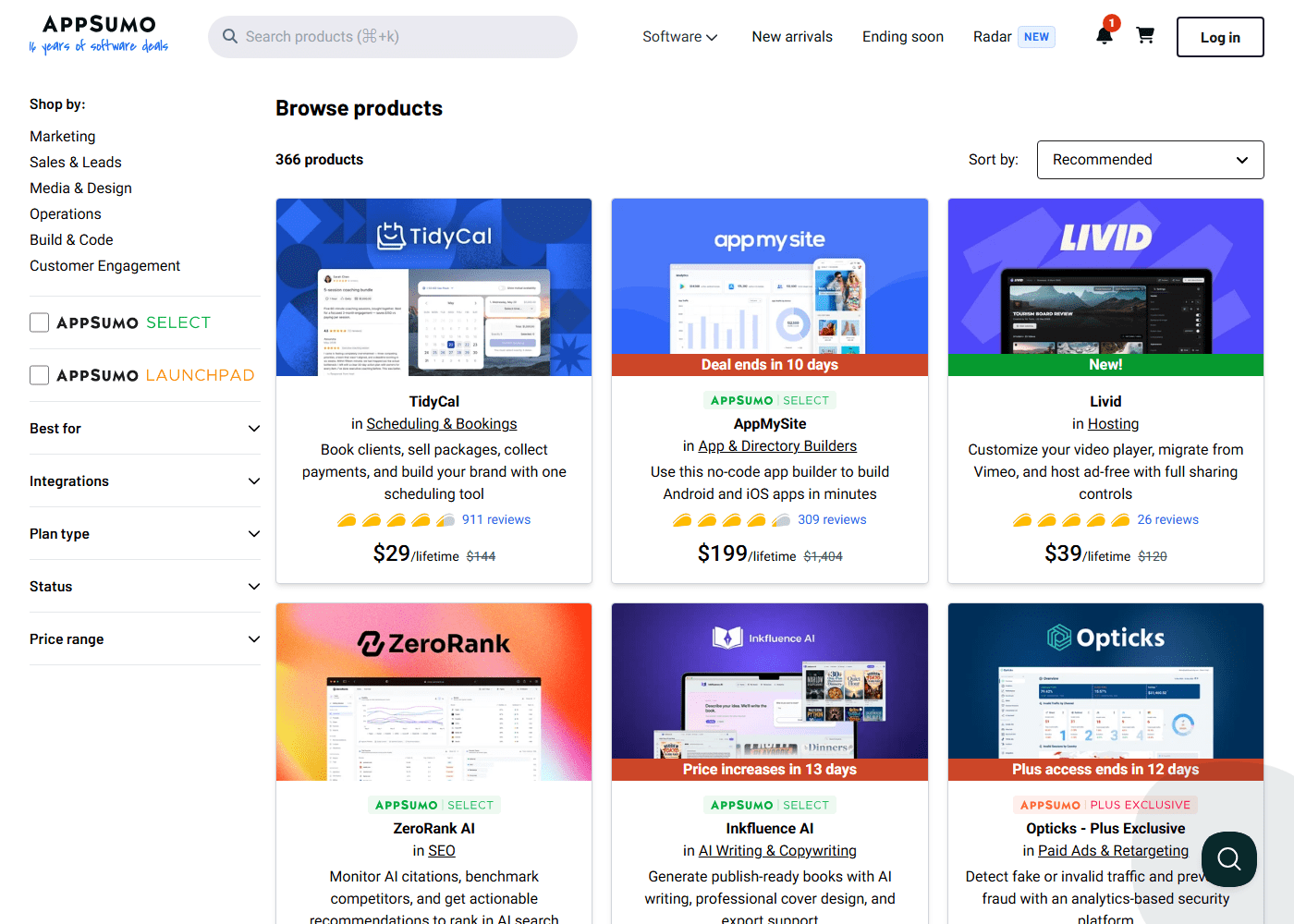
🥇 Inkfluence AI: The Book-Machine Headliner
The category's current headliner targets its most ambitious use case.
Inkfluence AI — Select-badged, generating publish-ready books with AI writing, professional cover design and export support.
It is running the classic heating pattern. Climbing review counts, and a "price increases in 13 days" banner.
That is the platform's honest advance notice that launch terms are expiring, per the reguloj de kampanjo-horloĝo.
Who it serves
| Buyer | Why a book |
|---|---|
| Authors with a back catalogue | Expertise waiting to be packaged |
| Course creators | A book-shaped lead magnet |
| Consultants | "Wrote the book on it" is a sales sentence |
| Content operations | Books as top-of-funnel assets |
Against subscription AI-writing incumbents at $30–$90 monthly, and traditional ghostwriting at four to five figures per manuscript, a lifetime licence repricing book production is exactly the category-headliner shape.
The diligence file, with book-specific extensions
The meter test. Book generation is long-form compute at scale.
So the tier chart's project allowances deserve extra scrutiny, and the middle tier the usual preference.
The voice test. Generate a real chapter from your actual expertise in week one.
Book-length coherence is harder than blog-length. The output's structural quality — argument flow, chapter logic, not just sentence polish — is the evidence that matters.
The export test rides along. A book you cannot cleanly move into your publishing workflow is a demo.
And the ownership check, from the kategorio reguloj. The terms should state plainly that generated content is yours.
Cleared on all counts inside the guarantee window, the arbitrage is real. The heating banner sets the calendar. 📚
🎁 10% Rabato Via Unua Skriba Interkonsento →
🗺️ What AI Writing Actually Does
Two years of daily AI-assisted production earn me a precise map.
It differs from both the marketing and the backlash.
| AI does this well | AI does not do this |
|---|---|
| First drafts from outlines | Decide what deserves saying |
| Outlines from raw notes | Supply lived specifics |
| Variant generation | Kill the plausible-but-wrong sentence |
| Format conversion | Take accountability for accuracy |
| Delete the blank page | Have taste |
Kie ili elstaras: akcelo de strukturo.
First drafts from detailed outlines. Outlines from raw notes. Variant generation — five subject lines, three intros, the ad-copy matrix.
Format conversion, the reuzanta movo: transcript to post, post to thread.
Expansion of bullet skeletons into prose for via posta formado.
And the blank-page problem generally, which they simply delete.
In my production loop, the drafting phase compressed by well over half.
Kie ili ne: aŭtoreco.
The judgment about what deserves saying. The lived specifics that make content credible — every receipt and ledger number in this series is the human layer.
The taste that kills the plausible-but-wrong sentence. And the accountability for accuracy.
For content that must rank or convert, the division is non-negotiable.
Search engines and readers alike have grown expert at detecting unedited generation. The E-E-A-T logiko of modern search explicitly rewards the experience layer AI cannot supply.
The working formula: AI drafts the scaffold, the human supplies evidence, voice and verdicts.
Editing time converts from cost into the entire job description.
Buyers expecting a content employee refund. Buyers hiring a tireless drafting assistant keep, and their output roughly doubles. ⚖️
📊 Kie iras la tempo de skribo de AI: antaŭ vs post (mia produktada buklo)
💸 Three years of drafting: subscription vs licence
And the licence's model improves each quarter without re-pricing.
🧑🏫 The Editor's New Job
A candid section for the reader worried the tools will flatten their voice.
The worry is half-right, and the half matters.
Unedited AI output does converge toward a recognisable register. Competent, agreeable, faintly weightless.
Publishing it raw is how brands dissolve into the beige tide currently washing through every feed.
But the mechanism is not the tool overpowering the writer.
It is the writer abdicating the editing pass that was always where voice lived.
Pre-AI, drafting labour rationed output enough that each piece got its craft hours by default.
Post-AI, the drafting bottleneck is gone. The only thing standing between doubled output and doubled beige is whether the editing discipline scaled with the volume.
The tools did not create this test. They removed the rationing that let writers pass it accidentally.
Four disciplines that survive the test
| Discipline | What it fixes |
|---|---|
| The read-aloud pass | AI prose fails the ear before the eye |
| The evidence quota | Specifics only you could supply |
| Deletion courage | AI drafts pad symmetrically |
| One human sentence | The lines readers remember |
The read-aloud pass. Cadence repairs are where voice re-enters.
The evidence quota. Every piece carries numbers, receipts, scars.
The quota is what makes the E-E-A-T tavolo real rather than aspirational.
Deletion courage. The edit that cuts a third is usually correct.
The one-human-sentence rule. Every section gets at least one line the model would never write.
None of this is new craft. It is old craft, promoted from optional to load-bearing.
The shelf sells acceleration honestly. Voice was always sold separately, and it still is. 🎙️
🔄 The Rotating Shelf: Four Species
Around the book machine, the shelf cycles four recognisable species.
| Species | Buy if you | Watch |
|---|---|---|
| Longformaj asistantoj | Blog and article regularly | Structure, not just polish |
| Kopiaj specialistoj | Run ads and campaigns | The variant workflow |
| Reutiligo de verkistoj | Podcast or make video | Most trustworthy economics |
| Niĉaj specialistoj | Have a concrete recurring need | Buy reactively only |
Long-form assistants. Blog and article engines with SEO-brief integration. The species most buyers mean by "AI writer".
Evaluate against the two tests, plus output strukturo: does it write arguments, or paragraph salads?
They pair naturally with the SEO-stakoj ŝlosilvortoj.
Copy specialists. Ad, email and landing-page generators optimised for variants and frameworks.
Their meter units are small, and their value lives in the matrix workflow — twenty options in the time one used to take.
Repurposing writers. Transcript-to-everything engines, covered in the video gvidilo.
The bounded-input species, whose economics are the shelf's most trustworthy.
Niche specialists. Press-release tools, product-description engines, technical-doc assistants.
Bought reactively against concrete recurring needs.
Portfolio guidance
One tool per species you genuinely produce in.
Resist the collector's temptation of overlapping engines. Two long-form assistants is one subscription-era habit wearing lifetime clothes.
Sequencing follows your content calendar's actual weight.
Bloggers start long-form. Commerce operators start copy. Podcasters start repurposing.
And the book machine joins when a manuscript-shaped project exists on the roadmap rather than in the daydream — the fakturoj-kaj-botelkololoj regas applied to ambition. 🧭
🎛️ Prompting Is Configuration
One practitioner's section the category guides skip.
The gap between an AI writer's demo output and its keeper-grade output is mostly agordo.
Treating prompting as a setup investment rather than a per-use chore changes the entire ownership economics.
Every credible tool exposes style controls. Tone presets. Sample-writing ingestion. Custom instructions. Brand-voice profiles.
Buyers who invest the setup afternoon get output two grades above buyers typing "write a blog post about X" into defaults.
My keeper's failed-then-passed voice test was exactly this. The tool did not improve between conversions. Its configuration did.
The protocol, worth the afternoon it costs
Week one: build the voice profile. Samples in, register rules written, output compared against your edit patterns, profile tuned twice.
Week two: template the recurring formats. Your article structure, your email skeleton, your thread pattern — saved briefs the tool fills rather than invents.
Ongoing: maintain the correction loop. When an edit repeats three times, it becomes a profile rule.
The setup investment also transfers. A well-documented voice profile moves between tools in an hour.
Which de-risks the category's proksimume 1 el 10 sunsubiraj ŝancoj.
Your configuration, like your CRM-datumoj, should always have an exit.
Owned tools reward owned skills. The profile is the skill, written down. 🧬
🏗️ The Pay-Once Writing Pipeline
Compose the purchases into a production system. For writing it runs leaner than any stack in this series.
| Tavolo | Ijobo | Prezo |
|---|---|---|
| Capture | Voice notes and calls become raw material | $49–$79 |
| Long-form assistant | Drafts from that material | $49–$99 |
| Repurposing engine | Each piece becomes platform fragments | $49–$59 |
| Core total | $150–$220 |
Against subscription equivalents billing $60–$140 monthly.
Capture comes from the renkontiĝo-inteligenta breto. Most writers' best thinking happens out loud.
Repurposing feeds the socia vico.
Optional extensions: the copy specialist when campaigns warrant, the book machine when the manuscript project is real, a grammar utility if your polish pass wants mechanical help.
The operating rhythm
Capture continuously. The voice-note habit is the writer's compounding asset.
Draft in batches. The assistant's acceleration rewards focused sessions.
Edit as the primary craft. The time the tools freed goes here.
Repurpose everything shipped. The engine's marginal cost is zero.
The ledger habit completes it. Content output per month, tracked against the pre-pipeline baseline, is this category's true ROI metric.
Mine reads roughly doubled output at identical hours. No subscription price ever purchased that.
La 10% rabato por la unua mendo belongs on the pipeline's largest ticket. 🏁
⚖️ The Disclosure Question Nobody Answers
Worth addressing directly, because readers ask and most guides dodge it.
Do you have to tell people AI helped write it?
The honest answer has three parts, and they differ by context.
For your own marketing content, no. Nobody discloses which word processor they used, and a drafted-then-edited article is your work in every sense that matters.
The standard is whether you stand behind every claim in it. If you do, it is yours.
For client work, ask. Some clients care, some do not, and the ones who care tend to care a lot.
A single line in the engagement terms turns a potential dispute into a documented agreement. Same logic as any other tool in a service business.
For books and bylined work, check the platform. Publishing platforms increasingly have explicit policies, and they change.
Read them before you generate a manuscript, not after.
| Context | Malkaŝi? |
|---|---|
| Your own marketing | Not required |
| Client deliverables | Ask at kickoff |
| Published books | Check platform policy |
| Anything with a byline | Your name, your accountability |
The one rule that covers every case: if your name is on it, you are accountable for every fact in it.
That accountability is precisely what the tools cannot take over, which is why the editing pass is not optional.
📔 My Two Purchases, Dissected
La kvitancoj kiuj instruis ĉi tiun gvidas ĝiajn regulojn.
| The keeper | The tragedy | |
|---|---|---|
| Prezo | $69, Tier 2 | 79 usonaj dolaroj |
| Meter | Stated per tier | "Unlimited" |
| Vendor subscription | $29/month, visible | Neniu |
| Bought at | Golden window, 4.3 tacos | Launch euphoria |
| Outcome | Years of daily use | Refunded day 31 |
The keeper. A long-form assistant, bought after its meter passed inspection and its campaign reached the golden window.
Week one ran the voice test honestly. Conversion one failed — generic register, listicle instincts on an explainer assignment.
An afternoon of style configuration followed. Conversion two returned light-polish output on my actual niche.
Keeper-grade by the edit-distance standard.
Years later it has drafted alongside every article in this series' production loop. Its meter has never once bound at my volume. Its changelog still ships monthly.
The tragedy. The "unlimited words forever" generator, bought in my first year.
Every warning this guide now codifies, ignored in one purchase.
No meter — the promise estis the red flag. No parallel revenue. Pre-settled reviews glowing at launch pitch.
And my motivation living in an imagined content operation rather than a scheduled one.
Output quality on real assignments ran rewrite-grade. The fair-use asterisk sprouted in the review threads by week three.
The tool sat unopened from day nine. Refund filed day 31, returned in two days.
The delta between the purchases was never information. Both deal pages displayed everything this guide screens for.
It was whether the screens ran before checkout. They cost fifteen minutes. ✍️
🚫 When You Should Not Buy an AI Writer
I earn a commission here. That is exactly why this section exists.
When the promise is "unlimited". On this shelf that is the single most reliable disqualifier, and it cost me $79 to learn.
When you want a content employee. These tools accelerate authorship. They do not replace it, and buyers expecting otherwise refund.
When you will not run the voice test. Quality is domain-specific. The demo tells you nothing about your niche.
When you already own one in the same species. Two long-form assistants is collecting, not stacking.
When the ownership terms are silent. For book or client work especially, generated content must be unambiguously yours.
When the content operation is imaginary. Buy for the calendar you keep, not the one you picture.
🏆 Verdict: Buy the Assistant, Keep the Authorship
The category verdict balances two truths.
AI writing lifetime deals deliver the platform's fastest workflow transformation.
Drafting compressed by half or more. Output roughly doubled. The blank page deleted.
At $49–$99 once, against the software industry's fastest-normalising subscription. Break-even in one to three months.
And the two week-one tests sort keepers from refunds before the guarantee window closes.
And: the tools accelerate authorship without replacing it.
Evidence, taste and accountability remain human. Non-negotiably so for content that must rank or convert.
Buyers purchasing a content employee will refund. Buyers hiring a drafting assistant will wonder how they produced without one.
Start with your actual bottleneck
The content stream you produce slowest. Find its species' current best deal, two-tested in week one, discounted below.
The writing life divides into before and after the blank page stopped being the job.
The crossing costs a dinner out. ✍️🌮
Where this shelf is heading
Writing tools are ageing in the buyer's favour faster than any category on the platform.
The underlying models improve quarterly. Challenger vendors ride those improvements into existing licences — the ĝisdatigo-rajtoj normo applies.
And the compute costs disciplining today's meters keep falling, loosening allowances across campaign generations.
A licence bought today on an honest meter is therefore a rare asset. It appreciates.
Same price, better model, roomier meter, compounding voice profile.
While every subscription equivalent re-prices its improvements into next year's invoice.
The blank page is not coming back. Neither is the era when deleting it billed monthly. 🌅
🌮 Foliumi AI-Skribantajn Ofertojn →
🎁 Ricevu 10% Rabaton por la Unua Mendo per Retpoŝta Aliĝo →
❓ FAQ
Kio estas la plej bona AI-skriba interkonsento pri AppSumo nun?
Inkfluence AI for book-shaped projects — Select badge, heating campaign, and the price-increase banner sets the calendar. For general production, the current long-form assistant passing the two tests.
Kiel mi provas AI-verkiston antaŭ ol la garantio eksvalidiĝas?
Week one, two tests. Verify the tier chart's monthly allowances and the vendor's parallel subscription business. Then run three real assignments and score edit-distance. Light polish keeps; structural rewrites refund.
Ĉu AI-skribita enhavo rangos en serĉo?
Unedited generation, increasingly not. Search rewards the experience and evidence layers only humans supply. AI-drafted, human-evidenced, human-edited content ranks exactly as well as its substance deserves.
Ĉu "senlimaj vortoj" dumvivaj ofertoj estas sekuraj?
Almost never. Long-form generation costs vendors real compute forever, and meter-less campaign-only vendors reliably throttle or sunset.
Kiom da skribiloj mi devus posedi?
One per species you genuinely produce in. Long-form, copy, repurposing, plus the book machine if a manuscript is real. Overlapping engines are subscription-era clutter.
Ĉu la 10% rabato validas?
Yes. The unuaorda oferto covers a new customer's first purchase. Place it on the pipeline's largest ticket.
Ĉu la enhavo, kiun mi generas, estas uzata komerce?
The credible deals state content ownership plainly in their terms. Verify it before buying, especially for book and client work. It is standard on well-run campaigns and a red flag when absent.
Ĉu ĉi tiuj iloj funkcias en aliaj lingvoj ol la angla?
Increasingly yes, with quality varying by language and tool. Test your target languages during the week-one voice test, exactly as you test your niche.
Will my lifetime licence benefit as AI models improve?
Yes. Tier updates include the vendor's model improvements, and falling compute costs are loosening meters across campaign generations.
How long does the voice profile take to build?
An afternoon for the first version, then two tuning rounds across a fortnight. It is the highest-return configuration work on this shelf, and it transfers between tools.
Rilata legado: Plej bonaj AI-iloj · SEO-iloj · Sociaj amaskomunikiloj iloj · La aĉetgvidilo
🔗 Related on this site
When you are mocking up a layout before the copy exists, there is a free multilingual placeholder text generator on this site that covers several languages rather than just Latin.

- Short-Form Video: Reach, Retention and Reality - Oktobro 24, 2026
- Outline Generators: The One Part of Scripting Worth Automating - Oktobro 24, 2026
- Video Content in 2026: What the Engagement Data Shows - Oktobro 21, 2026