
読んでいる言語で再生されます。任意の段落をタップすると、そこから再生が始まります。
I resisted AppSumo Plus for two full years.
A membership fee on a discount site felt like paying a cover charge at a thrift store. Conceptually offensive to the exact instinct that brought me to lifetime deals.
Then I did something embarrassing.
I counted my purchases from the previous twelve months. Then I multiplied them by the benefits I had been declining.
I had donated roughly $130 back to the platform through sheer stubbornness.
I upgraded that afternoon.
This review is the analysis I should have run in year one, laid out so you can run it in ten minutes. 🧮
🧾 主なポイント
| 質問 | 簡潔な答え |
|---|---|
| AppSumo Plusとは何ですか? | $99/year membership with discounts, coupons and perks |
| 主な利点 | 10% off, $100/yr coupons, extended windows, exclusives |
| とんとん | ~4 purchases/year |
| 最適 | リピート購入者、代理店、ブラック フライデー プランナー |
| 次の場合はスキップします | You buy 1–2 deals/year, or have not bought yet |
| 主な注意点 | 定期購入、 返金不可 |
| ここは新しいですか? | 取ってください 初回注文10%オフ first 🎁 |
📦 What Plus Actually Includes
詳細が計算を左右するため、AppSumo が提示したオファーをそのまま正確に報告させてください。
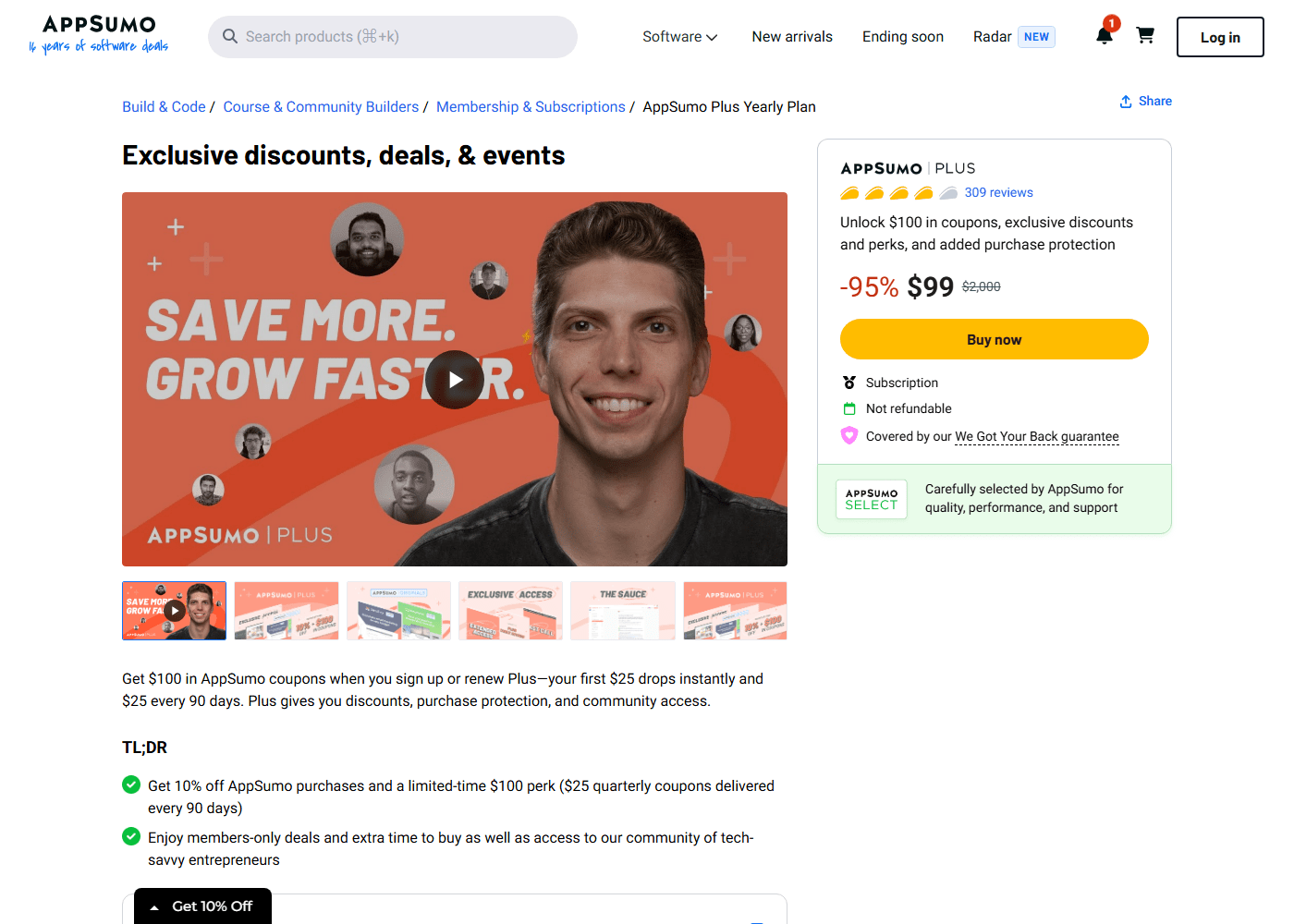
AppSumo Plus costs $99 per year.
The listing shows it as 95% off a $2,000 anchor, carries 309 reviews at a strong taco average, and is explicitly labelled a サブスクリプション そして 返金不可.
It sits under AppSumo's "We Got Your Back" framework rather than the standard 60-day refund.
| 利点 | What it delivers | タイプ |
|---|---|---|
| Coupons | $25 instantly, then $25 every 90 days | Mechanical |
| 購入品が10%オフ | On top of listed deal prices | Mechanical |
| 購入までの期間が延長されました | Extra window after a campaign ends | Situational |
| 会員限定セール | A rotating invisible shelf | Situational |
注目すべき構造: 値の半分は 機械的 and half is 状況的な.
The mechanical half — coupons and percentage discounts — arithmetic can price exactly.
The situational half — extended windows and exclusive shelves — depends entirely on how you buy.
Reviews of Plus split along exactly this line
Heavy buyers rave about the mechanical half paying for itself, and treat the situational half as free upside.
Light buyers report letting quarterly coupons expire and feeling fleeced.
Both camps are correctly describing the same product from different volumes.
That is the entire review in miniature. Plus は音量楽器です。 📊
🔢 The Mechanical Math
ちょうどその半額の価格から始めましょう。
The coupon stream. $25 on activation plus $25 each quarter equals $100 per membership year.
But only if you make a purchase in each 90-day window to spend it. Unused coupons are value evaporating on a schedule.
Buy four or more times a year, reasonably spaced, and the coupons alone return $100 against the $99 fee.
The membership is free before counting anything else.
Buy twice a year and you realistically capture $50, leaving a $49 gap the other benefits must fill.
The 10% discount is priced by your annual spend. $400 of purchases returns $40. $800 returns $80. $1,500 — a serious agency year — returns $150.
| 購入者のプロフィール | 取引/年 | 年間支出 | Coupons | 10%値 | vs $99 fee |
|---|---|---|---|---|---|
| カジュアル | 1-2 | $120 | $25–50 | $12 | –$37 ~ –$62 ❌ |
| レギュラー | 4–5 | $400 | $100 | $40 | +$41 ✅ |
| 電力購入者 | 8+ | $800 | $100 | $80 | +$81 ✅ |
| 代理店 | 12+ | $1,500+ | $100 | $150+ | +$151+ ✅✅ |
The table's message is blunt.
At four intentional purchases a year, Plus turns profitable and stays profitable at every volume above.
Below that, the mechanical math is negative and no exclusive shelf reliably rescues it.
My own crossover year — the one I counted too late — held six purchases totalling $510. That would have returned $151 against $99.
The $52 I lost is the cheapest tuition in this article.
Count your last twelve months of orders right now. The number you find is most of this decision. 🧾
🎁 AppSumo は初めてですか?まずは 10% オフ — メンバーシップは必要ありません →
⏳ The Situational Half
さて、利益の算術計算だけでは価格を決めることはできません。
購入までの期間が延長されました sounds minor until a campaign for a tool you were mid-evaluating closes on a Thursday night.
Regular buyers watch the price disappear forever. Plus members get additional window to complete the purchase.
On a marketplace whose deepest structural cruelty is that deals end permanently, an escape hatch has real option value.
I have used mine twice.
Once to finish diligence on an agency-tier licence without panic-buying. Once to grab a tool whose ending I simply missed while travelling.
Neither shows up in a spreadsheet. Both purchases rank among my best keepers, and both would have been lost at regular membership level.
If your buying style involves deliberation, the extended window converts your patience from a liability into a strategy.
Members-only deals vary by season
Which is exactly the honest framing. Treat them as upside, not justification.
In my membership years they have included early access on hot launches, exclusive pricing, and occasional credit promotions.
That early access softens the tier sell-out race that dominates ブラックフライデー.
Some quarters the shelf offered nothing I wanted. One quarter it alone out-earned the fee.
My scoring rule. If the mechanical math already clears $99 at your volume, the situational half is free and occasionally spectacular.
If the mechanical math is negative, do not let a hypothetical exclusive deal talk you across the line.
Hope is not a benefit tier. 🎲
📊 年間購入によるプラス価値(機械的特典のみ)
年間最大 4 回の購入で手数料ラインを超えます。化合物以上のすべて。
📅 My membership year, quarter by quarter
Q1 alone banked 94% of the fee. The rest of the year was profit.
✅ Who Should Buy Plus
ポートレート 1: スタック ビルダー。
最近 LTD を発見しました。 購入システム maps purchases to real bills, and you are assembling a five-to-eight tool foundation over the next year.
Scheduling, email, SEO, content, support.
You will clear four purchases trivially. Every quarterly coupon will find a target. The 10% rides your entire build-out.
Activating Plus before the stack build effectively discounts the whole project.
肖像 2: 代理店のオペレーター。
You buy client-facing capacity. White-label tiers, multi-workspace licences, 積み重ねられたコード.
Your annual platform spend runs four figures.
The 10% alone returns $150+. Coupons are rounding error. And members-only early access on agency tiers — the first inventory to sell out — is operationally valuable.
ポートレート 3: ブラック フライデー プランナー。
You buy in one concentrated November sweep, plus scattered purchases through the year.
Time the activation to the event.
The instant $25 lands on event pricing. The 10% compounds your whole sweep. Extended windows protect encore deals that empty fast.
A $400 event sweep as a fresh Plus member captures roughly $65 in immediate mechanical value. Two-thirds of the fee in one week.
All three portraits share one trait
They buy 意図的に. Bills mapped, tiers projected, reminders set.
Plus amplifies good buying habits. It does not create them, and it cannot rescue their absence.
The membership is a multiplier on a number you control. Make the number positive first. 🎯
❌ Who Should Skip Plus
AppSumo で購入したことがない場合はスキップしてください。
あなたの最初の動きは、 初回注文10%オフ. Free, instant, no membership required.
Then two or three real purchases that teach you your actual volume.
Buying Plus before your first deal is purchasing a bulk discount card before knowing whether you shop here.
年に1、2回購入する場合はスキップしてください。
The table is unambiguous. Negative $37 to $62 at casual volume.
And quarterly coupons expiring unspent are precisely the "fleeced" reviews in the listing's comment section.
A casual buyer's correct savings tools are campaign timing and the golden window. Both free.
返金不可の条項が気になる場合はスキップしてください。
Plus is a subscription, it renews, and it is explicitly not refundable.
Reasonable terms for a coupon-bearing membership. But they mean the downside of a wrong guess is the full $99.
When the math is marginal — three purchases a year, say — waiting one more quarter costs a few coupon dollars. A wrong activation costs the fee.
And skip if you are budget-fragile right now.
The membership's subtle behavioural effect is that owning quarterly coupons manufactures reasons to spend them.
Delightful at healthy volume. Corrosive when every purchase needs justifying.
The honest skip is not a failure of optimisation. It is optimisation. 🧘
🚀 Maximising a Membership You Have Activated
あなたの計算が基準をクリアしていれば、5 つの習慣が Plus の成果を最大限に引き出します。
| Habit | なぜ |
|---|---|
| Spend every coupon in its quarter | Unspent coupons are the top complaint |
| Align renewal with Black Friday | The instant $25 lands on floor prices |
| Use the extended window for diligence | Patience becomes a strategy |
| Check exclusives monthly, not daily | Daily checking manufactures temptation |
| Audit the membership annually | It is a tool like any other |
Spend every coupon inside its quarter.
My calendar carries four recurring "Plus coupon check" reminders.
Each pairs with the next planned purchase from my bills-first shortlist. So coupons land on tools I was buying anyway, rather than manufacturing purchases.
Route every purchase through the membership window.
The 10% is automatic. But the extended-buy option means Plus members can afford deeper diligence on ending deals.
Update your personal rules accordingly. Where regular buyers must decide by a campaign's final week, you may let evidence accumulate slightly longer.
And audit annually with the same three-column honesty as any tool.
Fee paid. Mechanical value captured. Situational saves that mattered.
Mine renews because the audit clears $99 by lunch each year. The year it does not, I will lapse without sentiment.
Exactly as I would refund a tool that stopped earning its place.
A membership is a tool. の 元帳 that governs my whole practice governs this line of it too. 📈
📔 A Year Inside Plus
Theory tables persuade. Receipts convince.
Here is my most recent full membership year, exactly as my ledger records it.
Quarter one. Activated in late November, deliberately timed to the event.
The instant $25 landed on a $59 encore deal from my October wishlist. The 10% trimmed the rest of a $340 sweep by $34.
And the extended-buy window rescued an agency-tier licence whose campaign closed while I was mid-diligence — a tool that now runs client reporting weekly.
Mechanical value banked in six weeks: $93 of the $99 fee.
Quarter two. The $25 coupon paired with a planned $49 utility purchase in February. The 10% added $4.90.
Slow quarter, exactly as expected. The membership still ran profitable on the year already.
Quarter three. The coupon nearly expired. My only close call.
An email-tool upgrade absorbed it in the window's final week — a save produced entirely by the recurring calendar reminder I preach above.
Quarter four. The members-only shelf produced its one spectacular moment.
Early access on a launch whose Tier 3 sold out publicly within days. I bought calmly on day one of the member window and watched regular buyers scramble.
Year-end audit
$99 paid. $100 coupons fully captured. $61 of 10% discounts across $610 of purchases. Two extended-window saves. One early-access win.
Call it $161 of mechanical value, plus situational saves I conservatively price at another $50.
Against a $99 fee, at a six-purchase volume the table predicted almost exactly.
The system is boringly reproducible. That is the compliment. 🧾
📆 Timing the Activation
Most people activate Plus the day they decide it is worth it. That is a small avoidable waste.
The membership year starts when you activate. So does the coupon clock.
Which means activation timing determines how much of your annual spend the benefits actually touch.
| Activate | What happens |
|---|---|
| Just before Black Friday | Instant $25 lands on floor prices |
| Before a planned stack build | The 10% rides every purchase |
| Mid-quarter, no purchases planned | First coupon risks expiring unused |
| Right after a big sweep | You just paid full price on your biggest order |
That last row is the expensive mistake.
Activating the week after a $400 sweep forfeits $40 of discount and starts the coupon clock in your quietest period.
If you are within a few weeks of a known buying event — Black Friday, a stack build, an agency capacity purchase — activate first, buy second.
And if you are not near one, consider waiting until you are.
The membership does not expire on the shelf. Your quarterly coupons do.
⚖️ Plus vs the Free Tactics
The sharpest objection deserves a direct answer. "The free tactics already save me plenty — why pay?"
Because the two layers are complements, not substitutes.
The free layer — ゴールデンウィンドウのタイミング, the first-order offer, Black Friday deferral, tier discipline — optimises いつ、何を you buy.
It is genuinely powerful. It carried my first two years profitably.
But it is fragile in exactly two places.
It cannot recover a deal that ends while your diligence is unfinished. The free buyer's only options are panic-purchase or permanent loss.
And it offers nothing recurring. Every saving must be re-earned per purchase, with no baseline yield on your volume as such.
Plus patches precisely those two gaps
The extended window converts ending-deal panic into ordinary process.
The coupon-plus-10% stream pays a baseline return on volume you were generating anyway.
Meanwhile Plus without the free tactics is equally lopsided.
A member who buys impulsively at launch prices with unspent coupons is subsidising everyone else's discounts.
The genuinely optimal configuration is layered.
Free tactics govern selection and timing. Membership yield compounds underneath at sufficient volume. And the 60日間保証 underwrites the residual risk on individual deals.
Run all three and the platform's economics tilt about as far toward the buyer as any marketplace allows. 🧮
🔁 The Renewal Decision
Plus renews automatically, which means most members never actively decide to keep it. That is the wrong default.
Run the same audit at renewal that you ran at activation.
Only now you have real data instead of projections.
| Check | Where to find it |
|---|---|
| Purchases made this year | Dashboard order history |
| Coupons actually spent | Your account credits |
| 10% captured | Total spend × 0.1 |
| Extended-window saves | Memory — but be honest |
Add those four and compare to $99.
If the total cleared the fee, renew without thinking about it. That is the membership working.
If it did not, look at why before lapsing.
Unspent coupons usually mean a reminder problem, not a volume problem — and that is fixable for next year.
Genuinely low purchase count means your buying phase changed, and the honest move is to lapse.
You can always reactivate before your next stack build or Black Friday.
The membership is not a relationship. It is a line item with a break-even.
Treat it exactly as ruthlessly as you treat the tools it discounts.
🏁 Verdict: Worth It at Four Buys a Year
AppSumo Plus is worth $99 for anyone making four or more intentional purchases a year.
The coupon stream alone refunds the fee at that volume. The 10% compounds every order above it.
And the extended windows plus exclusive shelves arrive as free upside, precisely when volume makes them likeliest to matter.
Below four purchases the mechanical math turns negative.
The coupons expire into the void, and the honest move is regular membership plus free tactics.
Golden-window timing, the first-order offer, and a September-to-November deferral discipline.
The non-refundable subscription terms make "decide with receipts" the only responsible method.
Count last year's orders, place yourself on the table above, and let the row you land in choose.
New to the platform entirely?
Your sequence is fixed and favourable.
Claim the 10% first-order discount below. Make two or three bill-mapped purchases under the guarantee's protection. Let your natural volume reveal itself.
Plus will still be there when your receipts vote yes.
And when they do, it quietly becomes what it has been for me since that embarrassing counting afternoon.
The only subscription I hold from a platform whose entire premise is escaping subscriptions — kept because it alone reliably pays for itself. ⭐
One final calibration
The four-purchase threshold is a centre of gravity, not a cliff.
A three-purchase buyer whose orders skew large — two $199 tier-three licences and an agency stack — clears the fee on the 10% alone.
They should weight the table toward spend rather than count.
Conversely a six-purchase buyer of $29 utilities captures coupons easily but earns only $17 from the percentage.
For them the coupons' quarterly rhythm is the entire case.
The two inputs that matter are purchases per year and dollars per year.
Run both against the table, trust whichever paints the more conservative picture, and revisit annually as your stack matures.
Buying patterns drift. Mine tripled once client work entered the picture.
A membership decision that was correctly negative in year one can flip correctly positive by year two. The receipts always know first. 📊
❓ FAQ
AppSumo Plus の料金と内容は正確には何ですか?
$99 per year for 10% off purchases, $100 in annual coupons, extended time to buy ending deals, and members-only offers. It is a subscription and non-refundable.
何回購入すれば Plus の価値が得られますか?
Four intentional purchases a year is the crossover. The coupons alone return $100 against the $99 fee, with the 10% as pure profit on top.
メンバーシップなしでも Plus の特典を利用できますか?
無料で同等のものは、 初回注文10%オフ, golden-window timing and Black Friday deferral. Nothing free replicates the quarterly coupons or extended windows.
四半期ごとのクーポンは繰り越されますか?
Treat them as expiring within their window. Unused coupons are the number-one source of disappointed Plus reviews.
Plus をアクティベートするのに最適な時期はいつですか?
Just before your highest-spend period. For most buyers, Black Friday. The instant $25 plus 10% lands directly on event pricing.
気が変わった場合、Plus は返金可能ですか?
No. It is explicitly non-refundable, unlike most deals' 60-day guarantee. That asymmetry is why this review insists on deciding from receipts rather than optimism.
Does Plus include access to Originals or freebies?
Originals sell as ordinary deals to everyone, and the freebies shelf is open to all accounts. Neither requires Plus. The membership's exclusives supplement rather than gate the standard catalogue.
代理店はチーム全体で 1 つの Plus メンバーシップを共有できますか?
The membership attaches to the purchasing account, so the practical pattern is centralising company purchases through one account. Licences bought remain governed by each deal's own tier terms.
What happens if I let it lapse?
Nothing to your existing licences. You simply stop receiving coupons and the 10%, and pay list deal prices again. Lapsing is a clean exit, just not a refund.
関連文献: すべての実際の AppSumo 割引 ・ ブラックフライデーガイド ・ AppSumoによる完全レビュー ・ 購入ガイド

- Video Content in 2026: What the Engagement Data Shows - 10月 21, 2026
- Monetising a Channel That Uses AI: The Rules That Bite - 10月 21, 2026
- SEO or Paid Ads? The Cost-Per-Acquisition Data - 10月 18, 2026