
Plays in the language you are reading. Tap any paragraph to start from there.
When a colleague first told me she ran her entire client business on software that billed her nothing monthly, I assumed she was exaggerating.
Or self-hosting. Or both.
She was doing neither.
She was a Sumo-ling — a customer of AppSumo, a marketplace I had somehow never examined despite fifteen years of buying software.
The twenty-minute tour she gave me over coffee eventually became 27 purchases, $2,000+ spent, and the series of guides this article anchors.
So let me be the colleague now.
AppSumo is the world's largest marketplace for software lifetime deals. One-time purchases, typically $29 to $199, that replace subscriptions costing ten times as much per year.
This guide explains the whole machine, and ends with the ten-minute path to a first purchase at 10% off. ☕
🧾 Key Takeaways
| Question | Short answer |
|---|---|
| What is AppSumo? | The largest marketplace for software lifetime deals (LTDs) |
| Founded | 2010 by Noah Kagan — "16 years of software deals" and counting |
| The core product | Pay once ($29–$199 typical), use the software for its lifetime |
| Catalogue size | ~366 live products across six categories |
| Safety net | 60-day money-back guarantee on most deals |
| The culture | Buyers = "Sumo-lings"; ratings = tacos out of five 🌮 |
| Getting started | 10% off your first order via email sign-up 🎁 |
📜 The Origin Story
AppSumo's history explains its personality.
Noah Kagan — employee #30 at Facebook, #4 at Mint — launched the site in 2010.
He famously bootstrapped the first deal with about $60 and a weekend of hustle. A bundled software promotion marketed to a borrowed audience.
It proved two things. Developers would discount deeply for distribution. And buyers would swarm genuine bargains.
That founding trade — vendor exposure for buyer discounts, marketplace in the middle — remains the entire business model sixteen years later.
Scaled from one bundle to a machine that has moved deals for tens of thousands of products to millions of customers.
The header of the site today reads "16 years of software deals." A longevity flex few internet marketplaces of any kind can match.
The cultural DNA set early and stuck
Kagan's marketing-first, scrappy-experiments ethos produced a platform that feels more like a bazaar than a store.
Launch hype and countdown timers. Founders answering buyers in public threads. A community that named itself. A rating system denominated in tacos.
And an email culture so central that the deal alerts remain the platform's real nervous system.
It also produced institutional resilience.
AppSumo survived every SaaS boom, bust and pricing-model fashion cycle since 2010. It built its own product line when partner inventory thinned. And it grew a vetting apparatus when scale demanded quality control.
Understanding the site as sixteen years of iterated bazaar rather than discount bin is the single best predictor of shopping it well.
The energy is real. The deals are real. And the buyer skills that matter are bazaar skills — reading crowds, timing windows, knowing vendors. 🏪
🔺 The Model: Why Everyone in the Triangle Wins
The economics run on a triangle whose incentives interlock.
| Corner | Gives | Gets |
|---|---|---|
| Startups | Deep lifetime discounts | Cash, users, feedback, reviews |
| Buyers | One payment | 67–95% off, plus a 60-day guarantee |
| AppSumo | Audience and vetting | Commission, Originals, Plus |
Startups need customers and cash. Conventional acquisition costs $200–$700 per paying customer via ads.
Launching on AppSumo converts that spend into product discounts.
A campaign selling thousands of licences at $59 banks meaningful upfront revenue, delivers active users whose feedback matures the product, and generates reviews that outlast the campaign.
Buyers capture software far below list pricing, with a 60-day guarantee underwriting each experiment.
AppSumo takes commission for operating the match, plus revenue from its own products and the Plus membership.
The triangle answers the skeptic's question with structure
"Why would anyone sell lifetime access so cheap?"
Because the discount is the marketing budget, redirected from ad platforms to customers.
It also predicts the model's known failure mode honestly.
Startups are mortal. Roughly one in ten LTD products eventually sunsets. And a lifetime licence lasts the lifetime of the product.
Sophisticated buyers price that risk the way my main review's ledger documents.
As a portfolio insurance premium the economics absorb several times over. $187 lost to my three shutdowns, against $9,000+ net saved.
The triangle has spun for sixteen years because every corner keeps winning on average. 📐
🗣️ The Vocabulary: Fluent Sumo in Five Minutes
Every marketplace develops dialect. AppSumo's is learnable over one coffee.
| Term | Meaning |
|---|---|
| LTD | Lifetime deal — pay once, use for the product's lifetime |
| Tiers | Licence sizes; Tier 1 solo, Tier 3 team or white-label |
| Codes | Units of licence |
| Stacking | Buying more codes to climb tiers — campaign-only |
| Tacos | The rating currency, one to five per review |
| Sumo-lings | The buyers, and the platform's quality mechanism |
| Select | Deals vetted by AppSumo's team |
| Originals | Software AppSumo builds and owns itself |
| Plus | The $99/year membership |
Tiers matter most at purchase. The tier chart is printed above every buy button, and the twelve-month sizing rule governs which to pick.
Tacos matter most at diligence. Sort by newest, and trust the week-two settle over launch euphoria.
Select is a real signal. My keeper rate on Select purchases runs dramatically above unbadged experiments.
Originals — TidyCal, SendFox, BreezeDoc among them — carry near-zero shutdown risk and anchor the freebies shelf with permanently free tiers.
"Ending Soon" and "Price increases in X days" are the countdown vocabulary. And they are literal.
Campaigns close forever, Black Friday encores excepted. Mid-campaign price rises are announced, not sprung. 🎓
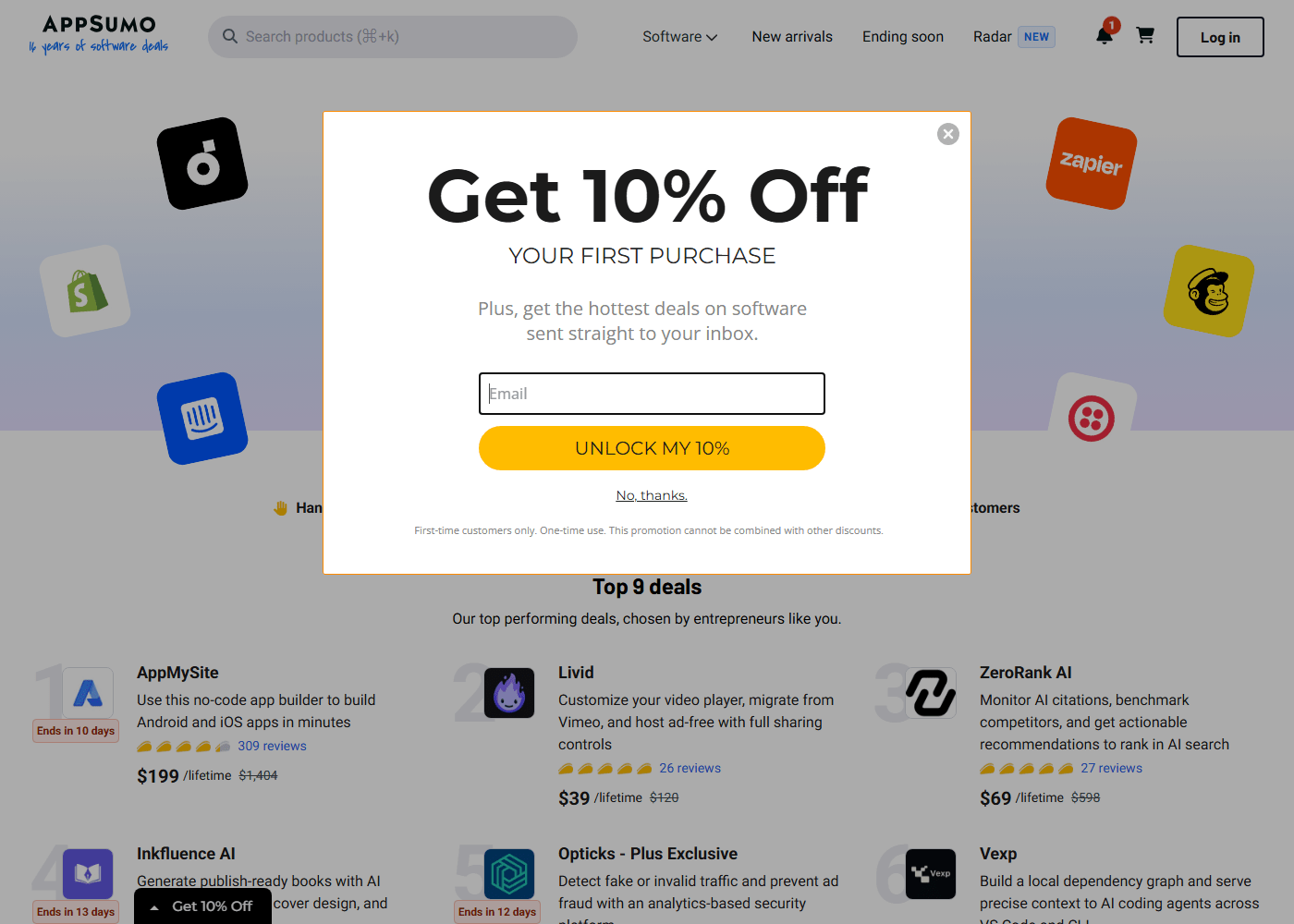
🎁 Fluent Already? Claim 10% Off Your First Order →
🛍️ The Catalogue: What You Can Actually Buy
The inventory currently spans 366 live products across six categories.
| Category | What lives there |
|---|---|
| Marketing | Email, social schedulers, SEO, lead capture |
| Sales and Leads | CRMs, outreach, proposals |
| Media and Design | Video editors and hosts, image tools |
| Operations | Project management, docs, scheduling |
| Build and Code | Website builders, app builders, dev utilities |
| Customer Engagement | Chat, support inboxes, review collectors |
Marketing is the deepest shelf, and the one my SEO and email marketing roundups patrol.
Overlaying the categories, the quality strata. Originals safest. Select vetted. Unbadged variable. And Launchpad earliest-stage.
The price architecture is remarkably compressed
The meaningful range runs $29 to $199 single-tier. Stacked agency configurations reach a few hundred dollars.
Against replaced subscriptions billing $120 to $1,400 per year.
That compression is why stack-building math gets absurd quickly.
My best-deals board routinely assembles a scheduling-email-SEO-video foundation for under $400 one-time. Displacing $150–$250 of monthly billing.
What the catalogue does not carry is equally clarifying.
The household-name incumbents rarely sell LTDs. So you are shopping hungry challengers at a tenth the cost.
For the small-operator workflows this site serves, that is almost always a trade worth making. And occasionally an upgrade outright. 🗺️
📊 The AppSumo triangle: who gets what
💸 What a $59 licence replaces, by category
🌮 The Culture: Why Tacos Are a Trust Mechanism
The whimsy is load-bearing, which newcomers consistently underestimate.
The taco ratings, the Sumo-ling identity, the founder Q&A threads.
These read as branding until you watch them function as the platform's actual quality-control infrastructure.
Sumo-lings write reviews like forensic accountants with grudges.
Version numbers. Tier-limit measurements. Support-response timestamps. Month-three updates when roadmaps slip.
Founders answer publicly, because silence is itself data the crowd prices in.
Deals that underdeliver get shredded to 2.5 tacos in a week — on the platform's own pages.
And AppSumo leaves the shredding up. Because sixteen years have taught it that credible criticism is what makes the five-taco averages worth anything.
A marketplace hosting its own prosecution is a marketplace whose acquittals mean something.
The culture translates into a diligence toolkit
My how-it-works walkthrough operationalises it.
Sort reviews by newest and trust the week-two settle. Read the questions tab for founder pulse. Check the changelog for shipping evidence. Weight Select and Originals badges.
It also carries an obligation worth honouring.
Your own honest reviews and fair refund behaviour are contributions to the commons that keeps everyone's diligence cheap.
The taco is silly. The taco is also sixteen years of compounded, prosecuted, public evidence. 🤝
⚠️ The Honest Risks, With Sizes
No explainer is complete without the liabilities.
| Risk | My measured cost | Management |
|---|---|---|
| Product mortality | $187 across 3 of 27 | Select, changelogs, diversify |
| Tier lock-in | The common regret | Twelve-month rule, stack in-campaign |
| FOMO machinery | My abandoned buys | Bills-first targeting |
| Variable support | Startup-dependent | Weight founder responsiveness |
Product mortality. Roughly one in ten LTDs eventually sunsets. Three of my 27, against $9,000+ net saved.
Tier lock-in. Buying today's tier instead of next year's is the community's most-repeated regret. Post-campaign upgrades cost regular pricing.
FOMO machinery. Countdown banners and launch hype are professionally persuasive.
My abandoned purchases all trace to shopping excitement instead of bills. Buy on days four through fourteen, never day one.
Variable vendor support. You are buying from startups. Founder responsiveness during campaigns is the best support you will ever see from that team.
Notice the pattern
Every risk is disclosed, statistical and procedurally manageable.
That is the profile of a legitimate market with known frictions. Not a trap.
The full legitimacy analysis runs deeper evidence.
Against the alternative — perpetual subscription billing with zero mortality risk and zero ownership — the risk-adjusted comparison is not close.
Which is why the lifetime-vs-subscription math gets its own article. 🧯
🪐 Beyond the Deals: The Rest of the Universe
The marketplace headline obscures a broader operation, and several satellite pieces materially change buyer economics.
The Originals product line makes AppSumo a software company in its own right.
House-built tools with permanently free tiers, famously cheap lifetime upgrades, and zero marketplace-mortality risk.
Ideal as first purchases and stack anchors.
The Plus membership converts repeat buying into a yield program. $99 yearly for 10% off, $100 in coupons, and extended windows.
Profitable from roughly four purchases annually.
The freebies layer onboards pre-revenue users at $0. Manufacturing future buyers from validated free-tier graduates — a funnel I walked personally.
The seasonal machinery peaks at Black Friday.
The one week when closed campaigns resurrect and prices breach their annual floor. Veterans structure entire buying years around it.
The content-and-community apparatus operates as a free diligence department no individual buyer could replicate.
Read as a system, AppSumo is less a store than a full lifecycle for small-operator software.
Discover free. Validate cheap. Buy protected. Scale via stacking. Harvest seasonal floors. And retire tools on your own schedule rather than a vendor's billing calendar.
The deals are the front door. The universe is why people stay sixteen years. 🌌
🔬 How a Deal Page Actually Reads
Everything above becomes practical the moment you open a real listing. Here is what each element is telling you.
| Element | What it signals |
|---|---|
| Price vs list | The discount depth — never a use case by itself |
| Tier chart | The real product; read it before anything else |
| Badges | Select = vetted; Originals = house-owned |
| Taco average | Trust it after week two, not at launch |
| Review count | Depth of evidence behind that average |
| Questions tab | Founder pulse — the best support forecast |
| Countdown banner | A real deadline, not a sales trick |
The tier chart is where money is won and lost.
It states what each code count unlocks — seats, workspaces, credits, white-label rights.
Buy the tier your twelve-month plan needs, because post-campaign upgrades revert to regular pricing.
The questions tab is the most underused element on the page.
Founders answering edge cases with specifics, at speed, during their own launch week, are showing you the next two years of support.
Silence there is data too.
And the guarantee line near the buy button is the one that makes the whole exercise low-stakes. Sixty days, self-serve, no argument required.
👥 Who Shops Here: Four Portraits
Abstract audiences blur. Meet the four buyers who actually populate the review threads.
| Portrait | Buys for | Typical spend |
|---|---|---|
| The freelancer | A client-facing stack | $350–$450 |
| The small business owner | Killing a $200/mo tool bill | $350–$500 |
| The agency operator | White-label, billable infrastructure | $138+ stacked |
| The creator | Cheap experiments | $49 at a time |
The freelancer assembles scheduling, proposals, invoicing-adjacent tools and portfolio hosting for a few hundred one-time dollars.
Because every subscription otherwise exits their own pocket. The freelancer playbook builds that exact stack.
The small business owner replaces the $200-plus monthly tool bill that quietly erodes margins.
They typically arrive via one urgent need before discovering the catalogue covers six more. The small business guide maps that journey.
The agency operator shops a different aisle entirely.
White-label rights, multi-workspace tiers, and stacked codes that convert $138 of licences into client-billable infrastructure.
The creator or side-hustler treats the platform as an experimentation lab.
$49 bets on new workflows, protected by the guarantee, funded by whatever the last experiment saved. The startup guide covers the scaling path.
What unites all four is the shape of their software problem.
Real functional needs. Real budget constraints. And no procurement department absorbing subscription creep on their behalf.
Enterprise buyers with compliance checklists are conspicuously absent from these threads. Correctly so. 🧑💼
🚫 What AppSumo Is Not
Three recurring mix-ups deserve explicit clearing. Each sends buyers to the wrong mental model.
AppSumo is not a coupon site.
It sells the software itself. Licences, delivered instantly, supported by vendors. Not codes for discounts elsewhere.
The aggregator pages ranking for "AppSumo coupon" are, as my promo-code investigation documents, almost universally fabricated.
The only true code is the platform's own 10% first-order offer.
AppSumo is not a subscription service.
Nothing renews except the optional Plus membership.
The core catalogue is one-time purchases by design. Which is precisely its appeal to buyers exhausted by billing calendars.
And AppSumo is not a discount outlet for the software giants.
The household-name incumbents essentially never sell lifetime licences.
The catalogue is hungry challengers — earlier-stage teams trading margin for growth. Simultaneously the model's discount engine and its mortality risk.
Expecting the incumbents' polish at LTD prices produces disappointed reviews.
Expecting capable challengers at a tenth of incumbent cost produces my ledger.
My alternatives survey confirmed no venue does the challenger-market trade better. 🎯
🚀 Your First Ten Minutes
The complete onboarding, compressed from my buying guide.
| Minute | Do this |
|---|---|
| 0 | Claim the 10% discount via email sign-up |
| 1–2 | Name the bill that should die first |
| 3–8 | Find and vet the candidate |
| 9–10 | Buy, set reminders, cancel the old subscription |
Minute zero. Claim the 10% first-order discount via email sign-up.
It binds to your account, applies automatically at first checkout, and enrols you in the deal alerts veterans treat as the platform's real front page.
Minutes one and two. Name the bill. Which current subscription or bottleneck should die first?
Bills-first targeting is the single behaviour that separates keepers from clutter.
Minutes three through eight. Find and vet the candidate.
Category shelf or search bar. Then the anatomy scan — guarantee line, tier chart at twelve-month sizing, badges. Then the diligence toolkit — newest ten reviews, founder pulse, changelog.
Minutes nine and ten. Buy, set the day-30 and day-45 reminders, redeem the licence immediately.
And cancel the replaced subscription the moment the keeper decision lands.
The canonical first target
The answer has not changed across every guide in this series.
An Original like TidyCal at $29. 911 reviews, five tacos, near-zero risk, ten-week break-even against any paid scheduler.
Or whatever currently tops the best-deals board against your particular bills.
Sixty days later you will hold either a tool that pays for itself monthly, or a full refund and a working education in the marketplace.
That asymmetry is now yours to spend. 🌮
🚫 When AppSumo Is Not for You
I earn a commission here. That is exactly why this section exists.
If you have a procurement department. Compliance checklists, SLAs and vendor audits are not what this bazaar sells.
If you need household-name incumbents. They do not sell lifetime licences, and no amount of browsing changes that.
If you cannot resist a countdown. The FOMO machinery is professional. Without the bills-first rule it will win.
If you will not test inside sixty days. The guarantee is the whole safety net, and it only protects people who use it.
If your software spend is already near zero. There is nothing to convert. Free tiers may be your whole answer.
If you want a tool to make you productive. Buying software is not doing work, and this marketplace is very good at making it feel like it is.
🎁 Get 10% Off First Order with Email Sign Up →
❓ FAQ
What is AppSumo in one sentence?
The world's largest marketplace for software lifetime deals — one-time purchases of $29–$199 that replace subscriptions billing ten times as much yearly, backed by a 60-day guarantee.
Who owns AppSumo?
It was founded in 2010 by Noah Kagan, formerly of Facebook and Mint, and remains an independent Austin-based company. Sixteen years into continuous operation.
Is AppSumo only for tech people?
No. The biggest beneficiaries are freelancers, small businesses, agencies and creators replacing everyday bills. No technical skill beyond normal app use is required.
What does "lifetime" actually mean?
The lifetime of the product, not yours. Most tools run for years; roughly one in ten eventually sunsets. The refund policy covers the first 60 days.
How is AppSumo different from a coupon site?
It is the store, not a coupon layer. Vendors list deeply discounted lifetime licences directly. The only true coupon is the 10% first-order email offer.
What should a total beginner buy first?
TidyCal at $29, or the current best-deals board leader that erases a bill you already pay. With the 10% applied and the day-45 reminder set.
Does AppSumo work internationally?
Yes. The marketplace serves buyers globally with standard card and PayPal checkout, and licences are delivered digitally within minutes. Individual tools' language support varies by vendor.
Can I sell my own software on AppSumo?
Yes. Vendors apply through the platform's partner process, from Launchpad early-stage listings to full Select-vetted launches. For buyers, that pipeline is what keeps the catalogue refreshing weekly.
How often does the catalogue change?
Weekly. New campaigns launch continuously and ending ones vanish with their terms, which is why the email alerts matter more than browsing.
Related reading: How AppSumo works · Is AppSumo legit? · Lifetime deals guide · Full review with my ledger

- Video Content in 2026: What the Engagement Data Shows - October 21, 2026
- Monetising a Channel That Uses AI: The Rules That Bite - October 21, 2026
- SEO or Paid Ads? The Cost-Per-Acquisition Data - October 18, 2026