
以您正在阅读的语言播放。点击任意段落即可从该段落开始播放。
I keep a running note on my phone titled "AppSumo savings."
After 27 purchases it contains exactly six entries. Six mechanisms that have genuinely reduced what I paid, tested with my own card.
Not one of them is a coupon code from an aggregator site.
Because in years of buying, I have never seen one of those codes survive contact with the checkout page.
This guide is that phone note, expanded into the complete discount map.
If you want to pay less on AppSumo — genuinely, repeatedly, without pasting dead codes into an error message — every working method is below. 🧭
🧾 主要收获
| 储蓄方式 | 这是给谁的 | 典型值 |
|---|---|---|
| 交易价格本身 | 大家 | 67–95% below list |
| 首单立享 10% 邮件优惠 | 新客户 | ~$3–$60 per order |
| AppSumo Plus(99 美元/年) | 每年 4 笔以上交易买家 | $100 优惠券 + 10% 折扣 |
| 活动时机 | 大家 | 击败交易中期价格上涨 |
| 广告活动中的代码堆叠 | 不断壮大的团队 | A fraction of post-deal upgrades |
| 黑色星期五 | 患者计划者 | The year's deepest prices |
| The 60-day guarantee | 大家 | Out-earned my coupon 15:1 |
🌮 Method 1: The Deal Price Is the Discount
Every conversation about AppSumo discounts must start with an inversion most shoppers miss.
On this marketplace, the product 是 the coupon.
Ordinary stores price at list and discount occasionally.
AppSumo's entire inventory consists of software already marked down 67 to 95 percent from the vendor's own pricing, for the duration of a limited campaign.
| 交易 | 价格 | 列表 | Cut |
|---|---|---|---|
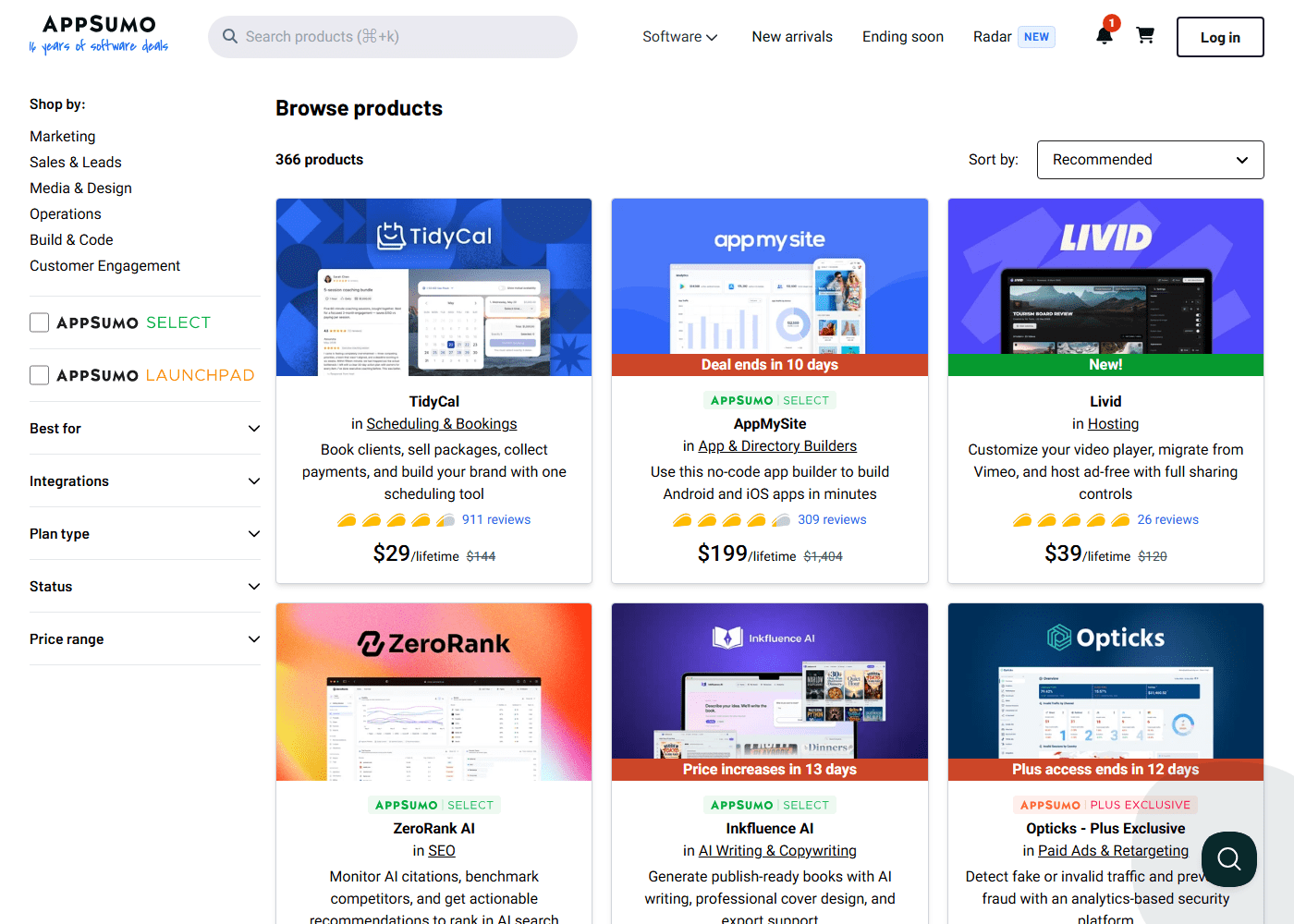
| TidyCal | 29美元 | $144 | 80% |
| 铁青 | $39 | $120 | 68% |
| 零阶人工智能 | $69 | $598 | 88% |
| 应用程序我的网站 | $199 | $1,404 | 86% |
Those are not sale prices on top of sticker. Those 是 the stickers, across all 366 products currently live.
The practical consequence rewires how you shop
Chasing an extra code on top of an 88% discount is optimising the wrong layer.
The leverage lives in 哪个 deal you buy, and 是否 it replaces a bill you actually pay.
A $69 tool that erases a $50-per-month subscription outperforms any coupon in retail history within two months. And keeps outperforming forever.
My ledger across 27 purchases reads $2,088 spent against more than $11,300 in subscription-equivalent value.
A 5.4x return, generated almost entirely by layer one — before the smaller mechanisms below added their percentage points.
Get the deal selection right and the codes become garnish. Get it wrong and no code can save you.
Which is why my 购买指南 确实是这个网站最大的折扣文档。 📊
✅ Method 2: The 10% First-Order Offer
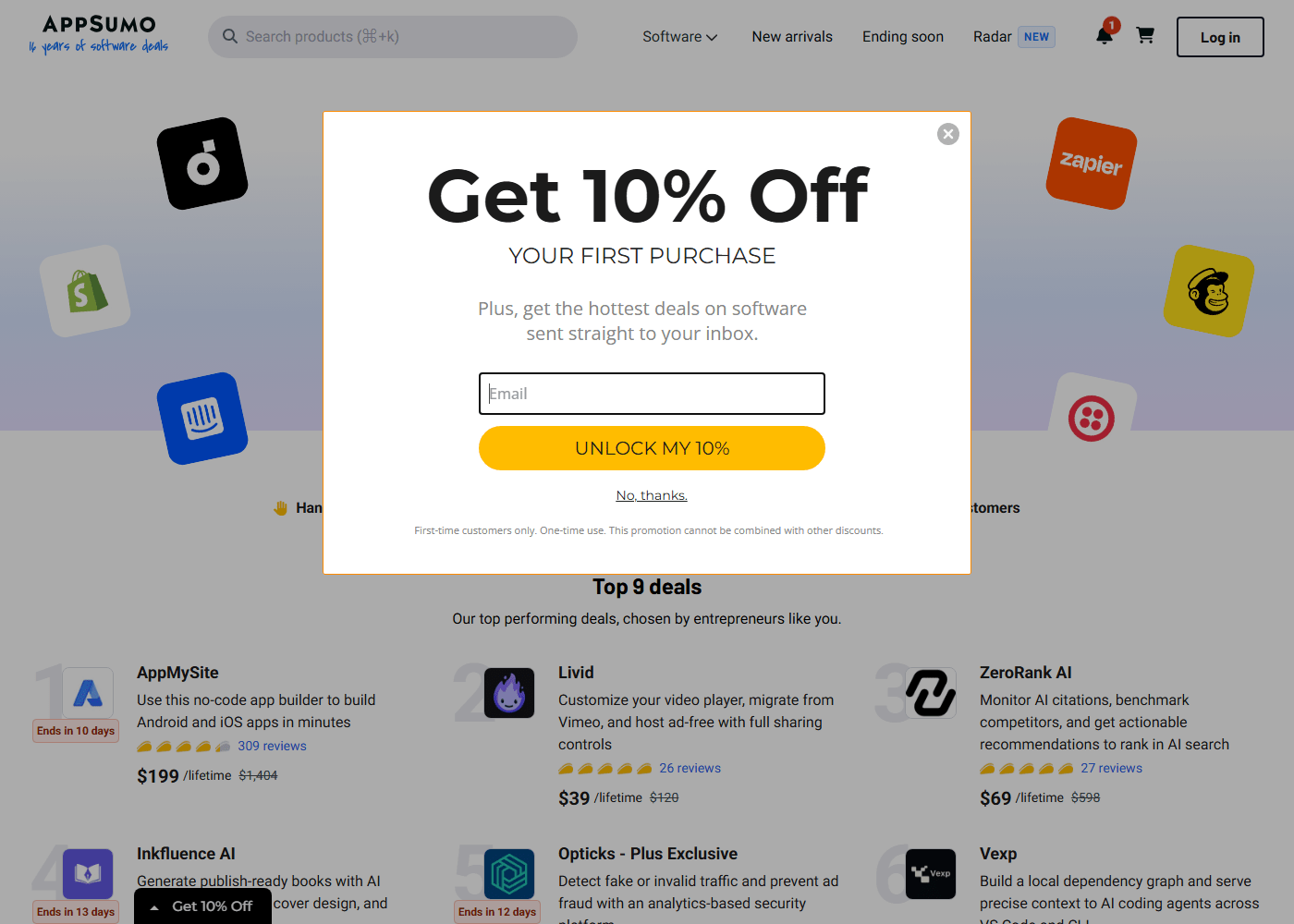
The single official promo mechanism for new customers is 首次购买享九折优惠.
Delivered through email sign-up rather than a paste-in code.
The homepage popup announces it plainly, with honest fine print. First-time customers. One-time use. Not combinable with other discounts.
If ad blockers hide the popup, the identical offer is claimable through this 直接注册链接.
The discount binds to your account and deducts automatically at first checkout.
No scavenger hunts. No expiry gambling. No red error messages.
Extracting maximum value takes one act of discipline
Spend it on your biggest planned first order, not your first impulse.
Ten percent of a $29 buy is pocket change. Ten percent of a $199 Tier 3 licence buys dinner.
Since the offer is one-time, shortlist deliberately for a week — bills you pay, bottlenecks you feel — then let the discount land where it matters.
The sign-up's hidden second payload usually ends up mattering more anyway.
Deal-alert emails that announce launches, ending campaigns, and impending mid-deal price rises before casual browsers notice.
The browse page regularly wears "Price increases in X days" banners. Subscribers move before those deadlines.
我的 一阶指南 walks the claim-to-checkout flow step by step. 🎯
💳 Method 3: AppSumo Plus
一旦首单优惠用完, 加 becomes the only standing discount program.
For the right buyer it is a quiet money printer.
The membership costs $99 per year and bundles four benefits.
| 益处 | 价值 |
|---|---|
| 购买可享 10% 折扣 | Scales with spend |
| 100 美元年度优惠券 | $25 instantly, then $25 quarterly |
| 延长购买时间 | Rescues mid-evaluation closures |
| Members-only offers | Invisible to regular accounts |
The listing shows 309 reviews and strong tacos. The sticker math is even friendlier.
The coupon stream alone refunds the fee for anyone who buys at least quarterly. The 10% rides on top of every order.
Run the profiles honestly, because Plus is not for everyone
A buyer making five purchases a year averaging $80 each collects the full $100 in coupons plus $40 from the 10%.
Roughly $140 of value against $99, before members-only deals.
A twice-a-year buyer likely wastes two quarterly coupons and nets negative. That buyer should skip Plus without guilt.
The membership is also non-refundable, so the decision deserves your real purchase count, not your aspirational one.
My rule: track your first six months of buying as a regular customer, and let the receipts vote.
我的 完整的 Plus 评论 includes the tier-by-tier arithmetic.
Heavy Sumo-lings upgrade and never look back. Occasional buyers lose nothing by abstaining.
Both outcomes are wins. Only unexamined membership is a leak. 🧮
⏱️ Method 4: Timing Beats Coupons
The least appreciated discount on AppSumo is the calendar.
Campaign prices are not static. Tiers sell out, terms tighten, and mid-campaign price increases are announced with countdown banners.
Learning the campaign clock converts that volatility from threat into savings.
| Phase | 怎么了 | Your move |
|---|---|---|
| Days 1–3 | Launch hype, thin information | Watch |
| 第 4-14 天 | Reviews settle, tiers stocked | 买 |
| Week 3+ | Price-rise banners, tier sell-outs | Decide now or lose it |
| Final week | "Ending soon" — last access, likely forever | Execute or accept the loss |
Days one through three run on launch hype. Enthusiasm high, information low.
Resist buying here. Nothing about the price rewards speed yet.
Days four through fourteen are the golden window.
Early reviews settle into honesty. Founders answer the hard questions publicly. All tiers usually remain in stock. And launch terms still apply.
The overwhelming majority of my purchases happen in this window.
It has repeatedly captured prices that rose 20 to 40 dollars later in the same campaign.
Weeks three onward bring the squeeze.
Popular deals post price-increase banners. Upper tiers occasionally sell out first.
And the final week's "Ending soon" badge marks your last access to the price, likely forever.
AppSumo campaigns rarely return, and returning terms are rarely better.
No pasted code has ever saved me as much as buying four days after launch instead of four weeks.
Timing is the coupon that never expires. ⏳
📉 节省的钱从何而来:我的 27 次购买明细
🛡️ The mechanism that out-earned my coupon 15:1
🧱 Method 5: Stack Codes In-Campaign
Tier economics hide a discount most buyers discover only after it expires.
Many deals let you 堆叠多个代码 to raise limits. Users, workspaces, credits, white-label rights.
And the stacking price during a live campaign is a fraction of what equivalent capacity costs once the deal closes.
The pattern repeats across the store.
Moving from Tier 1 to Tier 3 mid-campaign might cost $120 total. Achieving the same capacity post-campaign means the vendor's regular pricing — often $50 to $100 每月.
The delta is not a discount in the coupon sense.
It is a one-time window where capacity is mispriced in your favour, and it closes with the campaign.
The buying rule that follows
Project your needs twelve months out, and buy that tier now. Not the tier that fits today.
Under-tiering is the single most repeated regret in every lifetime-deal community.
Precisely because the correction costs ten times the prevention.
When genuinely uncertain, one tier up is almost always the right hedge. The marginal cost is small, and the 60-day guarantee covers the whole position while you validate.
I stacked codes twice in my 27 purchases. Both remain among my best-value holdings.
The one time I under-tiered to save $40, the eventual workaround cost me a full second tool.
Mechanics and edge cases are in my 代码堆叠指南.
Buy capacity while it is cheap. It is only cheap once. 📦
🖤 Method 6: Black Friday
Every mechanism above operates year-round. One event resets the floor annually.
Black Friday is AppSumo's deepest discount season.
The marketplace runs its biggest promotion of the year. Fan-favourite tools return for encore campaigns. Prices touch levels that do not reappear until the following November.
Veterans treat it as a harvest. Wishlists built in October, budgets pre-allocated, and a decisive sweep when the event opens.
Because the flip side of peak discounts is peak sell-out risk. The best deals historically empty their upper tiers fastest.
The full playbook lives in my 黑色星期五指南.
Two disciplines keep the event profitable
Deferral. From September onward, park every non-urgent purchase on the wishlist rather than buying at steady-season prices.
The weeks of waiting routinely return 20 to 30 percent.
Pre-commitment. Write the maximum budget before the banners start flashing.
The event's urgency design is world-class, and your January self will audit the receipts.
Now combine Black Friday with the other mechanisms. A Plus member spending quarterly coupons on encore deals selected months earlier.
That reaches the true bottom of AppSumo's price architecture.
A place no aggregator code has ever visited. 🗓️
🛡️ The Hidden Seventh Discount
One mechanism rarely appears in discount discussions, because it does not reduce the checkout price.
It reduces the 犯错的代价. Which over a portfolio is worth more than every percentage point above combined.
Most deals carry a 60天退款保证. Roughly four times a typical SaaS trial.
In my direct experience it is honoured without friction.
Two refunds across 27 purchases. Both self-serve from the dashboard. Both back on my card within three business days. Zero retention scripts endured.
Sixty days is long enough to deploy a tool into real client work, hit its actual limits, and decide with evidence.
Treat the guarantee as a discount on risk
A buyer who never refunds eats the full cost of every mediocre purchase.
A buyer who calendars day 45 on every order converts each buy into a reversible experiment, where the worst case is a full refund and a lesson.
The arithmetic on my own ledger: two refunds recovered $148 that undisciplined buying would have burned. My first-order code saved $9.90.
The guarantee out-earned the coupon fifteen to one.
The exceptions are few and printed. Plus itself is non-refundable, and a handful of deals mark their own terms.
Glance at the guarantee line before checkout, then buy with the calm of someone whose downside is capped at zero.
That calm, incidentally, is also what lets you buy early in golden windows while hesitant buyers wait past price increases. 🧘
🚫 Three Myths That Cost Buyers Money
Myth one: "I'll wait for a bigger code."
There is no bigger code coming.
The 10% first-order offer is the ceiling for new-customer promotions. And campaigns move in the opposite direction while you wait — mid-deal price increases and tier sell-outs.
I have watched shoppers sit out a golden window hunting a phantom 25% coupon, then pay $40 more after the announced increase hit.
The waiting itself was the expensive part.
Myth two: "Coupon sites sometimes work if you try enough codes."
In years of buying and testing — including deliberately, for this article series — the aggregator success rate against AppSumo checkout is zero.
Every minute in that loop is a minute not spent reading reviews, comparing tiers, or catching an ending deal. Those activities pay actual money.
Myth three: "Discounts matter more than selection."
Inverted priorities, and the most expensive myth of the three.
A perfectly discounted tool you stop opening in March is a 100% loss regardless of the code applied.
A full-price keeper that erases a $50 monthly bill returns 600% a year, forever.
Selection quality generates the overwhelming majority of returns.
Which is why the diligence habits in my 购买指南 belong upstream of every savings tactic here. 🧠
🔎 How to Spot a Fake Coupon Page in Ten Seconds
Since aggregator pages will keep outranking honest ones, here is how to dismiss them without wasting a click.
| Tell | 这意味着什么 |
|---|---|
| "Verified today" badge | Auto-generated, verified by nobody |
| Codes like SAVE80, SUMO50 | Pattern-generated for every brand they cover |
| A success-rate percentage | Invented — no aggregator can measure this |
| "Click to reveal code" | The click 是 the product |
| Dozens of codes, one merchant | Real merchants issue one or none |
The "click to reveal" pattern is the clearest tell.
Revealing a code opens the merchant in a new tab, which is how the affiliate cookie gets set.
Whether the code works is irrelevant to that business model. You have already delivered the thing they sell.
The second-clearest tell is volume.
A page listing fourteen active AppSumo codes is describing a merchant that issues one.
Real promotional mechanisms are few, published, and boring. That is what makes them real.
The practical rule: if a discount is genuine, the merchant will tell you about it directly.
AppSumo announces its 10% offer in a homepage popup. It does not hide it behind a third-party reveal button.
📅 A Year of Savings: The Worked Example
Let me assemble every mechanism into one concrete twelve-month story, using realistic numbers.
| Month | 行动 | 已保存 |
|---|---|---|
| January | 10% on a $199 Tier 3, golden window | 19.90美元 |
| March | $69 SEO deal kills a $99/mo bill | Paid back in a month |
| May | Stack a second code, $80 | vs regular pricing |
| June | Activate Plus at purchase four | $25 instantly |
| Sept–Nov | Wishlist converts at Black Friday | Two more coupons |
| 十二月 | Audit: one dud refunded | $59 back |
December's audit, mirroring my own ledgers.
Roughly $600 spent across seven tools. Perhaps $85 recovered through offers and coupons. One $59 dud refunded in full.
And the stack now covers functions that would invoice $250+ monthly on subscriptions.
Total first-year position: about $515 net spent. $3,000 a year of software burn erased. Break-even in month three.
That is what "AppSumo discount code" actually means when the question is answered honestly.
Not a string of characters, but a system. 🚀
🏗️ The Complete Stack: All Six Together
这是完整的系统,从今天开始我会把它交给朋友。
Month one. Claim the 首单享10%优惠. Shortlist against your current bills.
Spend the discount on your largest genuine need, during that deal's golden window.
Set the day-45 refund reminder at checkout. The guarantee underwrites everything.
Months two through six. Buy only what replaces bills or removes bottlenecks. Always inside the golden window.
Stack codes upward whenever a keeper's campaign is still live.
Track every purchase in a three-column note. Paid, subscription-equivalent, still using.
Month six. Count your purchases.
Four or more? Activate Plus and start harvesting quarterly coupons. Fewer? Stay regular and lose nothing.
September onward. Freeze non-urgent buying. Build the Black Friday wishlist. Execute the November sweep with pre-committed budget and coupons in hand.
Run this loop for a year and the numbers compound quietly.
The deals contribute the enormous base discount. Timing and tiers add their reliable percentage. And the official programs layer the final polish.
That is every real AppSumo discount in existence, tested against my own card across 27 purchases. 🏁
🚫 When Chasing a Discount Is the Wrong Move
I earn a commission here. That is exactly why this section exists.
When you are hunting aggregator codes. The success rate is zero, and the time costs more than the phantom saving.
When waiting means missing a golden window. Mid-campaign increases are real and announced. Delay is the expensive choice.
When the tool does not replace a bill. The best discount on a tool you will not use is still a total loss.
When you are considering Plus at two purchases a year. The coupons expire unspent and the membership nets negative.
When under-tiering to save $40. The correction costs ten times the prevention, and cannot be bought after the campaign closes.
When you skip the day-45 reminder because it was cheap. That habit out-earns every discount on this page.
✍️ The Habit That Ties It Together
One closing habit makes the whole system work. Keep the three-column ledger.
Paid, subscription-equivalent, still-using. One line per purchase, updated monthly, five minutes a quarter.
The ledger is what turns discount tactics into discount strategy.
Because it shows you in plain numbers which categories return, which teams ship, and whether your buying is compounding or collecting.
Mine is the reason every figure in this article is a receipt rather than a guess.
And the reason my hit rate climbed from coin-flip to four-in-five.
Discounts get you a good price. The ledger makes sure the price was worth getting.
Start yours with your first order today. 📊
❓ FAQ
现在有可用的 AppSumo 折扣代码吗?
是的——官方首单可享受 10% 折扣,通过 电子邮件注册 而不是粘贴代码。聚合站点代码几乎全部已失效或被发明。
现有客户如何获得折扣?
Through AppSumo Plus, campaign timing before price increases, in-campaign code stacking, and Black Friday. Existing customers cannot re-use the first-order offer.
为什么 AppSumo 不定期发放优惠券代码?
Because inventory already sells at 67–95% below vendor list pricing. The deal is the discount, and there is no margin left for stackable coupons on top.
AppSumo Plus 值 99 美元吗?
For buyers making four-plus purchases a year, yes. The $100 coupon stream alone covers the fee. For once-or-twice-a-year buyers, no.
一年中什么时候买最便宜?
Black Friday, decisively. Within any campaign, earlier — days 4 to 14 — beats later, because deals frequently increase prices mid-campaign.
我可以将 10% 优惠与其他折扣结合使用吗?
No. It is one-time, first-order-only, and non-combinable by its printed terms. Spend it on your largest planned purchase.
Do the discounts apply to AppSumo Originals?
Yes, Originals are ordinary deals and the first-order discount applies to them. TidyCal at $29 becomes $26.10, which makes it a common first purchase.
What is the single biggest saving available?
Buying a tool that replaces a real monthly bill. Everything else on this page is a percentage adjustment to a decision that was already the whole game.
相关阅读: AppSumo 促销代码真相 · 首单折扣攻略 · AppSumo Plus 评论 · 代码堆叠原理详解 · 黑色星期五指南

- Video Content in 2026: What the Engagement Data Shows - 10 月 21, 2026
- Monetising a Channel That Uses AI: The Rules That Bite - 10 月 21, 2026
- SEO or Paid Ads? The Cost-Per-Acquisition Data - 10 月 18, 2026