
Die Wiedergabe erfolgt in der Sprache, die Sie gerade lesen. Tippen Sie auf einen beliebigen Absatz, um dort zu beginnen.
The AI shelf is the most exciting and most dangerous aisle on AppSumo.
I say that holding several AI lifetime deals among my best-ever purchases. And the memory of two I refunded inside a fortnight.
Exciting, because AI subscription prices run hottest. $30 to $100+ monthly is the category norm.
So a $69 lifetime license buys the platform's most dramatic arbitrage.
Dangerous, because every AI generation costs the vendor real compute money.
Which means "lifetime AI access" demands sharper scrutiny than any utility or marketing tool.
This guide is my complete playbook. Plus the 10 % Rabatt auf die erste Bestellung das macht den ersten Versuch günstiger. ⚡
🌮 Durchsuchen Sie AI-Angebote auf AppSumo →
🧾 Wichtigste Erkenntnisse
| Frage | Kurzantwort |
|---|---|
| Sind AI-Lifetime-Deals nachhaltig? | The credit-metered ones, yes; "unlimited forever" promises, rarely |
| Aktuelle Highlights | ZeroRank AI (SEO, $69), Inkfluence AI (writing), TubeOnAI, vidBoard |
| Die goldene Regel | Honest credit meters beat unlimited promises, every time |
| Stufenstrategie für KI | Buy middle tiers; amortise over 18 months, not forever |
| Wo AI LTDs glänzen | Schreiben, SEO, Meetings, Wiederverwendung von Videos, Chat |
| Safest entry point | Utility AI — meetings and transcription |
| Erster Zug | 10 % Rabatt auf Ihre erste Bestellung 🎁 |
⚙️ Why AI Deals Play by Different Rules
Every other guide in this series preaches one lesson. The discount is the vendor's marketing budget.
On the AI shelf, that lesson needs an asterisk the size of a GPU cluster.
| Utility tool | AI tool | |
|---|---|---|
| Marginal cost per user | ~Zero | Real and recurring |
| What each use costs vendor | Nichts | Inference compute |
| How it ages | Gracefully | Depends on the meter |
| Trustworthy promise | "Unlimited" is fine | "Capped" is fine |
A scheduling tool's marginal cost per additional user rounds to zero. That is why utilities age so gracefully as lifetime purchases.
An AI tool's marginal cost is real and recurring. Every generation, transcription or analysis burns compute the vendor pays for in perpetuity, against your one-time $69.
That asymmetry defines the shelf's entire risk landscape.
A vendor promising "unlimited AI generations for life" is one of three things.
Running efficient small models with genuine margin. Quietly planning to throttle. Or arithmetic-blind.
Two of those three end with disappointed Sumo-lings.
The pattern shows up in review threads with grim regularity. Launch euphoria. Month-two throttling complaints. Month-four "fair use policy" emails.
The inversion that reads the whole aisle
The sustainable pattern is equally recognisable. Honest credit meters.
Deals that specify monthly allowances per tier — 10,000 words, 300 image credits, 50 transcription hours — are showing you a vendor who did the compute math.
Counterintuitively, the gedeckelt promise is the trustworthy one.
It means the economics close. The tool can serve its lifetime cohort indefinitely. Your license's value does not depend on the vendor's arithmetic improving later.
My AI keepers are all credit-metered. My two refunds were both "unlimited."
Internalise that inversion — on the AI shelf, limits are the feature — and the rest of this guide is execution detail. 📐
🥇 SEO and Search: ZeroRank AI Leads the Board
The strongest AI purchase on the current board sits at the intersection of two trends.
AI tooling prices falling. AI suchen Aufstand.
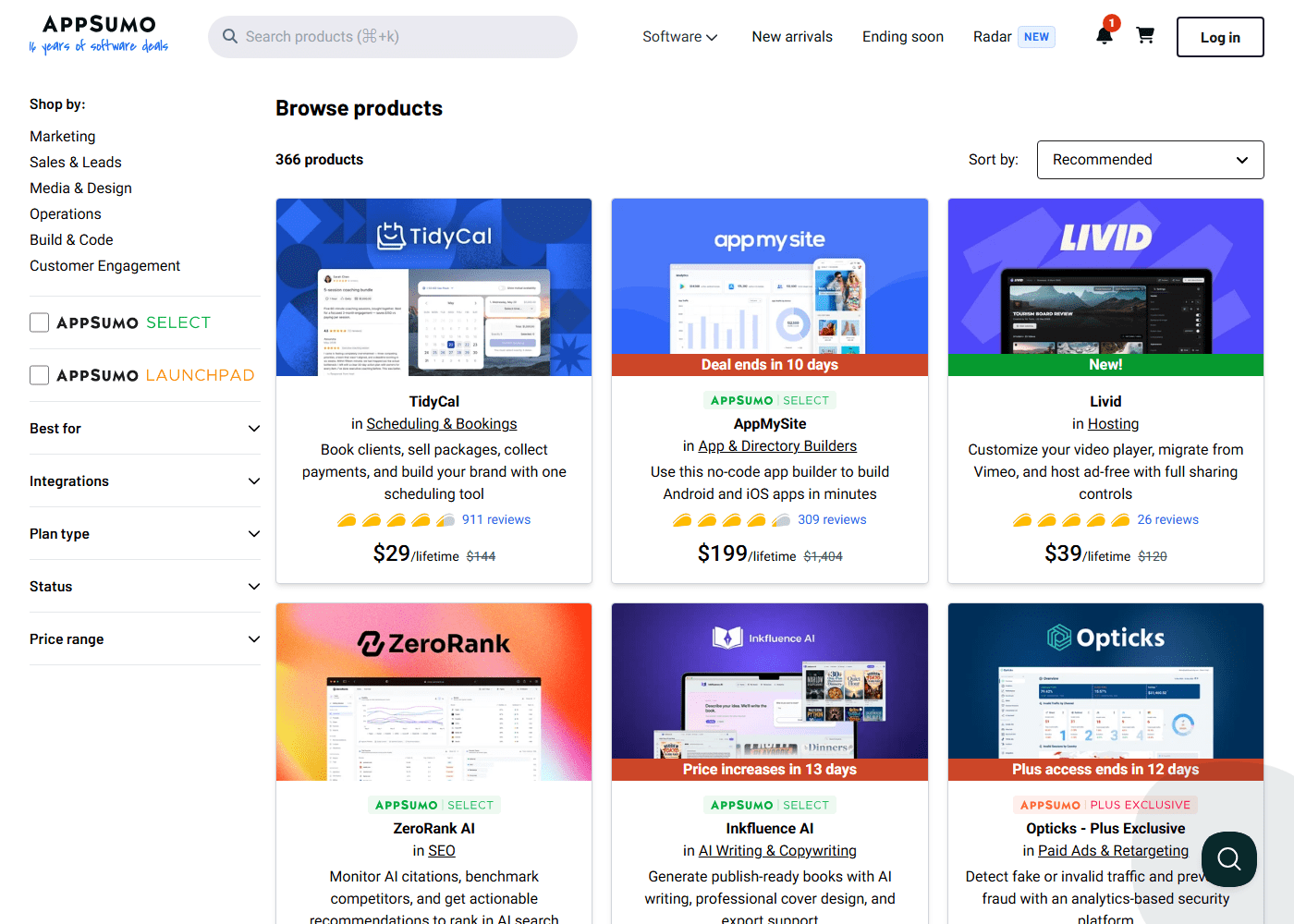
ZeroRank AI — $69 lifetime against a $598 list. An 88% discount, Select badge.
It monitors your brand's visibility inside AI search results, benchmarks competitors, and recommends actions to get your content cited in the answers themselves.
The strategic case writes itself.
Search behaviour is migrating into AI assistants faster than small-business tooling budgets can chase it.
Incumbent SEO suites price their AI-visibility modules at enterprise tiers. A lifetime license here means owning the monitoring layer for a shift still in its early innings.
The review base skews technical and detailed. Practitioner buyers, not hype waves — the crowd signal I weight heaviest on new-category tools.
Apply the shelf rules first
Check the tier chart's metering against your realistic query volume. Prefer the middle tier over any unlimited framing.
Amortise the $69 across eighteen months of expected value. Under those terms it clears break-even against any $50-monthly SEO subscription inside six weeks.
My deeper context lives in the Zusammenfassung der SEO-Tools.
But the positioning summary belongs here. This is the rare deal where discount depth and strategic timing point the same direction.
That is why it also holds the top slot on my Best-Deals-Board. 🔍
✍️ Writing and Content: The Deepest AI Shelf
AI writing is the marketplace's busiest AI category.
Inkfluence AI is the current headliner. Select-badged, generating publish-ready books with AI writing, professional cover design and export support.
It is drawing the classic heating-campaign signals. Rising review counts, and a "price increases in 13 days" banner — the platform's honest advance warning that launch terms are expiring.
For authors, course creators and content marketers, the arbitrage is the shelf's standard story.
Subscription AI-writing platforms run $30 to $90 monthly. One to two months of that billing, once.
Behind the headliner, long-form generators, repurposing engines and copywriting assistants rotate constantly. My Leitfaden für KI-Schreibwerkzeuge Verfolgt den Arbeitssatz.
The diligence one of my refunds taught me
Test output quality inside your own niche immediately.
AI writing tools vary enormously by domain. A generator brilliant at listicles may be mediocre at technical explainers.
Only your first week of real usage reveals which you bought.
Deploy against a genuine project inside days. Evaluate the output against what you would actually publish. Let the day-30 checkpoint vote with evidence.
The credit-meter rule applies with full force here. Word allowances per month, per tier, honestly stated.
One more writing-shelf specific: check the export and ownership terms. Your generated content should be unambiguously yours. The good deals state it plainly. 📚
🎁 10 % Rabatt auf Ihr erstes AI-Angebot – E-Mail-Anmeldung →
🎬 Video and Media: Repurposing Is the Killer App
The AI video shelf divides into two halves.
Generation creates video from prompts. Repurposing converts existing content across formats.
The repurposing half is where lifetime deals consistently deliver.
| Repurposing | Generation | |
|---|---|---|
| Input | Bounded — your library | Open-ended prompts |
| Vendor compute cost | Vorhersagbar | The most expensive in consumer AI |
| Meter honesty | Usually good | Watch closely |
| My diligence | Normal | Halved expectations |
TubeOnAI is one of the shelf's recurring strong campaigns. It summarises and repurposes YouTube and podcast content into posts, scripts and newsletters.
vidBoard turns text into presenter-led videos with AI avatars.
The economics favour repurposing structurally. It processes bounded inputs rather than open-ended generation, making vendor compute costs predictable and credit meters honest.
Think of the multi-format treadmill. Long video, then shorts, then posts, then newsletter.
A $49–$79 lifetime repurposing license replaces a $30-monthly subscription plus hours of weekly manual labour.
Pure generation deserves warier handling
Prompt-to-video is the most compute-expensive operation in consumer AI.
Which makes "unlimited generation for life" the least sustainable promise on the entire marketplace.
The deals that survive — and some genuinely do — meter generation minutes conservatively and price tiers accordingly. Treat anything else as a countdown to throttling.
My working rule: repurposing deals get normal diligence. Generation deals get the eighteen-month amortisation Und halved expectations.
Both get immediate real-project deployment, so the Tag-45-Rückblick decides on your footage, not the demo reel's.
The broader category continues in the Video-Tools-Anleitung. 🎥
📊 KI-Deal-Nachhaltigkeit: Worauf man vertrauen kann
🥧 My AI purchases, by outcome
🎙️ Meetings, Chat and the Utility AI Shelf
The least glamorous AI deals produce my highest keeper rates. Utility AI inherits utility economics.
| Utility AI type | Replaces | Why it ages well |
|---|---|---|
| Intelligenz treffen | $15–$30/mo | Bounded audio, honest hours |
| Chat and support AI | Per-seat tolls | Trained on your own docs |
| Audio cleanup and voice | 10–25 $/Monat | Bounded processing |
| Image workflows | $15–$40/mo | Watch per-image credit math |
| AI analytics summaries | Add-on tiers | Small token volumes |
Intelligenz treffen — recorders, transcribers and summarisers in the MeetGeek and Instaminutes mould — processes bounded audio with predictable compute.
It meters honestly by hours and replaces $15–$30 monthly subscriptions knowledge workers quietly accumulate.
These deals age like the schedulers and form builders of my Hauptportfolio.
KI-Chat und Support — website chatbots like Charla trained on your docs, or ThriveDesk's AI features — anchor the Kategorie „Chatbot-Tools“..
They deliver the small-business killer app. An assistant trained on your content, answering customer questions around the clock, for a one-time $59 instead of a per-seat monthly toll.
The protocol I actually run
Confirm the meter. Monthly allowance, per tier, stated plainly.
Confirm the vendor's parallel revenue. A subscription business outside AppSumo means the compute math already closes.
Deploy within days against real work.
Size tiers to realistic mid-term usage, not aspirational maximums.
For AI specifically the middle tier is almost always correct. Credit needs grow slower than imagination, and stacking stays available while campaigns run.
Utility AI is where the shelf's danger discount collapses to near zero and the arbitrage stays whole. Start here if the shelf intimidates you. 🎧
🔬 My Best and Worst AI Purchases, Dissected
Receipts teach faster than rules. Here are the shelf's two poles from my own ledger.
The best: a meeting-intelligence tool
| Linie | Detail |
|---|---|
| Preis | $59 at Tier 2 |
| Meter | Transcription hours, above my calendar's reality |
| Vendor's subscription | $18/month for the equivalent plan |
| Value to date | North of $600 |
| Times the meter bound | Null |
It deployed the afternoon it arrived. It summarised its first real client call within the hour.
It has since processed hundreds of meetings whose notes I would otherwise have typed or lost.
Every trust signal from the chart was present at purchase. Honest meter. Parallel revenue. Monthly changelog. Settled four-plus tacos.
Ten minutes of diligence, repaid several hundred-fold.
The worst: an "unlimited" content generator
$79, bought in my first year during launch-week euphoria. For a content operation I was Planung rather than running.
Every warning sign was present and ignored. No meter. No visible subscription business. Pre-settled reviews.
And my own motivation living in an imagined future.
Output quality in my actual niche proved mediocre. The "unlimited" promise sprouted a fair-use asterisk within weeks, confirmed by the review thread's collective groan.
The tool sat unopened from day nine. Refunded on day 31. Money back in two days.
The delta between the two purchases was never intelligence or luck. It was whether the six rules ran before checkout. 🎯
📋 The AI Buyer's Protocol: Six Rules
Everything above compresses onto an index card.
| # | Regel |
|---|---|
| 1 | Meters over promises |
| 2 | Parallel revenue is the second signal |
| 3 | Middle tiers, eighteen-month amortisation |
| 4 | Deploy inside a week |
| 5 | Golden-window timing still rules |
| 6 | The guarantee is your model-risk hedge |
Erstens: Meter über Versprechen. Credit-capped deals are the sustainable ones. "Unlimited forever" is a review-thread tragedy in progress.
Two: parallel revenue. Vendors selling real subscriptions alongside the LTD have proven the compute math. Pure-LTD AI vendors bet your license on future arithmetic.
Three: middle tiers, eighteen-month amortisation. AI capability curves move fast. Buy the tier matching realistic usage and treat anything beyond as bonus.
Viertens: Bereitstellung innerhalb einer Woche. AI output quality is domain-specific, and only your real work reveals it. The demo reel is not your niche.
Five: golden-window timing. Days four through fourteen, newest reviews sorted, founder pulse checked, per the Einkaufsratgeber.
Six: the guarantee is your hedge. Sixty days covers a full evaluation cycle. Set day-30 and day-45 reminders and let evidence keep the license.
The meta-rule that governs the six
Buy AI tools for present workflows, not future identities.
The shelf's marketing sells transformation. Become a video creator. An author. An agency.
My two refunded deals were both purchased for imagined selves rather than scheduled work.
The AI deals that compound in my stack all attached to tasks I was already doing manually. Drafting. Summarising. Repurposing. Answering.
AI that accelerates an existing verb earns its license in weeks. AI awaiting a new verb joins the abandoned pile. 🧾
🏗️ The AI Stack Blueprint: Four Layers
Individual AI deals compound when assembled deliberately.
| Schicht | Arbeit | Feeds |
|---|---|---|
| 1. Capture | Meetings, transcription, voice notes | Everything downstream |
| 2. Transformation | Writing, repurposing | Published output |
| 3. Distribution | SEO and visibility | Next week's layer two |
| 4. Response | Chatbots, support AI | The audience layers 1–3 attracted |
Schicht eins: Erfassung. Meeting and transcription tools convert spoken work into text every other layer feeds on.
Its utility economics make it the safest foundation, and its output multiplies everything downstream.
Schicht zwei: Transformation. Writing and repurposing tools convert captured material into publishable formats.
The client call becomes a proposal draft. The podcast becomes a newsletter. The long video becomes a week of shorts.
This is where the KI-Schreibregal earns its licenses.
Schicht drei: Vertriebsintelligenz. Tools like ZeroRank AI tell you where the content should aim, and whether it landed.
Schicht vier: Reaktion. Chatbots trained on your accumulated content answer the audience the first three layers attracted.
The full stack — one credit-metered deal per layer, middle tiers throughout — assembles for $250–$350 one-time, against a subscription equivalent north of $150 monthly.
And each layer's output makes the next layer's license more valuable.
Capture feeds transformation feeds distribution feeds response.
That compounding is unique to AI tooling. A scheduler never makes your email tool smarter.
Sequence the layers over two or three months, one day-45 verdict at a time. The machine assembles itself on recovered subscription money. 🔄
🚫 When You Should Not Buy an AI Deal
I earn a commission here. That is exactly why this section exists.
When the promise is "unlimited". This is the single most reliable disqualifier on the shelf, and it cost me two refunds to learn.
When the vendor has no subscription business. A pure-LTD AI vendor is betting your license on arithmetic that has not been proven.
When you are buying for a future self. If the verb is not already in your week, the tool joins the abandoned pile.
When it is prompt-to-video generation at an unlimited tier. That is the most compute-expensive promise in consumer AI. It does not hold.
When you will not test it in your own niche within a week. AI quality is domain-specific. The demo proves nothing about your work.
When the ownership terms are vague. Your generated content should be unambiguously yours, stated plainly in the fine print.
🏁 Verdict: Best Arbitrage, Sharpest Filter
The AI shelf offers the marketplace's largest per-deal savings, filtered through its highest diligence requirement.
Against category norms of $30 to $100 monthly, a $69 license is dramatic arbitrage.
The filter is learnable in one sitting — you just did it. Mechanical in application: meters, parallel revenue, middle tiers, fast deployment. And enforced at zero cost by the sixty-day guarantee.
Behind it, the current board rewards specific buyers specifically.
ZeroRank-KI for anyone whose customers arrive through search. Inkfluence AI for content and book creators inside its heating window. Repurposing engines like TubeOnAI for multi-format creators.
Und utility AI — meetings, chat, audio — for everyone, as the category's lowest-risk entry ramp.
Start where your work already is
The task you performed manually this week that AI demonstrably accelerates.
Find its deal. Run the six rules. Buy with the 10 % Rabatt auf die erste Bestellung. Let sixty days of real usage render the verdict.
That is how AI joins a stack as equipment rather than entertainment. 🤖
One forward-looking note
The shelf's context is shifting under it, favourably.
Frontier AI capability keeps commoditising downward. Models get cheaper per token every quarter.
So the compute-cost anxiety defining today's diligence rules is gradually easing for vendors.
Credit meters are quietly growing more generous across campaign generations. Deals pricing honestly today are being re-run with better terms than their predecessors.
The implication cuts both ways.
Your metered license will likely feel roomier in a year than at purchase. But waiting indefinitely for perfect terms forfeits months of arbitrage the current board already delivers.
The resolution is the same golden-window discipline. Buy present tasks at present prices. Let the meter grow around you.
The shelf rewards the deployed, not the perfectly timed. ⏳
🌮 Durchsuchen Sie AI Lifetime-Angebote →
🎁 Erhalte 10 % Rabatt auf deine erste Bestellung bei Anmeldung zum Newsletter →
❓ FAQ
Sind AI-Lifetime-Deals tatsächlich nachhaltig?
The credit-metered ones with vendors running parallel subscription businesses, yes. The meter proves the compute math closes. "Unlimited AI forever" from pure-LTD vendors is the shelf's recurring disappointment.
Was ist derzeit das beste KI-Angebot bei AppSumo?
ZeroRank AI at $69 for search-driven businesses. Inkfluence AI for content creators. Utility AI — meetings, chat — for the lowest-risk entry. Match the deal to a task you already perform.
Welche Stufe sollte ich bei AI-Angeboten kaufen?
The middle tier, almost always. Credit needs grow slower than imagination, stacking stays available during campaigns, and the eighteen-month frame keeps expectations honest.
Was passiert, wenn ein KI-Tool nach dem Kauf gedrosselt wird?
That risk is precisely why the diligence rules exist, and why the 60-Tage-Garantie matters. Deploy fast, watch behaviour at real volume, refund inside the window if terms shift.
Enthalten AI-Deals Modellaktualisierungen?
Your tier's updates, yes. AI vendors update constantly by necessity. Genuinely new premium capabilities occasionally launch as separate tiers, which is standard across the industry.
Gilt der Rabatt von 10 % auf AI-Angebote?
Yes. The Angebot erster Ordnung applies to a new customer's first purchase. On a $69–$199 AI deal it is the cheapest model-risk insurance you will buy.
Sollte ich auf bessere KI-Angebote warten, wenn die Modelle billiger werden?
No. Falling compute costs are already loosening meters across generations, but waiting forfeits months of arbitrage. Buy present tasks at present prices.
Wie viele KI-Tools sollte ein Stapel enthalten?
One per layer. Capture, transformation, distribution, response. Overlapping tools in the same layer is the shelf's version of collecting, and the day-45 audit should prune it.
What does "credit-metered" actually look like on a deal page?
A tier chart with numbers. So many words, images, minutes or hours per month, per code. If you cannot find that number, treat its absence as the answer.
Can I stack AI deals for more credits?
Usually yes, while the campaign runs. But stack to realistic mid-term usage rather than toward an "unlimited feeling" — the middle of the ladder serves almost every real workload.
Weiterführende Lektüre: KI-Schreibwerkzeuge · SEO-Tools auf AppSumo · Chatbot-Tools · Die besten Angebote diesen Monat
🔗 Related on this site
For the small jobs that do not justify a subscription at all, there is a free JPEG and PDF converter on this site that runs entirely in your browser.

- Video Content in 2026: What the Engagement Data Shows - Oktober 21, 2026
- Monetising a Channel That Uses AI: The Rules That Bite - Oktober 21, 2026
- SEO or Paid Ads? The Cost-Per-Acquisition Data - Oktober 18, 2026