
読んでいる言語で再生されます。任意の段落をタップすると、そこから再生が始まります。
The lifetime-versus-subscription argument is usually fought at the wrong altitude.
One side says renting software forever is madness. The other says lifetime deals are a graveyard.
Both are arguing about the category. The decision is never about the category.
It is made one tool at a time, against one specific bill, with one specific set of needs.
I have run both columns for four years and sorted 27 purchases against a live subscription stack.
Here is the maths, the risk pricing, and the six questions that settle it per tool. 🧮
🧾 主なポイント
| 質問 | 簡潔な答え |
|---|---|
| どちらが安いですか? | Lifetime, by an order of magnitude |
| 典型的な損益分岐点 | 1–4 months for most categories |
| Risk-adjusted 3-year cost | ~$620 lifetime vs $7,200 subscribed |
| When subscriptions win | Core revenue tools, compliance, team scale |
| The hidden subscription cost | Meters change how you work |
| The real decision | Per tool, never per category |
| Cheapest way to test | 初回注文10%オフ on one substitution 🎁 |
🧭 Reading This Article Correctly: Three Framing Rules
Before any numbers, three rules that keep the comparison honest.
Rule one: the comparison is per tool, not per philosophy.
Nobody should own an all-lifetime stack or an all-subscription stack.
Mine is roughly two-thirds lifetime and one-third subscription, and both parts are correct.
Rule two: "lifetime" means the lifetime of the product.
That is a real limitation and it must be priced, not hand-waved.
の definition piece covers the fine print properly.
Rule three: the downside is bounded and the upside is not.
A $59 lifetime purchase can lose you $59. A $59 monthly subscription can lose you $59 every month, indefinitely.
That asymmetry does most of the work in every calculation below.
What this article is not
It is not an argument that subscriptions are a scam. They are not.
Recurring revenue funds ongoing development, and some tools genuinely need that.
It is an argument that most small operators subscribe by default rather than by decision.
Default is the expensive part. Not the subscription. 🧭
📉 The Sticker Math: Break-Even Curves by Category
Start with the simple version, then complicate it honestly.
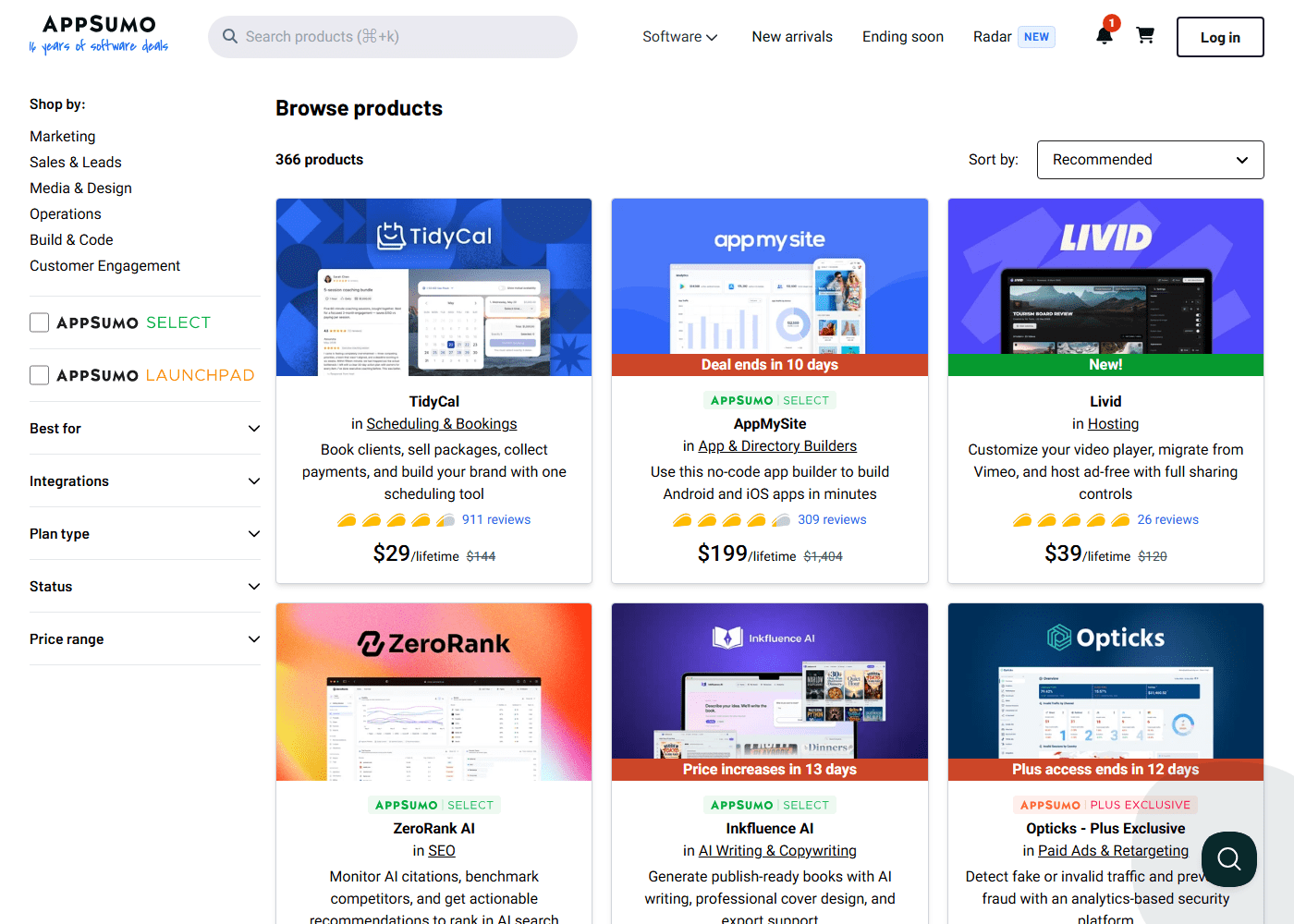
| カテゴリ | Typical LTD | Typical sub | とんとん |
|---|---|---|---|
| Scheduling | 29ドル | $12/月 | 10 weeks |
| Email marketing | 79ドル | $45/mo | 8 weeks |
| SEO research | $69 | $99/月 | 3 weeks |
| プロジェクト管理 | $99 | $40/月 | 11 weeks |
| App building | $199 | $117/mo | 7 weeks |
| Document signing | $39 | 月額20ドル | 8 weeks |
Look at the break-even column and notice something.
Every single row breaks even inside the 60-day refund window.
That is not a coincidence of my selection. It is how the category is priced.
Lifetime deals are typically pitched at one to three months of the equivalent subscription.
Why the refund window makes this remarkable
If a tool pays for itself before day 60, you can test it at zero net risk.
Use it inside real work for six weeks. If it fits, the money already came back.
If it does not, request the refund and you are exactly where you started.
The 60-day guarantee converts a purchase into a free trial with a real product.
の refund policy breakdown covers the exclusions honestly.
The stack-level number
A modest five-tool operator stack runs roughly $200 a month subscribed.
That is $7,200 over three years, and it never stops.
The same five functions covered by lifetime deals cost around $450 once.
Even replacing two of the five after a shutdown, you remain thousands ahead. 📉
⚰️ Pricing the Mortality Risk: The 10% Question
Now the honest complication. Sticker maths ignores the thing critics are actually worried about.
Products die. Across my 27 purchases, three sunsetted. An 11% rate.
So the fair comparison is not $450 versus $7,200. It is risk-adjusted.
📊 Three-year cost, risk-adjusted against a five-tool stack
The middle bar is the optimistic case. The right bar assumes things go badly.
It prices in replacing failed tools, paying twice in two categories, and losing the original outlay.
Even under pessimistic assumptions, the gap is roughly eleven to one.
Why the risk is smaller than it feels
Shutdown risk feels enormous because it is vivid. You lose a tool and it stings.
Subscription cost feels small because it arrives in monthly slices.
That is a framing artefact, not an economic fact.
My $187 of shutdown losses sit against $11,300 in avoided subscriptions.
The scary number is 1.6% of the boring one.
How to cut the 11% in half
Three moves, all free.
Favour オリジナル, which are house-owned and effectively cannot vanish.
Favour Select-badged deals, which have been vetted for stability and support.
And export your data on purchase day, so a shutdown costs money rather than work.
The third one is the most valuable and almost nobody does it. ⚰️
🎁 最初の注文が 10% オフ — メールでサインアップ →
📊 Cumulative cost over 36 months — the lines never cross back
The shape matters more than either endpoint.
One line flattens permanently. The other climbs for as long as your business exists.
That divergence is why arguing about a $30 price difference misses the point entirely.
You are not comparing two prices. You are comparing a payment and a slope.
The compounding nobody mentions
Extend the chart to year five and the gap roughly doubles again.
Subscriptions also rise. Price increases, tier restructures, features moving up a plan.
None of that touches a licence you already own.
The lifetime column is the only line on the chart you fully control.
🏆 Where Subscriptions Honestly Win
An article that never concedes anything is an advert. Subscriptions genuinely win in five places.
| 状況 | Why subscription wins |
|---|---|
| Core revenue tool | Ceiling costs more than the fee |
| Compliance requirements | SOC 2, DPAs, named support |
| Fast-moving category | You need continuous development |
| Large teams | Admin, SSO, provisioning |
| Short-term need | Three months, then cancel |
The core-revenue case is the strongest of the five.
If a tool sits directly in the path of how you earn, buy capability rather than cheapness.
A video editor for a video business. A CRM for a sales business.
The cost of hitting a ceiling there dwarfs any subscription fee you were avoiding.
The short-term case is underrated
Some needs genuinely have an end date.
A tool for one client project, a three-month campaign, a single launch.
Paying $40 for three months beats paying $99 once for something you will never open again.
Lifetime pricing only wins when the need is also lifetime.
The compliance case is absolute
If your buying process involves a security questionnaire, this is not a debate you get to have.
Young vendors selling lifetime licences cannot reliably supply attestations and SLAs.
That is a hard boundary, and pretending otherwise would be dishonest. 🏆
🗂️ Category by Category: Which Column Each One Belongs In
The six questions are general. Most categories have a settled answer already.
Here is the sort applied across every major shelf on the marketplace.
| カテゴリ | Default column | Reason |
|---|---|---|
| SEO research | Lifetime | Highest monthly bills, mature capability |
| Email marketing | Lifetime | Escapes list-size pricing entirely |
| ウェブサイトビルダー | Lifetime, carefully | High migration cost — buy once, well |
| Social scheduling | Lifetime | Solved problem, per-account pricing hurts |
| CRM | Depends on question 3 | Core to sales businesses, not to others |
| ビデオツール | Depends on question 3 | Core to creators, peripheral to most |
| Chatbots and support | Lifetime | Conversation meters punish growth |
Two rows in that table carry "depends", and they are the honest ones.
CRM and video sit in different columns for different businesses.
A sales-led company should subscribe to its CRM and buy its video tool once.
A video studio should do exactly the reverse.
The category with the largest swing
SEO research, without much competition.
Incumbent subscriptions run $99 to $199 a month for capability that has been stable for years.
A lifetime equivalent at $69 breaks even in three weeks.
No other category on the platform pays back that fast.
If you are running one substitution as a test, this is the one to run.
The category that most deserves caution
Website builders, because the migration cost is enormous.
Moving a live site is a week of work, not an afternoon.
So buy once, at the right tier, after checking export options thoroughly.
Getting this one wrong costs far more than the licence fee. The lifetime deals overview covers the tier logic. 🗂️
🧠 The Behavioral Ledger: What Meters Do to Businesses
Here is the part the spreadsheets miss entirely, and it may matter more than the money.
Metered pricing changes how you work, usually for the worse.
When every email costs, you send fewer. When every seat costs, you delay hiring.
When credits deplete, you hesitate before experimenting.
None of that appears on an invoice. All of it appears in your results.
The growth-punishment problem
List-size pricing is the clearest example.
Grow from five hundred subscribers to five thousand and your bill multiplies.
That growth is the exact outcome every guide tells you to pursue.
So the pricing model charges you more precisely when you succeed.
A one-time purchase severs that link entirely, and the psychological effect is larger than expected.
I write more, test more and experiment more on tools I have already paid for.
The seat-count problem for teams
Per-seat pricing quietly discourages collaboration.
You give the freelancer view-only access rather than a seat. You share a login you should not share.
の agency guide そして スタッキングガイド cover how stacked tiers fix this.
The counterweight, stated fairly
Meters do impose useful discipline sometimes.
A monthly invoice forces an annual "is this still worth it?" question that lifetime purchases never trigger.
Owned tools accumulate silently, which is its own kind of waste.
The fix is a January stack audit, run deliberately, since no invoice will prompt it for you. 🧠
⏰ The Industry's Direction: Why This Debate Has a Clock
One trend deserves naming, because it changes the calculation.
Software pricing is drifting from seats toward usage and AI credits.
Usage-based pricing makes costs less predictable, not more.
Your bill now depends on a month you cannot forecast.
For a small operator, unpredictability is worse than expense.
What that means for lifetime deals
It strengthens the case in categories with mature, stable capability.
Scheduling, signatures, forms and basic email are solved problems.
There is no reason to pay a growing usage fee for a capability that stopped evolving years ago.
Buy the solved categories once. Rent the moving ones.
That single line is the most durable version of this whole comparison.
Where the trend cuts the other way
AI tooling moves fast enough that a lifetime licence can go stale.
A model that impressed last year is ordinary now, and credit pools do not refill themselves.
の AIツールまとめ looks at which of those bets aged well.
My rule there is simple. Buy AI lifetime deals only when the underlying workflow is the value, not the model. ⏰
🔁 The Conversion Cascade: How the Switch Funds Itself
There is a mechanic here that makes the switch easier than it looks on paper.
Each cancelled subscription funds the next lifetime purchase.
You do not need a budget. You need a first move and a little patience.
| Month | What happens | Cash position |
|---|---|---|
| Month 1 | Buy one $69 tool, cancel a $99 sub | −$69, then +$99/mo |
| Month 2 | Recovered cash buys a $79 tool | Already net positive |
| Month 3 | Two subs cancelled, buy a third | +$144/mo recurring |
| Month 6 | Four conversions complete | +$200/mo, permanently |
Read month two carefully. That is the whole trick.
The first cancellation returns more per month than the purchase cost you once.
By the second month the conversion is self-financing and you never touch new money again.
Why sequencing matters more than selection
Start with your largest, most obvious bill. Not the cheapest, and not the most interesting.
The largest bill returns the most cash fastest, which funds everything downstream.
Most people start with a $12 scheduling tool because it feels low-risk.
It is low-risk, and it also funds nothing. The cascade never gets going.
Start where the money is, and the rest of the switch pays for itself.
The discipline the cascade requires
One rule, and it is the rule everyone breaks.
Cancel the old subscription before buying the next tool.
Running both in parallel "just in case" converts a saving into a double expense.
Two weeks of overlap, then cancel. Put the date in the calendar on purchase day.
の platform overview そして スタートアップガイド walk through worked cascades. 🔁
🎯 The Decision Framework: Per Tool, Six Questions
Here is the sort, reduced to six questions. Answer them per tool, in order.
| # | 質問 | If yes |
|---|---|---|
| 1 | Will I need this in three years? | Lifetime |
| 2 | Is the capability mature and stable? | Lifetime |
| 3 | Is it core to how I earn? | Subscription |
| 4 | Does compliance require attestations? | Subscription |
| 5 | Will my usage grow tenfold? | Lifetime, sized up |
| 6 | Can I export my data out? | If no, neither |
Question six is the veto and it applies to both columns.
A tool you cannot leave is a liability regardless of how you pay for it.
Check the export options before the price. It takes two minutes and it has saved me twice.
How the questions resolve in practice
Most tools answer yes to one and two and no to three and four.
Those are lifetime purchases, and they are the majority of any small stack.
A handful answer yes to three or four. Those stay subscribed, correctly and permanently.
の full buying system wraps these six questions into a repeatable protocol.
📔 The Worked Sort: My Own Stack, Both Columns
Applied to my own business, the six questions produce this split.
| Column | What lives there | なぜ |
|---|---|---|
| Lifetime | Scheduling, signatures, forms, SEO research | Mature, stable, not revenue-critical |
| Lifetime | Email marketing, app building | Biggest bills, cleanest substitutions |
| Subscription | Accounting and payroll | Compliance, regulatory updates |
| Subscription | One core production tool | Ceiling would cost more than the fee |
| Neither | Anything I cannot export from | Question six vetoes it |
Roughly two-thirds lifetime, one-third subscribed.
The subscribed third costs more than the lifetime two-thirds ever did, and that is correct.
Those tools earn their fees. The rest were being rented out of habit.
The audit that produced the split
It took an hour, once, and it is the single highest-return hour in this whole series.
Open your card statement. List every software charge. Run the six questions down the list.
Most people find two or three obvious conversions and one forgotten subscription.
の 中小企業向けガイド そして freelancer stack show worked versions.
🚫 When Neither Answer Is "Buy Something"
Sometimes the right move is to buy nothing at all.
If a free tier covers you today, use it. の free tools list is a real option.
If the need ends in three months, rent it and cancel. Lifetime pricing needs a lifetime need.
If you already own three unused licences, fix adoption first. Another purchase will not help.
If you cannot export your data, walk away from both options.
If you cannot name the bill it replaces, you are shopping, not solving.
That last one deserves emphasis, because it is the rule that governs the other four.
Every wasted dollar in my ledger traces back to a purchase with no named bill behind it.
Not one of them was a bad product. They were good products bought for imagined needs.
The named bill is what separates a conversion from a collection.
🏁 Verdict: The Math Was Never Close — The Sort Was
On sticker price, lifetime wins by an order of magnitude.
Risk-adjusted with pessimistic assumptions, it still wins by roughly eleven to one.
So the interesting question was never "which is cheaper?" It was "which tools belong in which column?"
Buy once in the solved categories. Rent in the moving ones and the regulated ones.
Run the six questions per tool, honour the export veto, and audit the split each January.
Do that and the debate stops being a debate. It becomes a sorting exercise you finish in an hour.
Start with your largest recurring bill and one substitution. The full ledger そして current best deals are the next stops. 🧮
🌮 Find a Deal That Kills a Bill →
❓ FAQ
Are lifetime deals cheaper than subscriptions?
Dramatically, in most categories. Typical break-even is one to four months.
A five-tool stack runs about $450 once against $7,200 over three years subscribed.
What if the product shuts down?
You lose access and your loss is capped at what you paid. Mine totalled $187 across three sunsets.
How often do lifetime deal products fail?
About one in ten in my experience. Originals and Select-badged deals fail noticeably less.
When should I keep paying a subscription?
Core revenue tools, compliance-bound categories, large teams and genuinely short-term needs.
生涯契約にはアップデートが含まれますか?
Usually within your tier, yes. Read the tier chart, since major new capability sometimes sits above it.
Can I mix both models?
You should. Mine is roughly two-thirds lifetime and one-third subscribed, deliberately.
What about AI tools specifically?
Buy them lifetime only when the workflow is the value rather than the underlying model.
How do I start the switch?
List your software bills, run the six questions, and convert the single largest obvious one first.
What if the lifetime tool is worse than my subscription?
Often it will be, slightly. The question is whether the gap is worth the recurring fee.
For peripheral tools it rarely is. For core revenue tools it frequently is.
Do subscriptions get cheaper if I ask?
Annual billing usually saves 15–20%, and that is worth taking on the tools you keep subscribed.
It does not close a gap this wide, but it narrows the third of your stack that stays rented.
How long does the switch take?
About six months for a full stack, converting one tool at a time as each cancellation funds the next.
What is the single biggest mistake?
Not cancelling the old subscription after migrating. It turns every saving into a double expense.
Is there a risk-free way to test this?
Yes. Most deals break even inside the 60-day guarantee, so a single well-chosen substitution costs nothing to try.
🔗 Related on this site
When you are comparing a one-off payment against years of monthly billing, the arithmetic depends on dates. There is a free 日付計算機 here if you want to check the break-even point.
