
Die Wiedergabe erfolgt in der Sprache, die Sie gerade lesen. Tippen Sie auf einen beliebigen Absatz, um dort zu beginnen.
Video is where small-operator software budgets go to die quietly.
The hosting bill. $10–$75 monthly for a player without someone else's logo.
The editing subscription. The repurposing tool for shorts. The screen recorder for tutorials. The avatar platform for faceless content.
None of them individually alarming. Collectively a three-figure monthly drain that grows with every format the algorithm demands next.
My video stack once billed $94 a month across four subscriptions.
Today the same pipeline runs on lifetime licences totalling less than two months of that old bill.
First purchase gets 10 % Rabatt. 🎥
🌮 Durchsuchen Sie Videoangebote auf AppSumo →
🧾 Wichtigste Erkenntnisse
| Frage | Kurzantwort |
|---|---|
| Bestes Hosting-Angebot | Livid — $39 lifetime vs $120, ad-free player, Vimeo migration |
| Beste Umnutzung | TubeOnAI-class: long content → shorts, posts, newsletters |
| Moderatorenvideo | vidBoard-class AI avatars for faceless and tutorial content |
| KI-Videoregel | Repurposing meters honestly; "unlimited generation" rarely survives |
| Volle Pipelinekosten | ~$150–$250 once vs $80–$150/month subscribed |
| Buy first | Hosting — unless you publish shorts, then repurposing |
| Erster Zug | 10 % Rabatt auf Ihre erste Bestellung 🎁 |
🩸 The Video Bill: Why This Category Bleeds
Video's cost structure ambushes people because it assembles itself one reasonable decision at a time.
| The decision | The bill |
|---|---|
| Hosting without a platform logo | $10–$75/mo |
| Repurposing for shorts | $20–$50/mo |
| Screen recording with editing | $15–$30/mo |
| Avatar platform for faceless content | $30–$90/mo |
| Total | $75–$245/mo |
You publish a course or client gallery, so you need hosting that does not decorate your content with someone else's suggested videos.
The algorithm rewards shorts, so the repurposing subscription arrives.
Tutorials need screen recording. Faceless content suggests an avatar platform.
None of these decisions was wrong. The sum is a $75–$245 monthly video department for operators who may publish four videos a month.
Worse, the bills are usage-decoupled.
Hosting charges by month whether you upload or not. Every subscription in the chain renews against your intentions rather than your output.
Why video is unusually attackable
| Function | Wirtschaft | LTD risk |
|---|---|---|
| Hosting and players | Mature, low marginal cost | Niedrigster |
| Repurposing | Bounded inputs | Low — meters are honest |
| Capture and editing | Commodity functions | Niedrig |
| Pure AI generation | Real compute cost | Fence it |
Hosting and players are the classic profile of Dienstprogramme, die schön altern as LTDs.
Repurposing processes bounded inputs — your existing content — making AI credit meters honest by construction.
Only pure generation carries genuine compute risk, and the shelf rules below fence it.
The result: video is one of the few categories where the ganz pipeline converts with no residual subscription stub.
My $94 monthly became $0. And the pipeline improved in the trade, because owned tools invite experimentation that metered ones tax. 📉
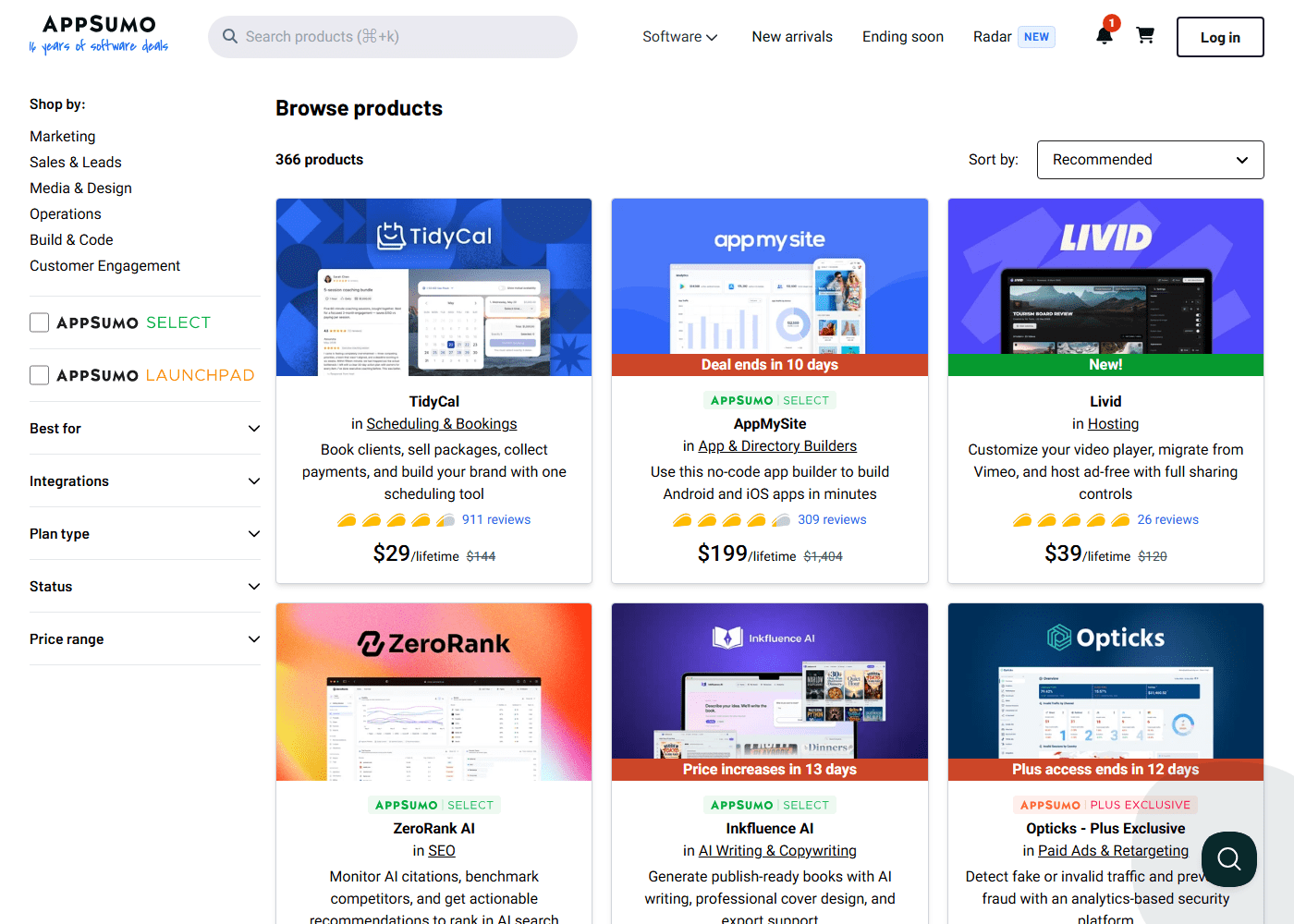
🥇 Livid — $39: The Hosting Sleeper
Der Video-Headliner des aktuellen Boards ist von der leisen Sorte.
Livid — $39 lifetime against a $120 list. Flying the "New!" badge with 26 early reviews at strong tacos.
It hosts your video with a fully customisable, ad-free player. Full sharing and embed controls. Direct migration from Vimeo.
That is precisely the feature set the $10–$75 monthly hosting incumbents meter.
The use cases are the bread of small-operator video
Course lessons that should not advertise a platform.
Client galleries that should look like dein studio.
Landing-page videos without a suggested-videos rabbit hole at the end.
Portfolio embeds that load fast and match the brand.
At $39 once, break-even against even the cheapest paid hosting tier lands inside four months.
Every month after is retained margin.
My position, and the honest caveat
My copy is past its Tag-45-Rückblick as a confident keeper.
Two client galleries migrated off a $19-monthly plan, with the migration tooling doing the tedious part.
The purchase illustrates the sleeper pattern my Best-Deals-Board tracks.
Hosting-adjacent utilities under $50 become the deals people mourn loudest after close. Their subscription counterparts bill forever and the use case never expires.
The newer-deal caveat applies honestly. 26 reviews is a thinner corpus than a TidyCal-class veteran.
So weight the sixty-day guarantee accordingly. Buy, migrate one real project inside a fortnight, and let your own player analytics render the verdict. 📼
🎁 10 % Rabatt auf Ihren ersten Video-Deal →
🔁 Repurposing Engines: The Treadmill, Automated
The modern content calculus is brutal.
One long-form piece must become shorts, clips, quote posts, a newsletter section and a thread. Or the algorithm's reach tax applies.
And doing that conversion manually costs more hours than the original recording.
The AI repurposing shelf exists for exactly this arithmetic. It is the video category's most reliable AI purchase.
Motoren der TubeOnAI-Klasse ingest YouTube videos and podcasts, then generate summaries, social posts, scripts and newsletter drafts from the transcript.
Adjacent deals clip long videos into short-form cuts, subtitle them, and reframe them per platform.
The economics favour the buyer structurally, per the KI-Regalregeln.
Repurposing processes begrenzte Eingaben — your existing library — so vendor compute is predictable and credit meters are honest by construction.
Deployment advice from my own pipeline
Feed it your am besten existing content first, not your newest.
The back catalogue is the free inventory most creators never mine.
Thirty published videos become ninety days of short-form pipeline in one afternoon of processing.
Meter-sizing follows the middle-tier rule. Credits scale with your realistic publishing cadence, not your aspirational one.
The quality check that matters is voice preservation.
Run three pieces through during week one and edit-distance them against what you would have written.
Keepers need light polish. Refunds need rewrites.
Mine cleared at light polish, replaced a $29 monthly subscription, and has since processed hundreds of conversions.
Conversions whose manual equivalent I simply would not have done.
That last clause is the real ROI. Repurposing LTDs do not just save the subscription — they manufacture output that metered tools priced out of existence. 🔄
🧑💼 Presenter and Avatar Video
The shelf's most futuristic aisle sells presence.
Plattformen der vidBoard-Klasse convert text into presenter-led video using AI avatars.
A human-seeming narrator delivering your script in multiple languages. Without cameras, studios, or the seventeen takes a self-recorded intro actually requires.
The legitimate use cases have hardened out of novelty.
| Use case | Why an avatar |
|---|---|
| Tutorial and onboarding libraries | Consistent presenter across hundreds of updates |
| Multilingual explainers | Same script, many markets |
| Product walkthroughs | A face lifts conversion; a film day is absurd |
| Faceless channels | The entire content economy |
Subscription pricing at the incumbents runs $30–$90 monthly with per-minute generation caps.
Lifetime deals in the $59–$99 band appear regularly and reprice the whole capability.
This aisle sits closest to the danger zone
Avatar generation is genuinely compute-expensive.
Which makes the credit meter the entire purchase decision.
Minutes per month, per tier, stated plainly, sized against your realistic production calendar with the eighteen-month amortisation frame.
Favour vendors running parallel subscription businesses. The compute math is then proven.
Test voice-and-language quality on your actual scripts in week one. Accent and pacing quality varies enormously by language.
And treat "unlimited avatar minutes forever" as the review-thread tragedy it reliably becomes.
Bought inside those fences, presenter video is one of the shelf's highest-leverage licences.
My own tutorial library refreshes quarterly through an avatar tool whose subscription equivalent would have billed more than my entire video stack's lifetime cost. 🎭
📊 Die Video-Pipeline: Abonnement vs. Lebenszeit (Jahresansicht)
Break-Even in ca. 10 Wochen; Die Pipeline läuft dann während ihrer gesamten Lebensdauer frei.
🔁 One recording, nine outputs — what repurposing actually returns
🖥️ Erfassen, Bearbeiten, Verbessern: Die Commodity-Ebene
Around the headliners, the commodity layer covers the rest of the pipeline at utility prices.
Screen recording and tutorial capture. Browser recorders, webcam-plus-screen tools, instant-share clips.
They rotate constantly at $29–$59 and replace the $15–$30 monthly tools tutorial-makers accumulate.
These carry the lowest risk on the entire shelf. Bounded utilities with mature feature sets.
Editing and enhancement. Browser-based editors, silence-cutters, filler-word removers, auto-subtitlers.
The subtitle tools specifically have quietly become mandatory equipment, as platforms autoplay muted.
Miniaturansicht- und Asset-Tools complete the packaging layer. The click decides whether the video's production budget mattered at all.
Buy these reactively, not speculatively
Commodity video tools are the shelf's most frequently re-run campaigns.
Capture and subtitle deals recur every few weeks.
So the correct trigger is the moment a workflow friction appears twice. Not the countdown banner's urgency.
The exception that overrides it: when a commodity deal wears the "Ends soon" ribbon Und Karten zu einer Reibung, die Sie bereits protokolliert haben, die Deals-Ende-für-immer-Regel resumes sovereignty.
My capture tool was bought exactly that way. Third recurrence of the same friction, ending campaign, four-minute decision.
It has recorded every tutorial since. 🧰
🎯 Who Each Shelf Serves
The shelf reads differently depending on which video life you lead.
| Buyer | Buy first | Warum |
|---|---|---|
| Course creators | Hosting | Lesson libraries live behind players |
| Kundendienstunternehmen | Hosting + white-label | Galleries are deliverables |
| Content-Ersteller | Repurposing | Output pain exceeds bill pain |
| Local businesses | Hosting + capture | Hero video and FAQ answers |
Kursersteller und Pädagogen get the deepest cut.
Hosting is their structural bill. Presenter video refreshes curriculum without re-filming. Capture tools produce the supplementary tutorials students actually request.
Their break-even is the fastest, because course hosting subscriptions run premium.
Kundendienstunternehmen buy for deliverables.
Branded gallery hosting. Walkthrough videos on client work. The multilingual avatar trick that converts owned capacity into billable line items.
For them the Agentur-Stapelwinkel trifft zu – White-Label-Player-Funktionen sind die zuerst zu überprüfende Ranglistenlinie.
Content creators on the algorithm treadmill should invert the standard order and buy repurposing Erste.
Their bill pain is smaller but their output pain is enormous.
The back-catalogue dividend is the single highest-leverage purchase on the entire shelf for them.
Lokale und kleine Unternehmen buy narrowest and win anyway.
One hosting licence for the site's hero video and testimonials. One capture tool for the FAQ answers customers keep phoning about.
Done. $70 total, replacing bills they were probably mispaying to a generalist platform.
Nobody needs all of it. The sorting question is which video verb — teach, deliver, publish, present — earns your money this quarter. 🧭
📦 The Migration Nobody Warns You About
Hosting is the easiest layer to buy and the fiddliest to move. Worth knowing before you start.
The transfer itself is usually automated. Livid-class tools pull directly from Vimeo, and most competitors offer bulk import.
That part runs unattended.
The work is on your side of the wire.
| Aufgabe | Effort | Miss it and |
|---|---|---|
| Re-embed every player | The bulk of it | Dead frames on live pages |
| Check course-platform embeds | Per lesson | Students hit blank lessons |
| Update email and social links | Quick | Old links 404 later |
| Keep the old host a month | One invoice | No fallback if something broke |
Find every embed before you cancel anything. Search your site for the old host's domain — that list is your task list.
Course platforms are the common trap, because lesson embeds live inside a system your site search never touches.
And overlap by one billing cycle. The single invoice you "waste" is what lets you fix a broken embed calmly rather than during a student complaint.
Mine took a fortnight, mostly waiting on the transfer. The active work was about three hours of re-embedding.
🏗️ The Assembly Order
Sequence matters because each layer feeds the next.
| Order | Schicht | Preis | Trigger |
|---|---|---|---|
| 1 | Hosting | $39 | The bleeding bill |
| 2 | Repurposing | $49–$79 | Back catalogue |
| 3 | Capture | $29–$59 | Second friction |
| 4 | Moderatorenvideo | $59–$99 | Recurring scripted content |
First: hosting. The pipeline's foundation stone, the bill most obviously bleeding, and the migration whose tooling does the work.
One fortnight, one real project moved, one subscription cancelled.
Second: repurposing. Pointed first at the back catalogue, converting your existing library into distribution inventory while the hosting migration settles.
This is the purchase that changes output volume rather than just cost.
Drittens: Gefangennahme, reactively, as tutorial and clip frictions earn it.
Viertens: Moderatorenvideo, inside the AI fences, once the calendar shows recurring scripted content.
The funding cascades
Each purchase runs the full protocol. Golden-window timing, newest-ten reviews, Erinnerungen am 30. und 45. Tag, subscription cancelled on keeper confirmation.
The hosting bill pays for the repurposer. The repurposer's cancelled subscription pays for capture.
The pipeline is self-financing by the second quarter.
Total build: $150–$250 across four licences, against $75–$245 monthly.
Der 10 % Rabatt auf die erste Bestellung belongs on the largest ticket in your sequence.
Ninety days, four purchases, zero recurring video cost. 🏁
📔 Field Notes: A Month Inside the Converted Pipeline
Texture beats tables for conveying what the converted pipeline feels like.
Here is a representative month from mine, logged as it ran.
Woche eins. Recorded one long tutorial with the owned capture tool.
Published it to the course library through the Livid player. No platform logo photobombing the lesson.
Then fed the recording to the repurposing engine, which returned two shorts scripts, a newsletter section and six quote posts before lunch.
The manual version used to consume a full afternoon. And, more honestly, usually did not happen at all.
Zweite Woche. A client asked for their gallery in Spanish.
The avatar tool re-delivered the walkthrough voiceover in localised form from the same script in eleven minutes.
A deliverable that would have been a polite refusal in the subscription era. Now a line item billed at full rate against zero marginal cost.
Weeks three and four. Back-catalogue mining continued. Three older videos processed into a fortnight of short-form pipeline.
The month closed with the ledger's quiet ritual.
Video tooling spend: $0. Video output: up roughly double against the subscription era's average. One client deliverable manufactured entirely from owned capacity.
What a year of such months confirms
The conversion's headline saving — $94 monthly, deleted — turned out to be its kleiner benefit.
The larger one is behavioural.
Owned tools get pointed at experiments, back catalogues and marginal deliverables that metered tools silently veto. Output compounds accordingly.
Subscription pricing does not just cost money. It edits ambition. 🎯
🚫 When You Should Not Convert
I earn a commission here. That is exactly why this section exists.
If you edit on a collaborative timeline suite. Broadcast-grade editing remains subscription territory for professionals who bill through it.
If you run live streaming infrastructure. That is a different product category with different reliability requirements.
If your library exceeds the hosting tier's storage. Check the chart against your catalogue plus eighteen months, and stack in-campaign if needed.
If the avatar deal promises unlimited minutes. Generation is the most compute-expensive promise on the platform. It does not hold.
If you publish video twice a year. There is no bill worth escaping, and the migration time exceeds the saving.
If you will not migrate a real project inside a fortnight. The guarantee only protects buyers who test while it runs.
🎬 Verdict: The Whole Pipeline Converts
Video is one of the few software categories where the entire operational pipeline converts to lifetime licensing with no subscription residue.
Hosting, repurposing, capture, presenter, packaging.
Because its functions split between mature low-cost utilities — the safest LTDs made — and bounded-input AI, the honest-meter kind.
The current board rewards immediate action on the sleeper. Livid at $39, thin reviews but guarantee-covered, the kind of deal mourned after close.
And systematic action on the rest. Repurposing for the back-catalogue dividend. Capture on friction. Avatars inside the compute fences.
The honest boundary mirrors SEOs. Broadcast-grade collaborative editing and live-streaming infrastructure remain subscription territory.
Everyone else has been renting a studio to use its tripod.
Start with the bill that annoys you most
My $94 monthly became $0 in one quarter, and the pipeline's output roughly doubled.
The unmetered tools invited experiments the metered ones taxed out of consideration.
That second effect is the shelf's quiet gift across every category. But video, with its many small meters, feels it most.
It is almost certainly hosting. 🌮
A last calibration on timing
Video deals carry the shelf's sharpest scarcity dynamics.
Hosting sleepers follow a pattern veterans know too well. Modest launch attention, slow review accumulation, then a surge of discovery right before close.
And the mourning threads afterward.
Repurposing and avatar deals, being AI-adjacent, additionally ride the "price increases in X days" escalator as campaigns heat.
The translation of both patterns is the same golden-window discipline, applied with slightly more urgency.
When a video deal maps to a logged friction and its diligence clears, the correct wait is measured in days, not weeks.
The category's subscriptions will happily keep billing while you deliberate. ⏱️
🌮 Durchsuchen Sie Video-Lifetime-Angebote →
🎁 Erhalte 10 % Rabatt auf deine erste Bestellung bei Anmeldung zum Newsletter →
❓ FAQ
Was ist derzeit das beste Video-Angebot auf AppSumo?
Livid at $39, against a $120 list, for hosting. Ad-free custom player, Vimeo migration, four-month break-even. For output leverage, a TubeOnAI-class repurposing engine pointed at your back catalogue.
Sind AI-Video-Lifetime-Angebote sicher zu kaufen?
Repurposing tools, yes — bounded inputs make their meters honest. Avatar tools, yes innerhalb der Zäune: plain meters, parallel subscription revenue, middle tiers, eighteen-month amortisation. "Unlimited generation forever" is the recurring tragedy.
Können diese Tools meinen gesamten Video-Abonnement-Stack ersetzen?
For small operators and creators, typically yes. Hosting, repurposing, capture, subtitles and presenter video all convert. Broadcast-grade editing and live streaming remain subscription territory.
Was soll ich zuerst kaufen?
Hosting for most buyers. It is the foundation, the most obviously bleeding bill, and the easiest migration. Content creators on the shorts treadmill should invert and buy repurposing first.
Wie viel kostet die vollständige Pipeline mit einmaliger Zahlung?
$150–$250 across four licences, versus $75–$245 monthly subscribed. Break-even lands around week ten, and the 10 % Rabatt geht auf das größte Ticket.
Was passiert, wenn ein Videotool, das ich kaufe, enttäuscht?
Der 60-Tage-Garantie covers it. Deploy a real project inside a fortnight, check outputs against your standards, and refund inside the window if the verdict votes no.
Gibt es bei lebenslangen Hosting-Angeboten Speicherbeschränkungen?
Yes. Tiers meter storage and bandwidth like any hosting product. Check the chart against your library size plus eighteen months of publishing, and stack codes in-campaign if your catalogue is large.
Welcher Käufer sollte dieses Regal ganz weglassen?
Professional editors and broadcast teams whose work runs on collaborative timeline suites and live-streaming infrastructure. Everyone whose video life is publish, teach, deliver or present converts cleanly.
How long does migrating hosting actually take?
A fortnight, mostly waiting. The migration tooling handles the transfer; your work is re-embedding players and checking that pages still load right.
Weiterführende Lektüre: Beste KI-Tools · KI-Schreibwerkzeuge · Die besten Angebote diesen Monat · Der Einkaufsführer

- Video Content in 2026: What the Engagement Data Shows - Oktober 21, 2026
- Monetising a Channel That Uses AI: The Rules That Bite - Oktober 21, 2026
- SEO or Paid Ads? The Cost-Per-Acquisition Data - Oktober 18, 2026