
Die Wiedergabe erfolgt in der Sprache, die Sie gerade lesen. Tippen Sie auf einen beliebigen Absatz, um dort zu beginnen.
Every guide in this series references "the system." The buying discipline behind every escape log, every stack build, every ledger line.
This page is that system, complete, in one place.
It exists because of a gap.
My first year on AppSumo: coin-flip keeper rate, five impulse purchases, launch-day enthusiasm as a strategy.
Every year since: four-in-five keepers, self-financing stacks, $9,000 net ahead.
The deals were identical. The difference was process.
Read this once before your next purchase and the rest of the series becomes reference material.
Der 10 % Rabatt auf die erste Bestellung remains step zero, as ever. 📋
🌮 Browse Deals With the System →
🧾 Wichtigste Erkenntnisse
| Bühne | The rule |
|---|---|
| Before browsing | Bills and bottlenecks write the shortlist |
| Per deal | The ten-minute protocol |
| Timing | Golden window, days 4–14 |
| Stufe | Eighteen months; one tier up when torn |
| After buying | Deploy in a week; day-45 decides |
| Annually | Re-audit, re-sort, plan for November |
| Overhead | About an hour per purchase |
🧾 Foundation One: Bills First, Always
The system's load-bearing rule precedes every purchase, and most buyers never install it.
The shortlist is written by your expenses, not the marketplace's shelves.
Before any browsing, run the twenty-minute bank-statement audit.
Every software charge highlighted. Each tagged with its plain-verb job.
That produces the only shopping list that reliably converts into keepers.
Because a deal that erases a bill you pay has its business case pre-proven by your own accounting.
The companion list is bottlenecks
Recurring frictions logged as they occur. The manual conversion you dread. The follow-up you dropped.
Each becomes a candidate for the tracking watchlist, with a trigger condition attached.
Between them, bills and bottlenecks generated every purchase this series' ledgers contain.
And their absence generated every entry in my abandoned pile.
The rule's negative form matters equally
A percentage is not a use case. A countdown is not a need. An imagined future is not a bottleneck.
Der anti-stack catalogue — agency tiers without client paths, overlapping AI collections, tools for unscheduled ambitions — is this rule violated five ways.
Und die FOMO firewall is its enforcement mechanism.
Watchlist-matched alerts opened. Everything else archived unread. A 24-hour candidate rule for survivors.
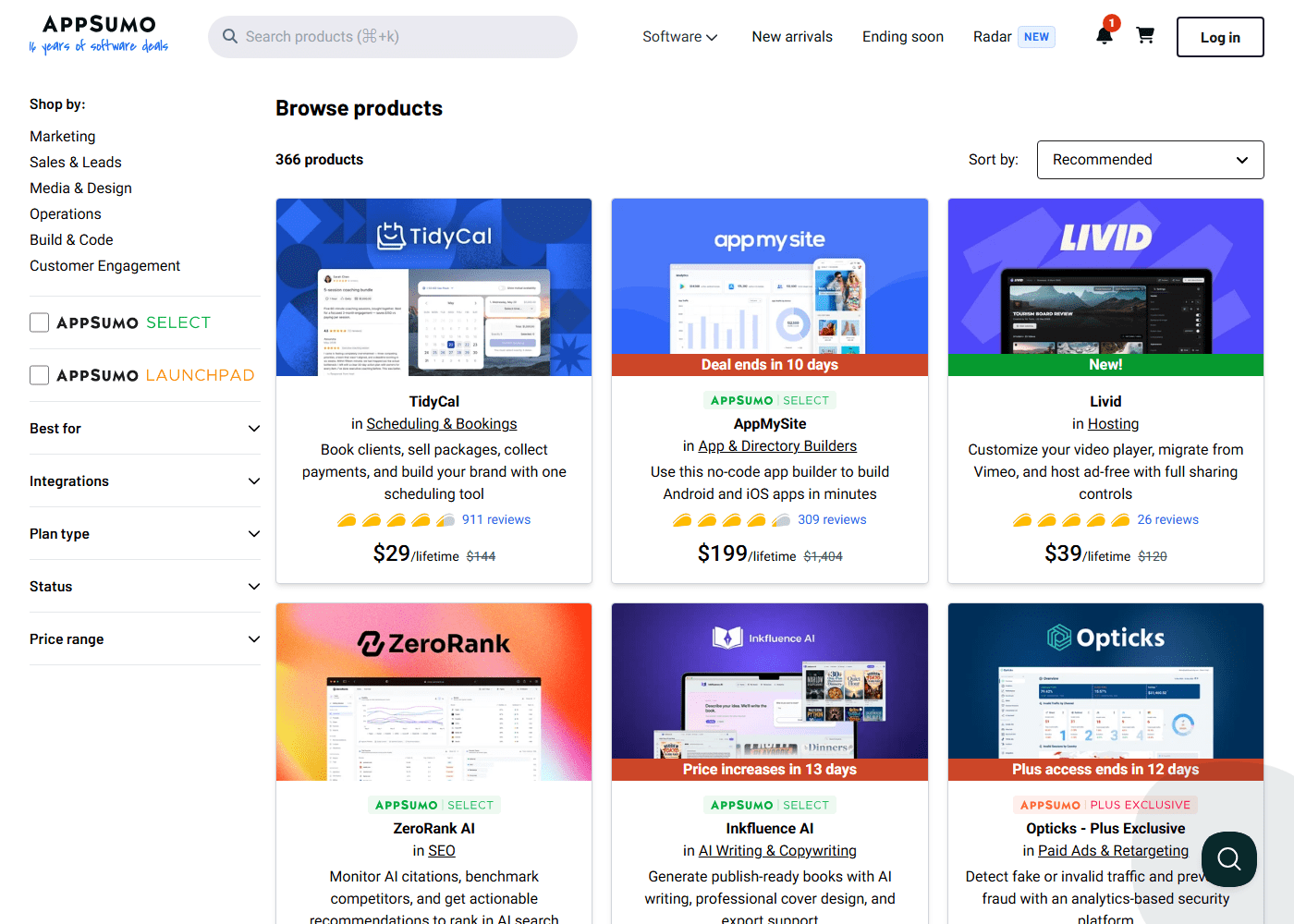
Install the rule and the platform's 366 products collapse into the six that matter to you.
Skip it and the platform happily sells you the other 360. 🎯
🔍 Foundation Two: The Ten-Minute Protocol
Per candidate deal, the diligence that separates my two eras runs ten minutes, structured.
| Minutes | Check |
|---|---|
| 1 | The guarantee line |
| 2–3 | The tier chart, completely |
| 4–6 | The newest ten reviews |
| 7–8 | Founder pulse and changelog |
| 9–10 | Badges and meters |
Minute one: the guarantee line. Under the price, confirming the standard 60-day coverage. Plus and marked items excepted.
Minutes two and three: the tier chart, completely.
Every tier's limits against your eighteen-month projection. The stacking ladder's shape.
And the specific features you need — white-label, API, seats — at whichever code count they actually live.
Minutes four through six: the newest ten reviews.
Sorted by recent, never by top. Reading for settled tacos, recurring complaint patterns, and the category-specific tells.
Sync complaints for CRMs. Deliverability for E-Mail. "Stopped posting" for schedulers. Throttling for KI-Tools.
Minutes seven and eight: founder pulse.
The questions tab's response speed and substance — the best support forecast that exists.
Plus the changelog. Shipped this month or not, which is the single strongest survival predictor across my whole ledger.
Minutes nine and ten: badges and meters.
Select status weighting quality upward. Originale collapsing vendor risk entirely.
And for anything AI-shaped, the honest-meter and parallel-revenue screens.
Agency buyers layer the white-label diligence week on top for anything client-facing.
The protocol is boring by design. Boring is what four-in-five keeper rates are made of. ✅
🎁 Step Zero: Bank the 10% First →
⏰ Foundation Three: Timing
The verified candidate meets the calendar. Three timing layers govern the meeting.
The campaign layer: the golden window.
Days one through three run on launch hype. Watch, do not buy.
Days four through fourteen are the goldenes Fenster. Reviews settled honest, founder pattern visible, tiers stocked, launch terms intact.
The heating and ending banners afterward force decisions on candidates already verified. Never discoveries.
The compression exception: scarce upper tiers sell out first, so capacity buyers execute early with pre-campaign diligence.
The infrastructure layer: the tracking system.
Alert emails, the Monday shelf scan, the function-triggered watchlist.
It guarantees the windows get met instead of mourned. Its ten-minute setup is the system's best-paying component.
The seasonal layer: the annual calendar.
Steady-season purchases run the golden-window rhythm.
September onward, deferrable capacity moves to the Black Friday-Wunschliste, where floor prices and encore resurrections concentrate.
Und die Plus Mitgliedschaftsmathematik gets its honest annual run.
The timing synthesis: urgent bills convert now, deferrable capacity waits for November, and decisions — never discoveries — happen under countdown pressure.
Der Startmodifikation stands for compressed clocks. Launch-critical capability outranks deal timing, always. ⏳
📊 The system, end to end
📈 My two eras, same marketplace
🛡️ Foundation Four: The Risk Ledger
The fourth foundation runs beneath every purchase. Risk postures installed once, before they are needed.
| Risiko | The posture |
|---|---|
| Vendor mortality | Select, changelogs, Originals, diversify |
| Capacity mispricing | Eighteen months; one tier up when torn |
| AI sustainability | Honest meters, parallel revenue |
| Data custody | Verify exports in week one, quarterly after |
| Self-risk | The firewall and the budget cap |
Vendor mortality — roughly one in ten partner LTDs eventually sunsets.
Managed by Select-badge preference, changelog pulse in every protocol run, Originals anchoring the stack's base, and diversification over concentration.
Plus the quarterly export habit, which converts any sunset from crisis into weekend migration.
Capacity mispricing is managed by the regret asymmetry. Over-buying refunds. Under-buying pays post-campaign pricing forever.
AI sustainability runs the honest-meter screens on anything generation-shaped, with "unlimited forever" treated as the tragedy it reliably becomes.
Data custody. Every tool holding business data gets its export path verified in week one and exercised quarterly.
Because the category lesson generalises. Your data must always have an exit — including from the escape vehicles themselves.
And self-risk, the ledger's largest entry.
The FOMO machinery's professional persuasion, managed by the firewall, the bills-first gate and the budget cap.
Those disciplines' absence wrote my era-one abandoned pile. Their presence has kept era two clean.
Der complete risk file prices each at its measured rate.
Risk, in this system, is not a mood at checkout. It is a checklist that already ran. ⚙️
🔄 The Post-Purchase Loop
Checkout is the system's midpoint, not its end.
At purchase, three acts.
Der Erinnerungen am 30. und 45. Tag calendared — the guarantee only protects buyers who remember it.
The licence redeemed immediately from the delivery email.
And the ledger line opened. Paid, subscription-equivalent, verdict-pending.
Week one: deployment into real work.
Actual client projects, live content, production data.
Because sandboxes generate opinions while production generates evidence.
Every category guide's week-one test runs here, while the window is longest. Voice preservation. Corpus quality. Output audits. Bad-week simulations.
Day 30: the usage check. Embedded, promising, or unopened — answered honestly.
Embedded keepers consider stacking while the campaign lives.
Day 45: the verdict, with two weeks of buffer.
Keep — and cancel the replaced subscription the same afternoon, the actual savings event this loop exists to reach.
Or refund. Self-serve, two to three days back, zero guilt.
And then the cascade
The cancelled subscription funds the next shortlist purchase.
The stack builds on recovered money — self-financing by the second quarter in every build this series logged.
And the quarterly ledger review keeps the whole portfolio honest.
The loop's arithmetic is the series' headline numbers. The loop's discipline is two calendar entries per purchase.
That exchange rate is the entire secret. 📈
🗺️ The Buyer-Type Router
The system is universal. The build sequences are not.
| You are | Your playbook | Sequence |
|---|---|---|
| Freiberufler | Core then growth | Scheduling first |
| Kleinunternehmen | Customer-flow conversion | Worst bill first |
| Agentur | Inventory build | White-label tiers |
| Creator | Leverage-first | Repurposing first |
| Startup | Phase zero to launch | Free tiers first |
Freiberufler run the core-then-growth build.
Scheduling, CRM, proposals, tracking, portfolio. Then email, content AI and support.
$350–$450 total, self-financing by quarter two, with the professionalism dividend as the quiet second return.
Kleine Unternehmen run the customer-flow conversion.
The bank-statement audit, the fortnight cadence, the found-booked-served-reviewed-returned spine.
Agenturen run the inventory build.
Stacked white-label tiers as billable deliverable catalogues, Plus from day one, and the week-long diligence layer on anything client-facing.
Schöpfer sequence by leverage. Repurposing first for the back-catalogue dividend, then the scheduler, the Pipeline schreibenund die video stack.
Startups run phase zero to launch. Free tiers until traction's ceilings bite, then the sub-$500 launch stack.
Whichever entry is yours, the underlying system runs identically beneath it. The playbooks just order the purchases. 🧭
🗓️ The Annual Rhythm
Run the loop long enough and it settles into the yearly rhythm veterans keep.
January — the stack audit.
Every licence faces the still-using test. The dreispaltiges Hauptbuch totals its year. Underused tiers flag for reassessment.
Und die Sechs-Fragen-Sortierung re-runs on the subscription survivors.
Categories mature annually, so last year's rational rental is this year's conversion candidate.
February through August — steady-season operation.
Monday scans. Golden windows. Bills-first purchases as campaigns and needs align.
September and October — the freeze and the wishlist.
Deferrable purchases park for the event. Budgets pre-commit in writing. The Black Friday playbook preps its sweep.
November — execution week.
December — the event audit and the cancellation pass, banking the year's recovered subscriptions where the ledger can see them.
The rhythm's yield compounds beyond money
The buyer who runs it holds current knowledge of their real tool usage. A tuned tracking system. A disciplined relationship with the persuasion machinery.
And the part no single purchase delivers. Calibration.
The accumulated pattern-sense that reads a deal page in seconds, prices a tier ladder at a glance, and recognises this year's version of last year's mistake before checkout.
My keeper rate's climb from coin-flip to four-in-five was this calibration accumulating, one honest day-45 verdict at a time. 🧠
📔 The Two Eras, Itemised
The system's proof is the contrast it produced.
Era one — the first year, pre-system.
Twelve purchases. Six keepers, a coin-flip rate.
Five impulse buys that became the abandoned pile, combined $317 — every one traceable to launch-day excitement against no logged bill.
One sunset. And zero refunds claimed, because I had not installed the reminders, so windows expired unused.
A stack that grew by enthusiasm rather than architecture.
The era still netted positive — the platform's economics forgive a lot.
But it netted a fraction of what the same dollars disciplined would have.
Era two — everything since.
Fifteen purchases at a four-in-five keeper rate. Every buy bills-mapped and protocol'd.
Two refunds claimed cleanly inside their windows, recovering $148 that era one would have eaten.
Two stacks executed on the probe pattern. Der conversion cascades self-financing from cancellations.
And the annual rhythm running without willpower, because the calendar owns it.
Same marketplace, same deal quality, same buyer. Different system.
The itemisation's point is not autobiography.
It is that the system is retrofittable at any point. Mine installed after twelve purchases of tuition. Yours can install before the first.
That sequencing is the only advantage this series can actually hand you. ✍️
🩹 The Three Leaks the System Still Has
A system you only ever praise is a sales pitch. Here are mine, honestly.
| Leak | Was es kostet | Patch I use now |
|---|---|---|
| Category blindness | Missed better tools | Quarterly rescan of one category I ignore |
| The sunk-cost keeper | Clutter, false confidence | Still-using test, no exceptions |
| Stack sprawl | Onboarding friction | Cap of two new tools per quarter |
Leak one: category blindness.
Bills-first buying is disciplined. It is also conservative.
It aims every dollar at problems I already know I have.
So the tool that would have solved a problem I never framed as a problem never reaches my shortlist.
My patch is small. Once a quarter I scan one category I habitually skip, with no intent to buy.
Just to learn what exists. Two of my best purchases came out of those scans.
Leak two: the sunk-cost keeper.
Some tools survive the day-45 verdict because I paid for them, not because I use them.
The ledger hides this well. A licence with one login six months ago still shows as a keeper.
The still-using test is the only cure, and it only works if you answer it honestly in January.
Leak three: stack sprawl.
Every tool carries a setup cost nobody prices at checkout.
Imports, integrations, teaching a client the new login. Buy four in a month and you spend the month onboarding.
Two new tools per quarter is the ceiling I hold myself to now.
Naming the leaks is not an apology for the system. It is the system working. 🩹
📌 The System in One Paragraph
For the reader who bookmarks one thing.
Claim the 10% and the alerts Heute.
Let your bills and logged bottlenecks — never the shelves — write the shortlist.
Run the ten-minute protocol on every candidate. Guarantee, tiers, newest reviews, founder pulse, badges and meters.
Buy in the golden window at the eighteen-month tier. One tier up when torn.
Calendar days 30 and 45 at checkout. Deploy into real work within a week, and let the day-45 evidence keep or refund without sentiment.
Cancel every replaced subscription the day its keeper confirms, and let the recovered money fund the next purchase.
Defer everything deferrable to November from September onward.
Audit the stack every January.
And archive unread every alert your watchlist did not ask for.
That paragraph, executed, is the difference between the marketplace's two populations. The ledger-writers and the warning-posters.
It costs perhaps an hour of overhead per purchase, against multiples returned.
Everything else this series wrote is that paragraph, expanded.
Der Kategorienführer name the targets. The buyer playbooks sequence the builds. The risk files price the hazards. The worth-it verdict sorts who should bother.
The system is not clever. It is just complete. 🏗️
🚫 When the System Says Do Not Buy
I earn a commission here. That is exactly why this section exists.
When no bill or logged bottleneck matches. That is the whole first foundation, and it disqualifies more deals than every other check combined.
When the changelog is silent. The strongest survival predictor in my ledger, and it fails fast.
When the tier chart only covers today. Post-campaign upgrades cost regular pricing, so under-buying is the expensive mistake.
When you cannot deploy inside a week. The guarantee needs evidence, and evidence needs production use.
When you will not calendar day 45. Era one claimed zero refunds for exactly this reason.
When the only thing pushing you is a countdown. Decisions belong under banners. Discoveries never do.
🏁 Verdict: The Deals Were Never the Skill
AppSumo's deals are abundant, recurring, and available to everyone identically.
The scarce resource was always the buying system. And now you hold all of it.
Bills-first targeting converts the catalogue from temptation into inventory.
The ten-minute protocol converts listings into verified candidates.
The windows convert candidates into well-timed purchases.
The loop converts purchases into audited keepers.
And the rhythm converts keepers into a compounding practice.
The marketplace's machinery — guarantees, badges, reviews, alerts — was engineered to reward exactly this buyer.
Der sixteen-year platform grew on their repeat business.
Start where the system starts
The discount banked. The audit run. The first candidate protocol'd. The first window met.
One purchase, run completely through the loop, teaches more than every guide here.
And this guide exists so that purchase goes right. 🌮
A closing note, since a capstone should be honest
These guides were written to be outgrown.
The frameworks, the protocols, the routers — they exist to install the calibration that eventually makes them unnecessary.
The pattern-sense that reads deal pages in seconds and prices ladders at a glance.
A year of disciplined loop-running from now, you will consult these pages rarely.
Because the system will have moved from the bookmarks into the reflexes. Which was the destination all along.
The marketplace rewards buyers who no longer need buying guides. Go become one. 🎓
🎁 Erhalte 10 % Rabatt auf deine erste Bestellung bei Anmeldung zum Newsletter →
❓ FAQ
What's the single most important buying rule?
Bills first. The shortlist comes from your expenses and logged bottlenecks, never from browsing. Every keeper in my ledger maps to a bill it erased; every regret maps to a shelf that persuaded.
Wie lange dauert die ordnungsgemäße Due-Diligence-Prüfung pro Transaktion?
Ten structured minutes. Guarantee line, complete tier chart, newest ten reviews, founder pulse, badges and meters. Agency client-facing purchases add the white-label week.
When exactly should I buy?
Days 4 to 14 of a campaign, for verified candidates. Earlier only for scarce upper tiers racing sell-outs. Under ending banners only for decisions already made.
Which tier should I pick?
The eighteen-month projection's tier, one up when torn. Over-buying costs a refundable delta; under-buying costs post-campaign pricing forever. Stack during campaigns, never after.
What happens after I buy?
The loop. Reminders calendared at checkout, licence redeemed immediately, week-one deployment into real work, day-30 usage check, day-45 verdict. Keep and cancel the replaced subscription, or refund self-serve.
Where do I start right now?
Bank the 10% and the alerts, run tonight's twenty-minute bill audit, and protocol your first candidate from the Best-Deals-Board. Or start at $0 on the kostenlose Stufen.
How do I avoid the impulse-buying trap?
The firewall. Watchlist-matched alerts get opened, everything else archives unread, and non-watchlist temptations face the 24-hour candidate rule. My abandoned purchases all predate it.
Does the system work for someone buying just one or two tools?
Perfectly. It scales down to a single purchase — one bill, one protocol run, one window, one loop. The rhythm and routers only matter as volume grows.
How long before the system feels automatic?
About two quarters, or five to six purchases. After that the checks stop feeling like a checklist and start feeling like reading.
Weiterführende Lektüre: Die besten Angebote diesen Monat · Is AppSumo worth it? · Leitfaden für lebenslange Angebote · New deals tracking · Full review

- Video Content in 2026: What the Engagement Data Shows - Oktober 21, 2026
- Monetising a Channel That Uses AI: The Rules That Bite - Oktober 21, 2026
- SEO or Paid Ads? The Cost-Per-Acquisition Data - Oktober 18, 2026